


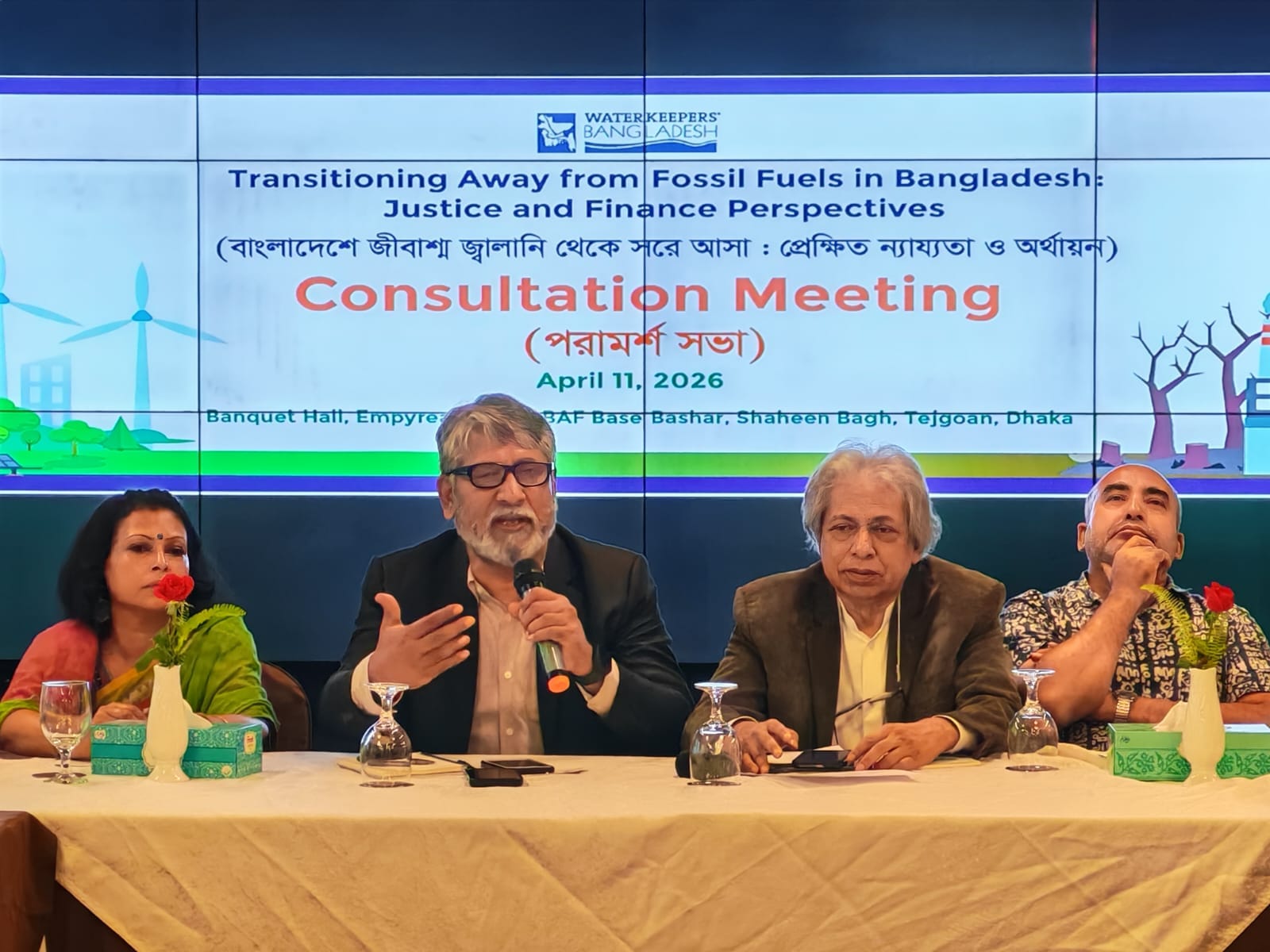
A consultation in Bangladesh has called for a stronger focus on climate justice and financing as the country seeks to transition away from fossil fuels.
The meeting, titled “Transitioning Away from Fossil Fuels in Bangladesh: Justice and Finance Perspectives”, was organised by Dhara (We for Protecting the Earth), Waterkeepers Bangladesh and the Fossil Fuel Treaty Initiative. It brought together energy experts, academics and civil society representatives to find out the challenges of a sustainable energy transition.
Sharif Jamil, member secretary of Dhara, warned that simply drafting a roadmap to phase out fossil fuels would not be enough. He said climate finance and justice must be embedded in the process, criticising existing carbon market mechanisms for allowing developed nations to continue polluting indirectly. He also highlighted the growing toll of climate change and fossil fuel expansion on farmers, fishers, women and marginalised communities in Bangladesh.
Experts at the meeting pointed to structural and policy barriers slowing progress.
Mostafa Al Mahmud, president of the Bangladesh Sustainable and Renewable Energy Association, said the transition was both a climate necessity and an economic one, but criticised a lack of long-term vision in policymaking. He noted that heavy import dependence and the influence of powerful business interests were major obstacles, while hidden costs in the solar sector were undermining renewable energy growth.
Dr Mosahida Sultana of the University of Dhaka warned that global instability and the energy crisis were pushing Bangladesh towards greater reliance on liquefied natural gas (LNG), placing sustained pressure on the economy. She argued that investment in renewable energy would offer a more affordable and sustainable alternative, and called for an end to new LNG infrastructure alongside stronger support for local renewable systems.
Md Shamsuddoha, chief executive of the Centre for Participatory Research and Development, said a “just transition” must go beyond reducing fossil fuel use to include adaptation, employment and equity. He added that global commitments had yet to be effectively translated into national policy, urging clearer roadmaps within Bangladesh’s climate frameworks.
Legal barriers were also highlighted as a key challenge. Dr Kazi Zahed Iqbal, a Supreme Court advocate, said conflicting and fragmented laws were hindering renewable energy initiatives, calling for a comprehensive legal framework to enable progress.
Abul Kalam Azad of ActionAid Bangladesh said that while the technology and global support for transition already exist, progress is being held back by entrenched fossil fuel interests. He urged coordinated action to ensure the shift to renewable energy is fair and inclusive.
Shafiqul Alam, an analyst at the Institute for Energy Economics and Financial Analysis, noted that more than 62% of Bangladesh’s primary energy is imported, contributing to a significant deficit in the power sector. He warned that continued reliance on costly imported fuels such as LNG is unsustainable, calling for urgent investment in renewables, improved efficiency and better policy planning.
Organisers said they hope the consultation’s recommendations would help strengthen Bangladesh’s energy security while supporting its climate goals.