


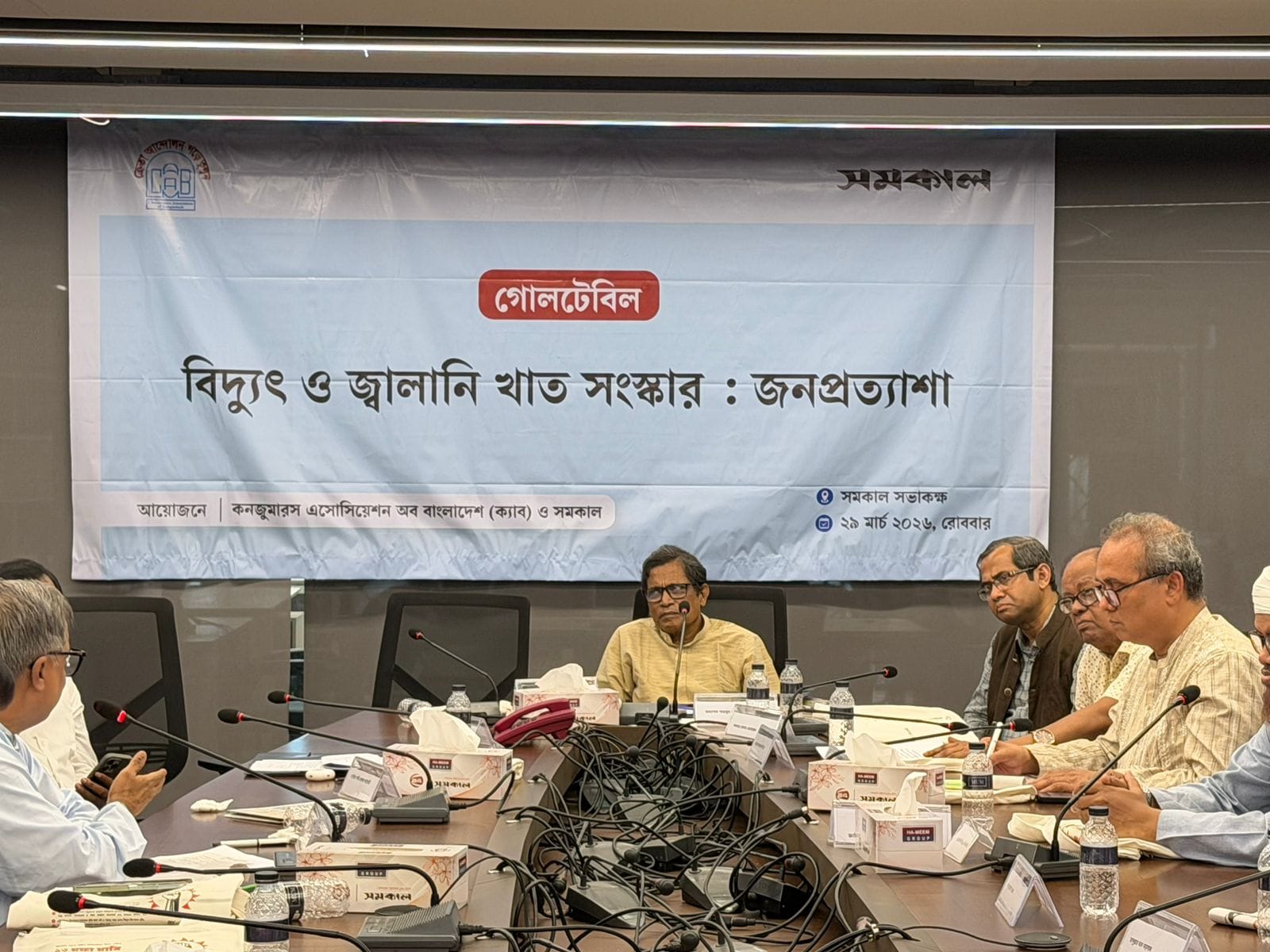
Energy experts have warned that the country’s power and energy sector is facing a deepening crisis, citing persistent lack of transparency and accountability despite long-term planning. They said inefficient use of natural resources, growing import dependence, high production costs, quick rental power plants, and mounting capacity charges have ultimately shifted the burden onto consumers. Structural and policy reforms are now essential for sustainable solutions.
The observations came at a roundtable titled “Power and Energy Sector Reform: Public Expectations” held on Sunday. The event was jointly organized by the Consumer Association of Bangladesh (CAB) and Samakal. It was moderated by Samakal Editor Shahed Muhammad Ali, while CAB Secretary General Advocate Humayun Kabir Bhuiyan delivered the closing remarks.
Joining virtually, the State Minister for Power Aninda Islam Amit said that although the country’s peak electricity demand is around 18,000 MW, generation capacity exceeds 30,000 MW. This surplus capacity has left many plants idle, yet the government is obliged to pay substantial capacity charges under existing contracts, increasing financial pressure.
He also noted that the sector remains heavily dependent on imported fuel, particularly coal and liquefied natural gas (LNG). Volatility in global energy prices has driven up generation costs. The government currently owes around Tk 47,000 crore to power producers, he added.
Professor Shamsul Alam, energy adviser to CAB, alleged that transparency and fairness have long been ignored in the sector. He claimed that non-competitive investments have created what he described as a “rent-seeking structure,” leading to unnecessary power plants and inflated costs.
He further pointed out a lack of transparency in policymaking and tariff setting, with public hearings often overlooked. He also raised allegations of corruption in projects, including the installation of prepaid meters.
Khandaker Golam Moazzem, Research Director at the Centre for Policy Dialogue (CPD), emphasized the need for major reforms in the sector. He said unrealistic demand projections in the past encouraged costly contracts and excess capacity, increasing capacity payments and putting pressure on the broader economy.
According to him, weak institutions, lack of coordination among agencies, and opaque decision-making remain significant challenges. Despite strong potential in renewable energy, policy limitations have hindered progress in the sector.
Representatives from political and civil society groups also criticized the current state of the energy sector. They attributed the crisis to past opaque deals, corruption, and import-dependent policies. They stressed the need to strengthen domestic gas exploration, expand renewable energy, and reduce system losses.
Speakers also called for increased investment in solar, wind, and waste-to-energy sources, ensuring policy transparency, and enhancing public and civil society participation to achieve energy security.
The keynote paper presented at the discussion noted that while the power sector has expanded significantly over the past three decades, structural weaknesses have simultaneously intensified. Although generation capacity has increased, costs, import dependence, and pressure on foreign exchange reserves have also risen. In many cases, investor interests have been prioritized over consumer welfare.
Participants warned that without comprehensive structural reforms, the existing crisis will deepen further, with direct consequences for ordinary citizens.