


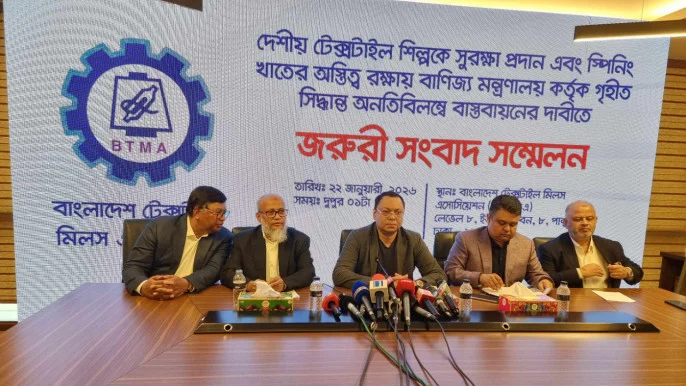
The Bangladesh Textile Mills Association (BTMA) has announced that all textile mills across the country will shut down indefinitely from 1 February, citing the interim government’s failure to protect domestic spinning mills by suspending duty-free yarn imports under the bonded warehouse facility.
The decision was announced at an emergency press conference held at the association’s office in Karwan Bazar, Dhaka, on Wednesday (22 January). BTMA said the shutdown was unavoidable unless the government immediately implements a commerce ministry decision aimed at safeguarding the local textile industry and ensuring the survival of the spinning sector.
Speaking at the briefing, BTMA President Showkat Aziz Russell said mill owners had reached a breaking point. “We will shut down no matter what. We no longer have the capacity to repay bank loans,” he said, adding that repeated appeals to relevant ministries and agencies had failed to yield any concrete support.
Russell alleged that responsibility was being passed from one authority to another without action. “Every department is shifting the burden to others, like a game of pillow passing,” he said. According to him, the industry’s capital base has been reduced by half, leaving no realistic pathway to service existing debts. “Even if we sell all our assets, it will be impossible to clear the loans,” he added.
Senior leaders of BTMA were also present at the press conference.
The announcement follows a request made by the Ministry of Commerce to the National Board of Revenue on 12 January to suspend duty-free yarn imports under the bonded warehouse facility, a step intended to protect domestic spinning mills. However, industry stakeholders warned that such a move could significantly raise production costs for garment and knitwear exporters, with import duties potentially rising to around 37% and yarn prices increasing by $0.30 to $0.60 per kilogram.
The proposed policy change has triggered a standoff between textile millers and exporters. Representatives of the Bangladesh Garment Manufacturers and Exporters Association (BGMEA) and the Bangladesh Knitwear Manufacturers and Exporters Association (BKMEA) held talks with Commerce Adviser SK Bashir Uddin seeking a review of the decision, while BTMA leaders separately met the finance adviser, though no resolution was reached.
Industry insiders warn that the dispute could place additional pressure on Bangladesh’s $28 billion knitwear export sector and further strain relations between domestic yarn producers and garment manufacturers.