


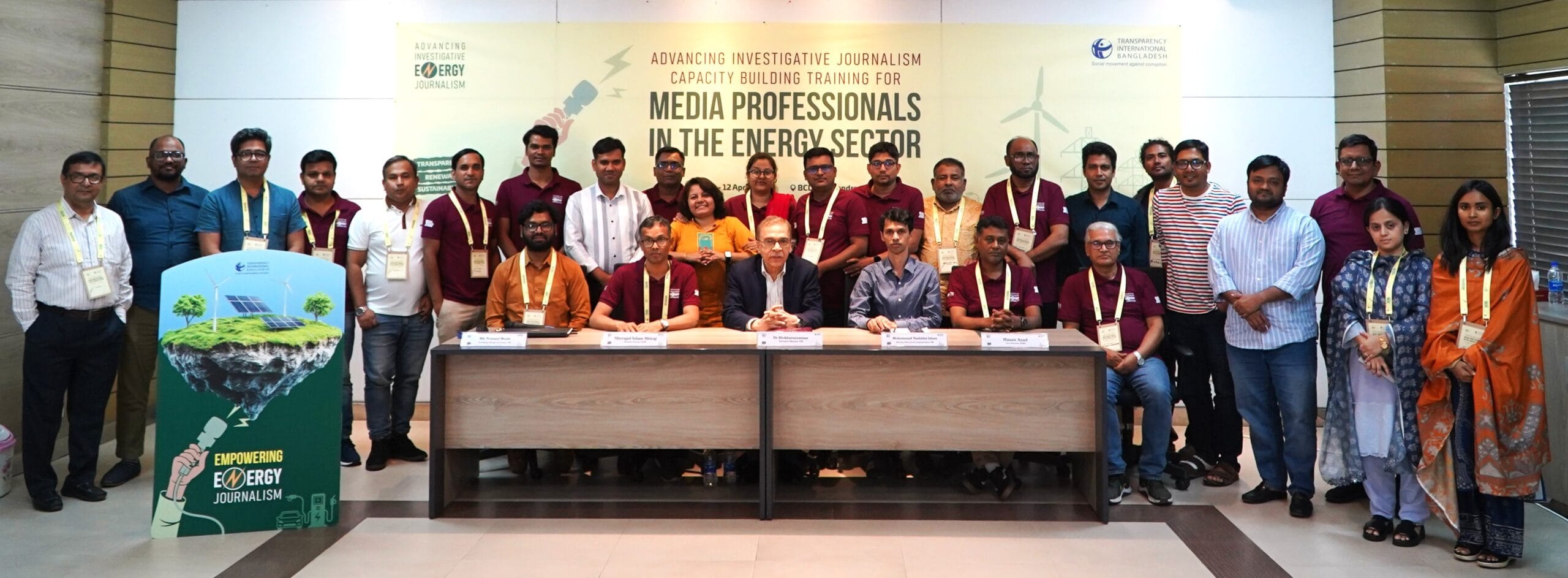
Transparency International Bangladesh has hosted a three-day residential workshop aimed at strengthening investigative journalism in the country’s energy sector, amid growing concerns over governance, transparency and the slow transition to renewables.
The programme, titled “Advancing Investigative Journalism: Capacity Building Training for Media Professionals in the Energy Sector”, brought together more than 20 members of the Forum for Energy Reporters Bangladesh (FERB) at the BRAC Centre for Development Management between 10 and 12 Aprilat the BRAC Centre for Development Management.
The initiative sought to equip reporters with the tools to investigate governance failures, corruption risks and policy weaknesses in Bangladesh’s power and energy industries — particularly in the renewable energy segment.
Sessions covered data journalism, investigative techniques, and analysis of regulatory and accountability gaps, alongside discussions on global energy trends and barriers to clean energy expansion.
Speaking at the closing session, TIB Executive Director Iftekharuzzaman warned that Bangladesh’s shift towards renewable energy was lagging behind expectations, attributing this in part to entrenched fossil fuel interests.
“One of the key reasons is that the entire sector has now come under policy capture through the fossil fuel lobby,” he said.
“The most effective force to overcome this situation is the media. The more evidence-based investigative reporting appears, the easier it will be to ensure transparency and accountability.”
Participants highlighted persistent challenges in reporting on the sector, including limited access to information, institutional opacity and a lack of specialised expertise. Group discussions focused on issues such as project approvals, foreign investment, land acquisition, environmental clearances and power purchase agreements — areas often criticised for weak transparency.
Journalists attending the workshop stressed the need for stronger, independent reporting to improve public accountability and called for wider collaboration to enhance information integrity in energy coverage.
The training concluded with a certificate ceremony, with organisers reiterating the role of media professionals as key stakeholders in tackling corruption.
Representatives from FERB, including Executive Director Serajul Islam Siraj and Vice Chairman Hasan Azad, were also present.
The workshop forms part of TIB’s broader efforts to build institutional capacity and promote transparency in Bangladesh’s governance framework, particularly in sectors vulnerable to corruption and policy capture.