


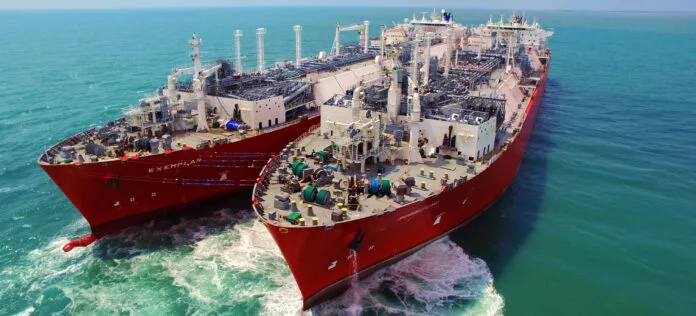
The government plans to increase Bangladesh’s LNG import capacity by 600 million cubic feet per day (mmcfd) within the next two years as it moves to address the country’s persistent energy shortage, Prime Minister Tarique Rahman told parliament on Wednesday.
A new floating LNG terminal is being planned at Kutubjom in Cox’s Bazar’s Maheshkhali, with the government currently holding discussions with interested companies, the prime minister said in response to a question from Selina Sultana, MP for reserved seat-35, during the question-and-answer session.
The proposed terminal is expected to begin supplying regasified LNG by December 2028, adding 600mmcfd to the country’s LNG import capacity.
The government is also conducting feasibility studies for setting up one or two additional floating LNG terminals near Payra or Mongla ports or along the southwestern coast, according to the prime minister.
Alongside expanding LNG imports, the government is seeking to raise domestic gas production to reduce the country’s dependence on imported fuel.
A programme has been taken to drill new wells and carry out workovers on 150 existing wells. Of these, work on 30 wells has already been completed, adding 140mmcfd of gas to the national grid.
Work is now underway on seven more wells, which are expected to add a further 85mmcfd once completed, Tarique said.
The government also plans to conduct 4,500 line-kilometres of 2D seismic surveys and 4,200 square kilometres of 3D seismic surveys to identify new domestic gas reserves.
To strengthen exploration capacity, steps are being taken to reinforce Bangladesh Petroleum Exploration and Production Company Ltd (Bapex), including the procurement of two new drilling rigs.
The government is also seeking fresh investment in onshore and offshore gas exploration.
Following approval of the Offshore Model Production Sharing Contract (PSC) 2026, a bidding round has been invited, while approval of the onshore model PSC is still under process.
Tarique said the government was pursuing LNG infrastructure expansion, domestic gas exploration and increased production simultaneously to strengthen energy security and reduce reliance on imported gas.