


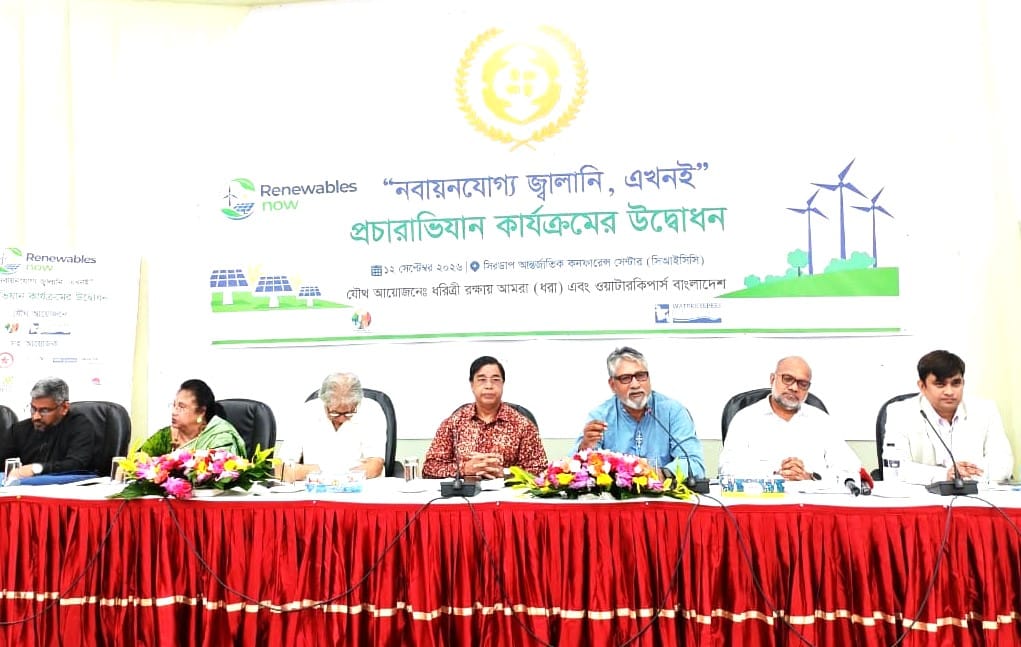
A month-long campaign aimed at strengthening Bangladesh’s energy security, reducing dependence on imported fuels and promoting a clean and just energy transition has been launched in Dhaka.
The campaign, titled ‘Renewables Now’, is being led by Dhoritri Rokkhay Amra (DHORA) and Waterkeepers Bangladesh and jointly organised by 37 civil society and social organisations.
The campaign was inaugurated at the CIRDAP International Conference Centre in Dhaka, where organisers also formally launched a coastal walk as part of a series of activities planned throughout the month.
The programme will include public awareness campaigns across the country, cycling and boat rallies, road processions, a coastal walk, cultural performances and a national dialogue on renewable energy.
At the launch, Bangladesh Energy Regulatory Commission (BERC) chairman Jalal Ahmed, the chief guest, handed over the campaign banner to Mashfiqul Hasan Tony, executive director of the Bengal Peace Foundation, marking the formal launch of the coastal walk.
Jalal Ahmed said the biggest obstacle to expanding renewable energy was not technology but resistance to change.
“Our conventional perception of a power plant still brings a thermal power plant to mind; this mindset must change,” he said.
He said large-scale solar power generation could be developed by making better use of existing land, including areas such as Matarbari.
“What is needed now is to break the barriers to change and move rapidly towards solar power,” he added.
The event was chaired by M S Siddiqui, co-convenor of DHORA.
Siddiqui said renewable energy was no longer simply an environmental issue but had become a matter of Bangladesh’s energy security, economic self-reliance and sovereignty.
“We must move away from the risks of an import-dependent energy system and generate our own energy,” he said.
He called for the expansion of solar, wind, biomass and other renewable sources, saying the transition could create opportunities for investment, employment and local economic development.
Sharif Jamil, member secretary of DHORA and coordinator of Waterkeepers Bangladesh, said Bangladesh’s reliance on imported energy was creating a major challenge for energy security.
He said a rapid and planned transition to renewable energy was essential and called for a clear roadmap and strong political commitment to meet the target of generating 10,000 megawatts of renewable electricity by 2030.
“This change is not the sole responsibility of the government; it is our collective responsibility,” he said.
The campaign, he added, was intended to unite civil society organisations and build public support for renewable energy across Bangladesh.
Mostafa Al Mahmud, president of the Bangladesh Sustainable and Renewable Energy Association (BSREA), warned that continued dependence on imported energy was putting Bangladesh’s energy security at risk.
He said establishing a new floating storage and regasification unit (FSRU) would not by itself resolve the country’s energy challenges and could require nearly Tk20,000 crore in additional investment for pipelines and related infrastructure.
Instead of increasing dependence on imported LNG, Bangladesh should rapidly expand its renewable energy capacity over the next three to four years, he said.
Shafiqul Alam, Bangladesh lead energy analyst at the Institute for Energy Economics and Financial Analysis (IEEFA), also called for an urgent expansion of renewable energy.
He said the transition required accessible financing, investment-friendly policies and more efficient use of energy.
Golam Iftekhar Mahmud, editor and publisher of Dhaka Stream, said the renewable energy transition should not focus solely on increasing electricity generation.
He warned that discarded batteries and solar panels could become significant sources of pollution without proper waste management.
“Renewable energy cannot be pursued only to increase electricity generation; it must go hand in hand with environmental accountability and pollution control,” he said.
Professor Dr Ahmed Kamruzzaman Majumder, dean of the Faculty of Science and professor of Environmental Science at Stamford University Bangladesh and founder and director of the Center for Atmospheric Pollution Studies (CAPS), said reducing fossil-fuel use would help tackle both climate change and air pollution.
He noted that dust accumulation on solar panels could reduce their efficiency, while cleaner air could help improve their performance.
Zakia Shishir, coordinator of Haoroncholbashi, said greater public awareness was needed to accelerate the development of renewable energy.
She also called for a stronger legal framework to support investment in renewable energy and urged an end to the use of fossil fuels.
The launch event brought together civil society representatives, energy analysts, environmental campaigners and renewable energy advocates, with discussions focusing on expanding renewable generation, raising public awareness and increasing public participation to help Bangladesh meet its 2030 renewable energy target.