


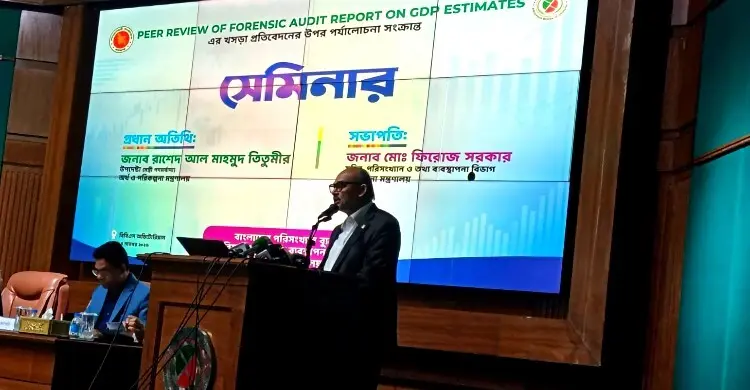
A forensic audit of Bangladesh’s national accounts has found that GDP growth was overstated by 0.8 to 1.13 percentage points, with discrepancies identified in seven of the 22 sub-sectors examined, Adviser to the Prime Minister on Finance and Planning Rashed Al Mahmud Titumir said yesterday.
The overestimation was mainly found in sectors where GDP estimates relied on secondary and administrative data rather than direct surveys, raising questions about the accuracy of the country’s official growth figures.
Speaking at a peer review meeting on the draft forensic audit report at the Bangladesh Bureau of Statistics (BBS) seminar room, Titumir alleged that previous governments had inflated growth figures to serve political interests and promote a narrative of economic development.
He said inconsistencies in national income accounting had emerged since 2014-15, particularly in sectors where data were collected from government agencies and other administrative sources.
Explaining the findings, Titumir said revenue data had been inconsistent before the introduction of the iBAS system at the National Board of Revenue (NBR). Discrepancies were also found between cement production figures and the corresponding estimates of value addition.
The petroleum sector, too, had seen substantial overstatement of data at one stage, he said.
In contrast, the audit found no similar overestimation in sectors such as the garment industry, where information was considered more reliable. This indicates that the problem was concentrated mainly in sectors dependent on administrative data rather than survey-based information.
GDP is calculated largely on the basis of value addition, making consistency between production figures and the corresponding value-added estimates essential, the adviser said.
Titumir said unreliable statistics could distort government planning, budget formulation and development priorities. Restoring public confidence in official data was therefore essential.
He, however, said the audit was not intended as an exercise in political retaliation. To protect its scientific independence, government officials were not directly involved in preparing the report.
The draft report was prepared following standard research procedures and reviewed by two experts. The government is also seeking opinions from specialists of the Bangladesh Economic Association and the Bangladesh Statistical Association before finalising it.
Alongside the review, the government is moving to strengthen the BBS’s data collection and verification systems to prevent similar discrepancies in future.
Geocoding and computer-assisted personal interviewing (CAPI) systems are being introduced to verify whether field enumerators actually visit survey locations and conduct interviews, rather than submitting fabricated information from their offices or homes.
The government is also reviewing the sampling and data collection methods used for the Index of Industrial Production (IIP) and the quantum index of industrial production (QIIP).
To independently verify industrial output, the BBS will use indicators such as electricity and gas consumption. For export statistics, the government has decided to use actual data from Bangladesh Bank instead of figures supplied by the Export Promotion Bureau, customs and the NBR, Titumir said.
The government is also considering introducing the income-based approach to GDP accounting alongside the existing production- and expenditure-based methods. It plans to develop internationally standardised input-output table templates to facilitate research and improve the transparency of economic data.
Titumir said an open data system was also being developed to allow researchers and members of the public to access, scrutinise and verify official statistics.
He stressed that statistical independence must be protected even when governments change, saying GDP should never be used as a political instrument.
“State statistics do not belong to any individual or government; they are the property of the people,” he said.
He also warned that restoring the credibility of Bangladesh’s official statistics was important for improving the country’s international standing, as negative assessments of its statistical standards could undermine confidence in its economic performance.