


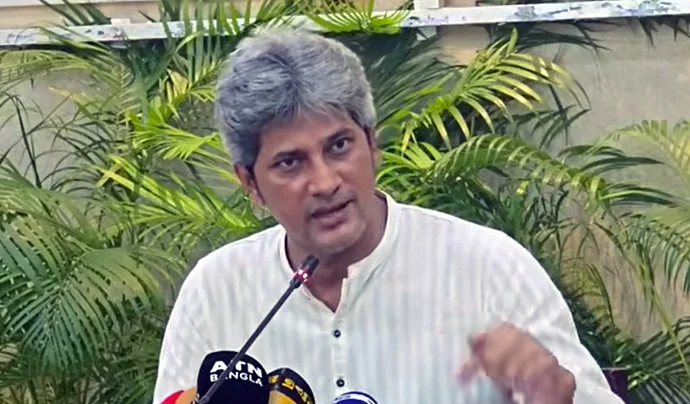
The government needs to build more metro rail lines in Dhaka and its surrounding areas and gradually expand the modern mass-transit system to other major cities to meet rising demand for public transport, Planning State Minister Md Zonayed Abdur Rahim Saki said on Wednesday.
“More metro lines are needed in Dhaka, and more metro lines have to be built around Dhaka and further expanded in other big cities of the country,” he told reporters after the ECNEC meeting at the NEC Conference Room in Sher-e-Bangla Nagar.
His remarks came on the day the government approved a Tk 45,503.76-crore MRT Line-5 Southern Route from Gabtoli to Dasherkandi and revised the costs of MRT Line-1 and MRT Line-5 Northern Route, taking their combined cost to Tk 2,04,243.25 crore.
Saki said the expansion of metro rail was necessary as rapid urbanisation was increasing pressure on public transport and creating a growing need for efficient urban mobility.
He also stressed the need for Bangladesh to develop its own institutional and technical capacity in metro rail construction, saying the country had gained practical experience through the operation of its first metro system.
“We have built a metro rail line, trains are running and people are enjoying its benefits. Now we need to develop the capacity to participate in different components of metro rail construction,” he said.
Technology transfer would be an important consideration in future projects so that Bangladesh could gradually reduce its dependence on foreign expertise, he added.
Cost escalation under review
Asked about the high cost of the newly approved MRT Line-5 Southern Route, Saki said differences in project scope, underground construction, detailed design, financing conditions, exchange rates, inflation and taxes contributed to variations in metro project costs.
He said the Planning Commission had scrutinised the southern-route proposal and reduced its cost before placing it before the ECNEC.
“The initial estimate of the project was substantially higher, but the Planning Commission scrutinised the proposal and brought down the cost before placing it before ECNEC,” he said.
A technical committee also examined the project’s cost and financing issues in detail, he added.
Responding to allegations that a consultancy firm had already been selected at a high cost for the project, Saki said no consultancy contract had yet been awarded.
“The project has only been approved. After approval, the project appointment process will take place, then tender documents will be prepared and subsequently the vendor will be appointed,” he said.
He said claims of excessive consultancy expenditure could not be accepted unless there was a formal notification of award or contract showing that a particular firm had received the work.
Saki said the government was reviewing the project-preparation process to address weaknesses that contribute to cost escalation.
“Project preparation has to be redesigned, and we have to close the gaps that create opportunities for wastage and corruption,” he said.
The government is working to amend project implementation guidelines and strengthen scrutiny of feasibility studies, detailed designs and cost estimates before major projects are approved, he added.
JICA financing gets costlier
On the sharp rise in the cost of the Japan-funded metro projects, Saki said delays in taking decisions had affected the financing terms of loans from the Japan International Cooperation Agency (JICA).
The interest rate, which had earlier been considered at around 0.7 percent, had risen to about 3.05 percent, he said.
“JICA could revise the rate again if the agreement remained pending,” Saki said, adding that the government had negotiated as much as possible in the national interest.
He ruled out international pressure as a reason for placing the projects before ECNEC, saying the proposals had gone through the Planning Commission’s prescribed scrutiny process.
He said some proposals had been placed together because financing terms could change if agreements remained pending beyond the applicable period.
Focus on safety, accountability
Saki also said the government was reviewing concerns over the quality and safety of existing metro rail infrastructure and had taken steps to examine reported technical problems.
“If any weakness has resulted from negligence, dereliction of duty or corruption, accountability will be ensured,” he said.
Future metro rail contracts would put greater emphasis on quality, maintenance and safety, he added.
For underground sections, project arrangements would include provisions requiring responsible entities to address damage to structures above tunnels, including repairs and compensation where applicable.
Saki also said Prime Minister Tarique Rahman had instructed government agencies with the necessary technical capacity to undertake relevant work instead of allocating separate consultancy funds.
The government was also examining meeting allowances and other project-related expenditures to reduce unnecessary costs, he said.
He said renewable energy, particularly solar power, would also receive greater attention in public infrastructure projects wherever feasible.
The broader objective, he said, was to ensure that public investment generated long-term benefits through improved mobility, reduced travel time, higher productivity and better value for money.