


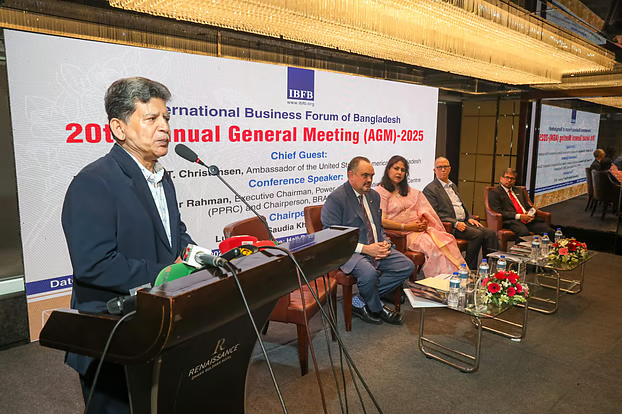
Institutional harassment is discouraging businesses and ordinary citizens from complying with tax rules, undermining efforts to widen Bangladesh’s tax base and holding back economic growth, economist Hossain Zillur Rahman said on Thursday.
Although corruption receives considerable attention, institutional harassment remains a less-discussed barrier to economic progress, said the chairperson of BRAC Bangladesh and executive chairman of the Power and Participation Research Centre (PPRC).
“People and businesses are willing to pay taxes, but institutional harassment is preventing the expansion of the tax net,” he said, calling for business leaders, civil society and grassroots communities to build a credible account of these obstacles and ensure that national leaders listen to them.
Hossain Zillur was speaking at the 20th annual general meeting of the International Business Forum of Bangladesh (IBFB) at a hotel in Dhaka’s Gulshan. US Ambassador to Bangladesh Brent T Christensen attended as the chief guest.
He said people across society—from slum dwellers and the middle class to young people, women, farmers and workers—were increasingly taking initiatives to improve their lives and shape their own futures.
But the state, political actors and influential sections of society were failing to recognise and support this entrepreneurial energy and hard work, he said.
While acknowledging the country’s economic difficulties, Hossain Zillur cautioned against allowing negative news to dominate the national outlook. Bangladesh must also identify its own strengths, resources and untapped opportunities, he said.
The country should look beyond immediate challenges and consider where it wants to be in the next five years. Its factories, farms, cities and young people all have considerable potential for enterprise and innovation that could drive a positive transformation, he added.
US sees scope for more investment
US Ambassador Brent T Christensen said the United States was working to improve Bangladesh’s business environment to attract more international capital and investment.
The reciprocal trade agreement signed by the two countries in February includes provisions for transparent tariff arrangements, simpler business regulations, predictable policymaking and adherence to international standards, he said.
Christensen said Bangladesh had become eligible for financing from the US International Development Finance Corporation (DFC), which provides loans, equity investment, political risk insurance and feasibility-study funding for projects in energy, healthcare, infrastructure and technology.
To qualify, projects must be commercially viable and financially feasible, he said.
Pointing to the presence of US companies in Bangladesh, the ambassador said Chevron produces more than half of the country’s natural gas, while Excelerate operates two floating storage and regasification units. GE Vernova is also involved in the country’s power sector.
US companies are interested in expanding their investments and business operations in Bangladesh, he added.
Business leaders seek easier rules
IBFB President Saudia Khan called for a stronger role for the Bangladesh Investment Development Authority (BIDA) and effective implementation of the One-Stop Service Act to improve the investment climate.
She said businesses faced unnecessary complications in securing construction approvals, accessing government services and carrying out routine operations. These hurdles need to be reduced to make the country more attractive to investors.
The IBFB has organised discussions and roundtables on Bangladesh-US trade relations, environmentally friendly shipbuilding and new industrial opportunities, she said. One of its members has already started building environmentally friendly ships.
Saudia Khan said DFC financing could open up important opportunities for Bangladeshi investors, while the IBFB could help connect local businesses with US investors.
Drawing on her own experience, she said policy-related obstacles continued to make doing business difficult in Bangladesh. Investment rules and procedures must therefore be simpler, fairer and more transparent.
Leaders and members of the business forum attended the meeting.