


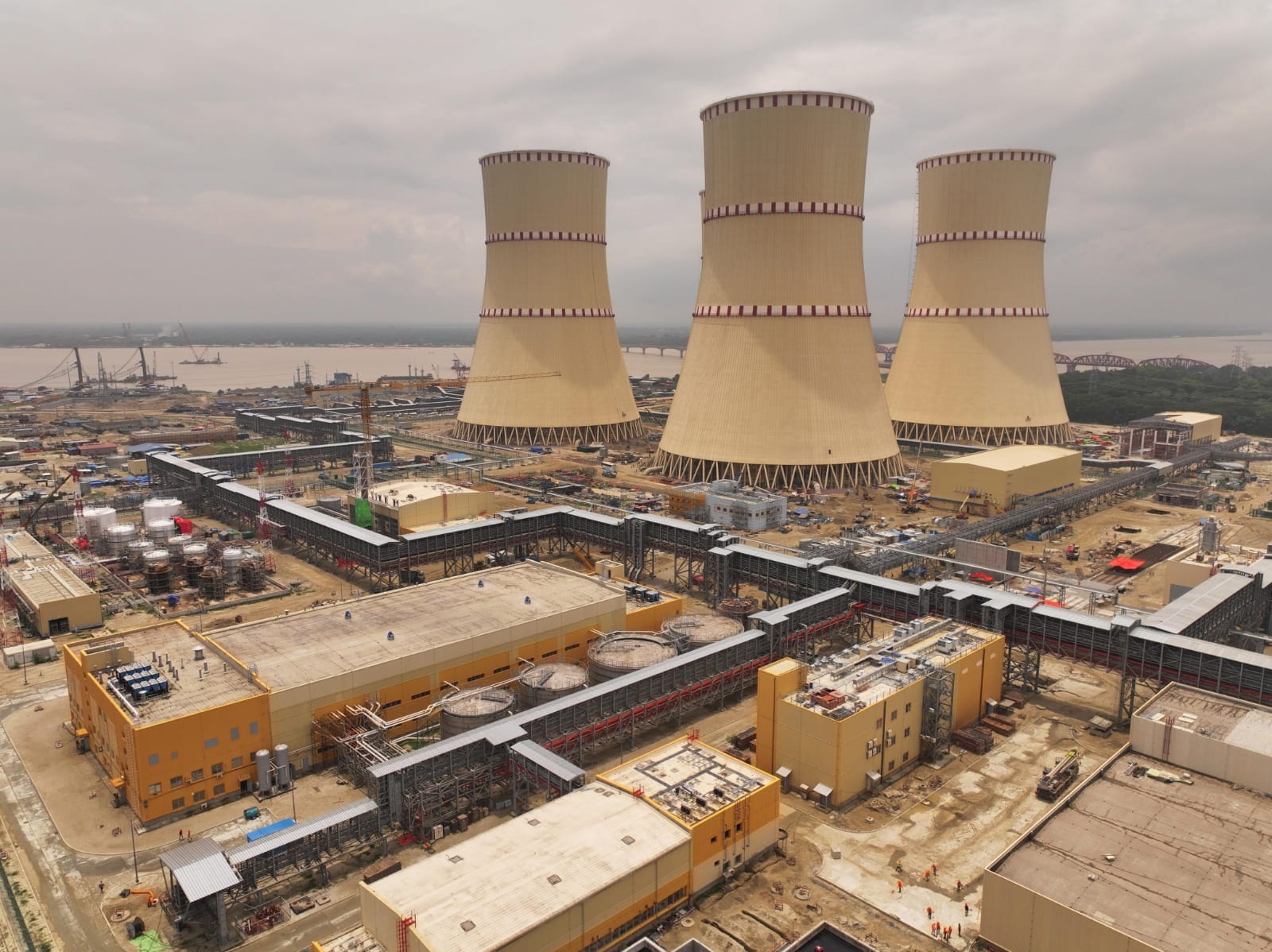
Bangladesh’s first nuclear power plant is edging towards completion, but a technical fault in a key safety valve has halted testing of its second reactor, casting fresh uncertainty over the timetable for bringing the 1,200MW unit into operation.
The fault was detected in Unit-2’s Pressurizer Pilot-Operated Relief Valve (PORV) as engineers prepared to move to the next stage of reactor testing, according to an inspection report by the Implementation Monitoring and Evaluation Division (IMED).
A formal root-cause analysis is underway, and testing will not resume until the problem has been investigated, the report said.
Cost soars as work nears completion
The setback comes as the overall Rooppur Nuclear Power Plant project has reached 82.4% physical completion, with Unit-1 significantly ahead of Unit-2.
However, the government monitoring team identified a series of other issues that could affect the remaining work, including delays by the Russian contractor in deploying manpower and procuring materials, unresolved land issues and incomplete operational arrangements.
The project’s approved cost has meanwhile climbed to about Tk1,38,637 crore, up from Tk1,13,092.91 crore when it was approved in 2016. Financial progress, at about 78%, is also trailing physical completion.
The findings emerged from an August inspection by the Fast Track Project Monitoring Task Force under the Joint Coordination Committee and IMED.
Unit-1 moves ahead, Unit-2 falls behind
Unit-1 has completed hot- and cold-state testing, control-rod assembly checks and criticality-related trials.
The Bangladesh Nuclear Regulatory Authority issued its operating licence in April, and fuel loading began the same month. However, the unit has yet to supply electricity to the national grid, with grid connection now targeted by the end of 2026.
Unit-2, by contrast, has stalled at an earlier stage.
The reactor had entered its initial hot-state testing phase when the PORV fault was detected. The problem prevented engineers from proceeding to the next stage of testing ahead of fuel loading and eventual grid synchronisation.
The inspection report did not specify when the suspended testing would resume.
Russian contractor behind schedule
The IMED team found that Atomstroyexport, the Rosatom subsidiary implementing the engineering, procurement and construction contract, was behind its own Level-2 schedule for both manpower deployment and materials procurement.
The committee asked the contractor to submit an updated and realistic work schedule and accelerate manpower deployment and delivery of materials to prevent further delays to Unit-2’s start-up readiness.
The monitoring team also recommended fast-tracking an Additional General Agreement to extend turbine-building work into 2027.
Project cost rises sharply
Rooppur’s approved cost has increased substantially since the project’s original approval in 2016.
The initial cost was Tk1,13,092.91 crore, including Tk91,040 crore in Russian state credit and Tk22,052.91 crore in government funding.
A revision in late 2025 added Tk13,386 crore, taking the cost to about Tk1,26,479 crore. A further increase approved in early 2026 brought the total to about Tk1,38,637 crore.
Government officials have attributed the increase mainly to the depreciation of the taka against the US dollar, as most of the project’s equipment is imported from Russia.
The Planning Adviser has said that, in dollar terms, the project’s cost has not increased significantly. However, IMED’s assessment shows financial progress at about 78%, compared with physical progress of 82.4%.
Land disputes remain unresolved
While the main plant moves closer to commissioning, some associated land and resettlement work remains unfinished.
The resettlement component covers nearly 1,690 acres and families displaced by the project. Compensation and utility-relocation work remain incomplete, with the related schedule extending beyond the expected commissioning of the main plant.
A separate dispute over a boat-club and jetty plot in the project’s riverside area also remains unresolved with the Bangladesh Inland Water Transport Authority (BIWTA).
The monitoring team recommended ministry intervention to settle the dispute and wider use of the electronic Project Management Information System to track pending approvals.
Safety, environmental compliance under scrutiny
The inspection also highlighted outstanding environmental monitoring and safety-preparedness work.
IMED asked the authorities to keep environmental monitoring reports up to date and ensure strict compliance with the project’s Quality Assurance Programme.
A local warning and evacuation-alert system linking the plant with nearby union parishads, the state broadcaster and law-enforcement agencies is also being completed. The report recommended completing the system before Unit-2 begins commercial operation.
Grid and fuel arrangements pending
Several operational arrangements also remain incomplete.
These include a power purchase arrangement involving Nuclear Power Plant Company Bangladesh Ltd, Bangladesh Power Development Board and Bangladesh Atomic Energy Commission, as well as licensing and supply arrangements for fresh nuclear fuel ahead of Unit-2’s fuel loading.
A service contract with GE Vernova T&D India for the plant’s SCADA/EMS control and grid-interface systems is also pending.
First power draws closer
Rooppur is Bangladesh’s first nuclear power project, comprising two VVER-1200 reactors with a combined capacity of 2,400MW.
The framework agreement with Russia’s Rosatom was signed in 2011, followed by a $12.65 billion engineering, procurement and construction contract in December 2015. Construction of the two units began in 2017 and 2018 respectively.
With overall construction now more than four-fifths complete, the project is entering a critical phase as it moves from construction and testing towards commercial operation.
For Unit-2, however, further progress depends on resolving the valve fault, catching up on manpower and materials, and completing a range of technical, regulatory and operational arrangements.