


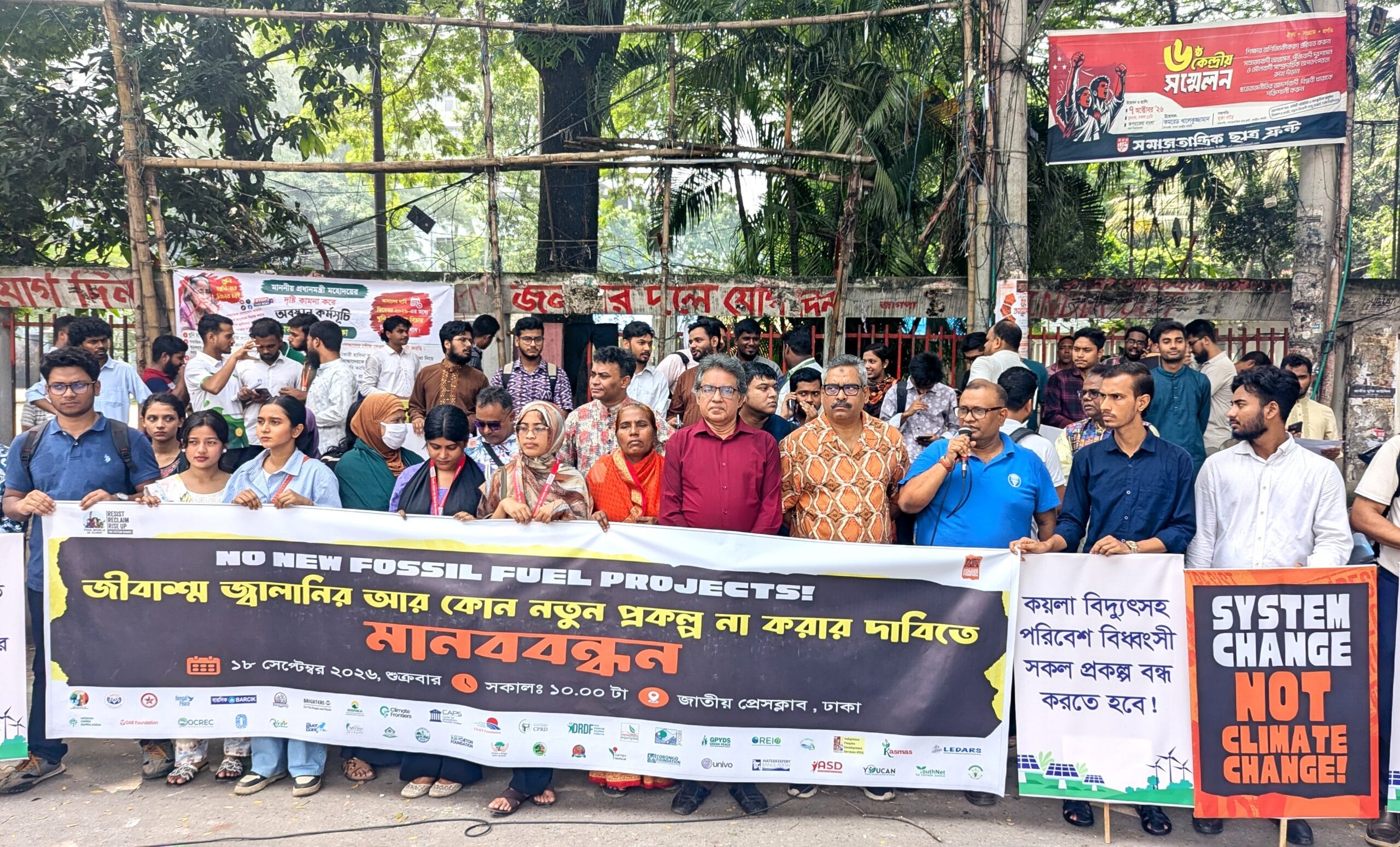
Forty-two civic and social organisations, including Dharitri Rokkhyay Amra (Dhara), have staged a human chain in Dhaka calling for climate justice, an end to new fossil fuel projects and financing, and a rapid and just transition to renewable energy.
The demonstration was held outside the National Press Club on Friday morning as part of the Global Week of Action. Held ahead of the 81st session of the United Nations General Assembly (UNGA 81) and COP31, the event also called for adequate climate finance for people and the development of a clean-energy-based future.
Speakers said that increasing dependence on fossil fuels could not provide a sustainable solution to the energy and climate crises. They called for a rapid transition to renewable energy to ensure energy security for the public and urged an end to new investment in fossil fuel projects.
Iqbal Faruk, head of research at Waterkeepers Bangladesh, said in his welcome address: “There should be no more new fossil fuel projects. Renewable energy must be implemented now.”
He called for clear timelines to phase out existing coal-fired power plants. A feasibility study has already been conducted for a 442MW solar power project at Rampal, he said, adding that the initiative should now move beyond the study stage and construction should begin as a matter of urgency.
“This transition can no longer be delayed in the interests of energy security, the environment and people’s lives and livelihoods,” he said.
Badrul Alam, president of the Bangladesh Krishok Federation, said the energy crisis had demonstrated the risks of relying heavily on fossil fuels.
“Bangladesh has opportunities to harness solar, wind and other renewable energy sources,” he said.
The government has set a target of generating 10,000MW of renewable electricity by 2030, he said, adding that implementation needed to be accelerated.
“Renewable energy is no longer a matter for the future — it is needed now to ensure energy security,” Alam said.
Nikhil Chandra Bhadra, coordinator of the Sundarbans and Coastal Protection Movement, called for a specific action plan to make full use of Bangladesh’s renewable energy potential.
He said solar power projects could be developed through government initiatives on railway land, along riverbanks, on embankments and on land managed by the Bangladesh Water Development Board. The government should also support rooftop solar generation by involving local communities, he said.
“We do not want to limit ourselves to protest. We want to work with the government to help implement its renewable energy initiatives,” Bhadra said.
Mir Mohammad Ali, president of the Dream Research and Development Foundation, said communities in Bangladesh’s coastal areas were bearing some of the heaviest impacts of fossil fuel-based projects.
Damage to coastal ecosystems, habitats and livelihoods had put the lives and livelihoods of millions of people dependent on hilsa fishing under increasing pressure, he said. Many coastal residents were being forced to move to slums in Dhaka in search of work.
“To protect the coast and save people’s lives and livelihoods, we must move away from fossil fuel projects and transition to renewable energy now,” Ali said.
Abul Hasan, project head of the Climate Change and Resilience Department at the Coast Foundation, said Bangladesh had a plan to generate 10,000MW of renewable electricity by 2030, but the financing required to implement it had yet to be secured.
“A specific year-by-year roadmap must therefore be developed and the necessary financing secured,” he said.
He also called for technology transfer to support the transition to renewable energy to be provided through grants rather than loans, in line with the Polluter Pays Principle.
“This is Bangladesh’s right and a demand for climate justice,” Hasan said.
Al Imran, senior officer for research and campaigns at the Centre for Participatory Research and Development (CPRD), said renewable energy was not only an issue of climate and the environment, but was also linked to Bangladesh’s energy security, sovereignty and economic capacity.
Bangladesh already had policies and commitments concerning the transition to renewable energy, he said, but the action plans, technology, research and initiatives required to implement them remained unclear.
“The government must therefore move beyond policy declarations and immediately develop a specific and implementable work plan,” Imran said.