


The government is set to launch a Tk 2,498.08 crore solar power project at Rampal, Bagerhat as part of its efforts to expand solar power generation amid energy crisis created by escalated tensions in the Middle Ease.
The project ‘Rampal 442 MWp Solar Power Plant Construction Project’ is being placed at the Executive Committee of the National Economic Council (Ecnec) on Wednesday for final approval, official sources said.
If approved, the Bangladesh Power Development Board (BPDB) will build the 442-megawatt-peak (MWp) grid-connected plant between September 2026 and March 2029. It is one of the biggest renewable energy investments proposed in recent years.
Who pays
The project needs no money from the government budget. The BPDB will provide Tk 374.71 crore, or 15 percent, from its own funds. The remaining Tk 2,123.37 crore, or 85 percent, will come as a loan from the Power Sector Development Fund.
The loan carries 2 percent interest, a one-year grace period and a 16-year repayment period. The Bangladesh Energy Regulatory Commission gave in-principle approval for financing from the fund on May 22, 2022.
What will be built
The plant will use solar panels of at least 640 watt-peak each, with grid-tied inverters of 360MW cumulative capacity and a pooling sub-station.
Power will travel on a 230kV double-circuit transmission line of about 3km, with three new 230kV bays (two in use, one spare) at the substation it connects to.
The civil works include an officers’ dormitory, a staff dormitory and rest house, a one-storey mosque and a three-storey control building. The project provides for 96 person-months of local consultants. The earlier papers had listed 32 person-months of foreign and 52 of local consultants.
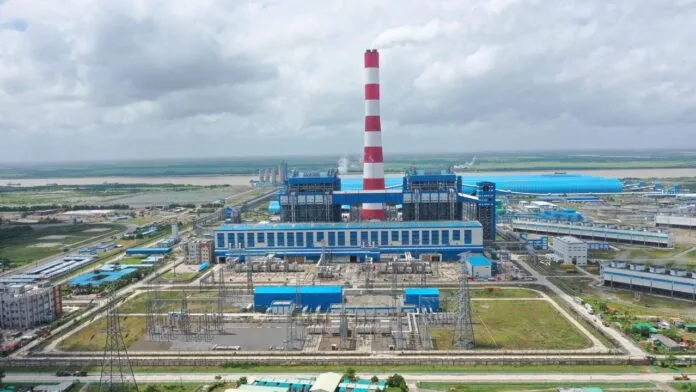
The plant will stand on Block-B at Rampal. The BPDB acquired 1,834 acres there in 2012 for coal-fired generation and split it into Block-A (915.5 acres) and Block-B (918.5 acres).
Block-A hosts the 2×660MW Bangladesh-India Friendship Power Company coal plant. Block-B remained with the BPDB, so the solar project needs no land acquisition or development, which officials say keeps its cost down.
Officials say the plant will emit no carbon dioxide, sulphur oxides, nitrogen oxides or particulate matter. They add that this will ensure environmental safety in the Sundarbans area and help earn carbon credits.
Returns and jobs
A feasibility study by IIFC, a third-party consultancy, was completed in May 2025 and found the project viable. At a 12 percent discount rate, the financial benefit-cost ratio is 1.001, so the project barely covers its costs commercially. Its financial internal rate of return is 12.02 percent, while the economic return is 18.31 percent.
The project would create about 25 jobs during construction, 14 on deputation and 11 outsourced. About 256 people would run the plant afterwards, 53 permanent and 203 outsourced.
The government’s election manifesto promises to raise the renewable share of the energy mix to 20 percent by 2030. Renewables supply only 3.76 percent, about 1,216MW, of the country’s installed capacity of 32,332MW.
Earlier questions
Earlier at a Project Evaluation Committee (PEC) meeting, Planning Commission officials had raised several questions about the project before it reached this stage.
They said the papers did not discuss the effect on the Sundarbans ecosystem or the nearby Pashur river, and asked whether embankments and sluice gates are planned against tidal flooding. They also questioned whether the equipment can withstand salinity-induced corrosion.
They found the cost estimates lacked proper units and quantities and called several smaller items excessive. They also asked whether the BPDB has an agreement to use the neighbouring coal plant’s substation.
“The project is being placed before Ecnec meeting after getting satisfactory answers from the implementing agency to the issues raised by the PEC earlier,” said Shibraj Chowdhury, a Planning Commission official familiar with the matter.About the use of coal power plant’s land for solar power, he said, “Now, it is the priority of the new government to use this land for solar power plant as they have given priority to renewable energy over the coal power.”