


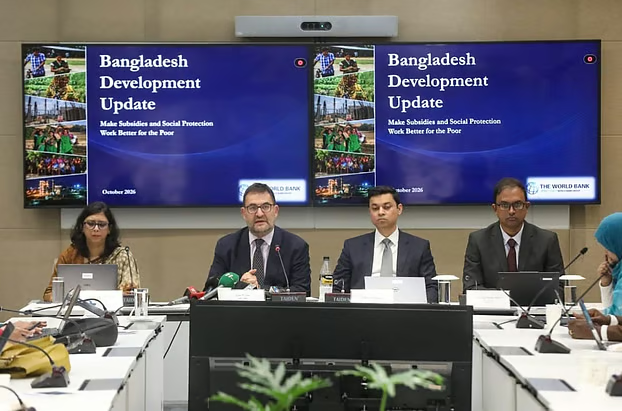
Bangladesh needs urgent and wide-ranging reforms in the banking, energy and revenue sectors to revive economic growth, attract private investment and create jobs, the World Bank has said.
The warning came as the World Bank projected Bangladesh’s economic growth at just 3.4% in both FY2026 and FY2027, citing weak investment, slowing exports, persistent inflation and deepening financial-sector vulnerabilities.
Growth could recover to 3.9% in FY2028 if energy supply improves gradually and the government accelerates its reform programme, according to the latest Bangladesh Development Update, released on Tuesday.
“To avert economic downturn and return to an inclusive growth path, driven by private investment, fast and bold reforms are needed in banking, domestic revenue mobilisation and the energy sector,” said Jean Pesme, World Bank division director for Bangladesh and Bhutan.
“The time to act is now,” he said, stressing the need to protect poor households while creating more and better jobs.
The report paints a difficult picture of Bangladesh’s economy, with poverty and inequality rising alongside stalled job creation.
Around 2.1 million more people fell into poverty in FY2026 compared with the previous year, while women continued to lose jobs, the World Bank said.
The national poverty rate is estimated to have risen to 22.5% in FY2026, up from 18.7% in 2022, marking a fourth consecutive annual increase.
Banking sector under growing strain
Financial-sector weaknesses have intensified, further undermining credit flows and investor confidence.
The non-performing loan ratio rose to 33.2% in June 2026, from 30.6% in December 2025, highlighting the continuing stress in the banking sector.
At the same time, limited fiscal space has constrained public investment. Government revenue collection stood at only 8.3% of GDP, one of the lowest levels in the world, while the fiscal deficit widened to 3.9% of GDP in FY2026, from 3.5% a year earlier.
Despite domestic pressures, the external sector has shown resilience, supported by strong remittance inflows and an improvement in foreign-exchange reserves.
Poor households missing out
The World Bank also raised concerns over the effectiveness and coverage of Bangladesh’s social protection system.
About half of the poorest households remain outside social protection programmes. The report found that the poorest 20% of the population receive an average of Tk7,140 a year in social protection benefits, compared with Tk10,472 received by the richest 20%.
Only 54.4% of people in the poorest 20% directly receive benefits, while 31% of the richest 20% also receive them.
The World Bank said better targeting could significantly increase the impact of government spending on poverty reduction.
It estimated that consolidating food subsidies and better integrating the Family Card with existing cash-support programmes could lift an additional 2.85 million people out of poverty.
Under the existing approach, the Family Card could lift about 1.58 million people above the poverty line annually, but effective targeting could raise the figure to around 2.85 million, the report said.
Energy subsidies favour bigger users
The report also questioned the distributional impact of energy subsidies.
The richest 20% of households receive about 33% of electricity subsidies, while the poorest 20% receive slightly more than 15%, as higher electricity consumption attracts a larger share of the subsidy.
The World Bank also highlighted the growing burden of agricultural subsidies. Fertiliser subsidies increased almost fourfold, from Tk7,200 crore in FY2020 to Tk28,000 crore in FY2025.
Since FY2023, about 80% of the Agriculture Ministry’s budget has been absorbed by subsidies, according to the report.
The World Bank recommended better targeting of support to small and vulnerable farmers, alongside greater investment in agricultural research, extension services, soil testing, marketing and water management.
South Asia resilient but jobs remain key
The Bangladesh update was released alongside the World Bank’s South Asia Economic Update, which projects regional growth at 6.9% this year, easing to 6.7% in 2027 as global headwinds increase.
The World Bank said South Asia must find new drivers of growth and create more jobs, including by making greater use of artificial intelligence.
“South Asia has demonstrated remarkable resilience in a challenging global environment. But the region needs to invest in new drivers of growth to sustain momentum and create more jobs,” said Johannes Zutt, World Bank vice-president for South Asia.
The report said AI adoption is accelerating across the region, although it remains well behind advanced economies. It highlighted opportunities to use AI to raise labour productivity, expand exports and improve public services, including AI-assisted retinal screening in Bangladesh.
But governments must first address weaknesses in skills, infrastructure and the wider business environment if the region is to benefit fully from the technology, the World Bank said.