


Japanese conglomerate Marubeni Corporation is looking to expand its investment in Bangladesh, exploring opportunities in fertiliser production, information technology, energy, automobile manufacturing and ship recycling.
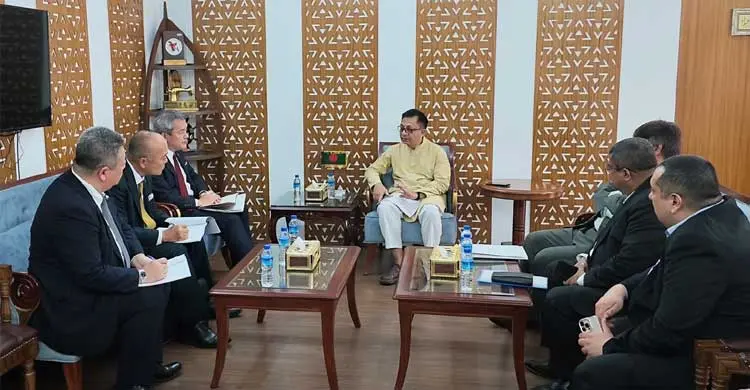
The company expressed interest in expanding its existing operations and investing in new industrial sectors at a meeting with Commerce, Industries, Textiles and Jute Minister Khandaker Abdul Muktadir at the Secretariat in Dhaka on Sunday.
Marubeni President and CEO Masayuki Omoto led the delegation at the meeting, which also discussed modernising fertiliser production, expanding technology cooperation and strengthening bilateral trade and investment ties.
The minister said the government was working to simplify business procedures, remove administrative bottlenecks and create a more investment-friendly environment to attract foreign investors.
He said Japanese technology, expertise and investment could play a significant role in Bangladesh’s industrialisation, technology transfer and job creation, adding that the government would provide the necessary policy and institutional support to deepen economic ties with Japan.
The discussions covered potential investment in fertiliser production, IT, energy, ship recycling and Toyota-branded automobile manufacturing. The two sides also reviewed progress towards signing and implementing the Bangladesh-Japan Comprehensive Economic Partnership Agreement (CEPA), as well as opportunities to diversify jute products.
Omoto highlighted Marubeni’s longstanding business presence in Bangladesh and identified opportunities to modernise the Karnaphuli Fertilizer Company Limited (KAFCO), improve the efficient use of natural gas and increase fertiliser production capacity.
He also expressed interest in fresh investment and technology cooperation in producing diammonium phosphate (DAP) and triple superphosphate (TSP) fertilisers.
In the information technology sector, Omoto pointed to the potential for expanding cooperation in artificial intelligence and IT offshoring. Hundreds of Bangladeshi engineers working for Bangladesh Japan Information Technology (BJIT), a joint investment venture, are already providing services to Japan and other international markets, he said.
The meeting also explored the use of environmentally friendly technologies in ship recycling, a proposal for Toyota vehicle manufacturing and the need to ensure uninterrupted power supplies to economic zones.
Small modular nuclear reactors (SMRs) also came up for discussion as a potential long-term option for strengthening energy security.
On jute, Muktadir said the government wanted to move beyond traditional products and promote higher-value, diversified goods. Initiatives include blending jute fibres with cotton, viscose and polyester, developing improved seeds and expanding research.
He said international technological cooperation and investment could help unlock the sector’s potential.
The minister added that the government was prioritising simpler procedures for company registration, trade licences and investment approvals, alongside facilitating the repatriation of profits and capital by foreign investors.
The two sides stressed the need to deepen Bangladesh-Japan economic relations, capitalise on the potential benefits of the CEPA and build long-term partnerships in industry and technology.
Industries Secretary Abdun Naser Khan was also present at the meeting.