


Bangladesh’s ambition to meet 20 percent of its electricity demand from renewable sources by 2030 will require a major expansion of solar power, substantial private investment and a fundamental improvement in grid infrastructure, speakers at a national seminar said on Tuesday.
They also cautioned that financing constraints, inadequate energy storage, land availability, regulatory uncertainty and concerns over electricity pricing could slow the country’s journey towards a solar-powered future.
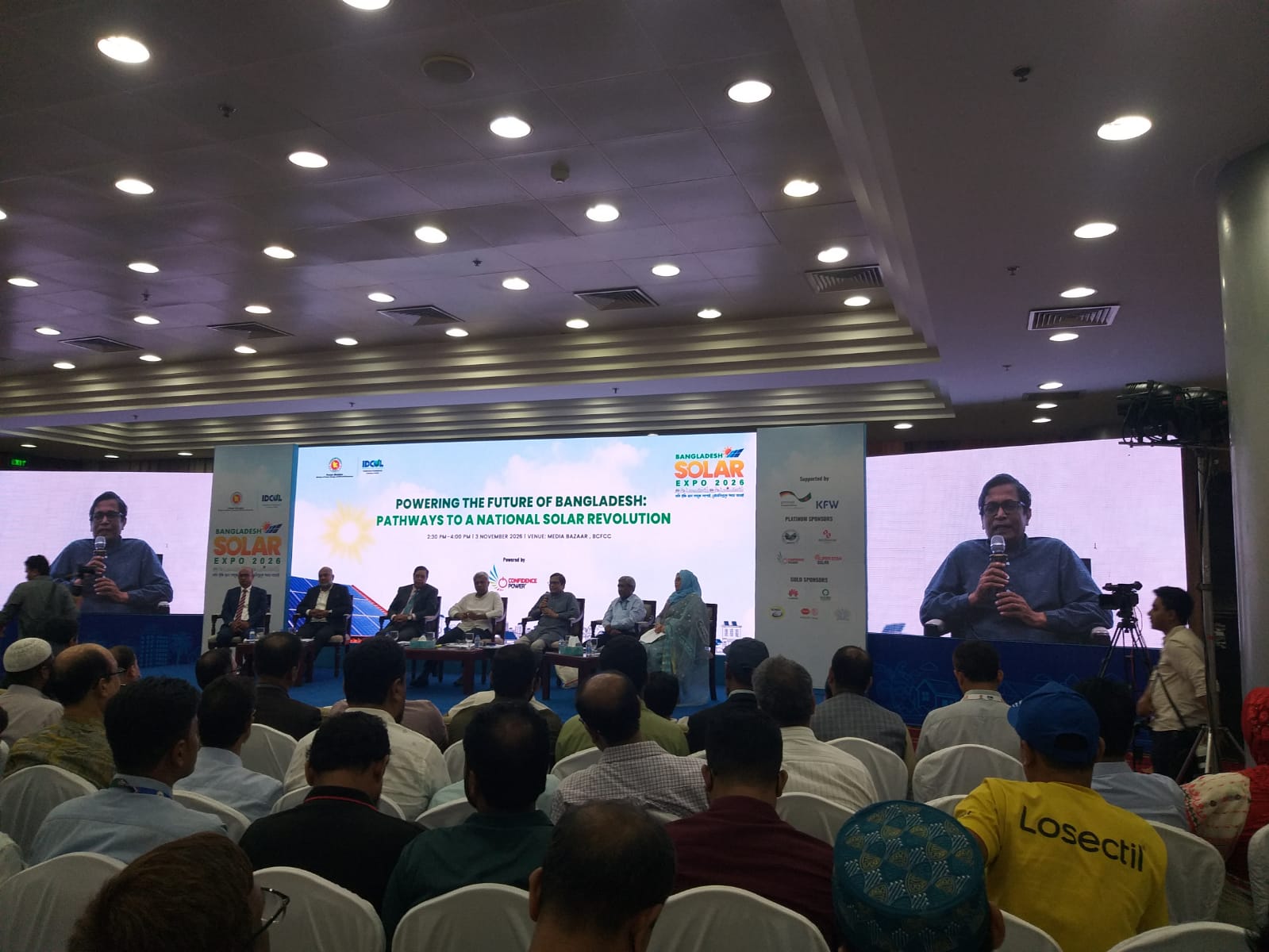
The observations came at a seminar titled “Powering the Future of Bangladesh: Pathways to a National Solar Revolution”, held on the sidelines of the first day of Solar Expo 2026.
Bringing together policymakers, energy-sector experts, private entrepreneurs and consumer representatives, the discussion focused on how Bangladesh could turn its renewable energy ambitions into practical and financially sustainable solutions.
The country’s target of generating 20 per cent of its electricity from renewable sources by 2030, equivalent to around 10,000 megawatts (MW) under the projections discussed at the seminar, represents a significant shift in its energy strategy.
According to figures presented at the seminar, Bangladesh currently has around 840MW of installed grid-connected solar capacity, producing approximately 700-750MW of operational output. Reaching the 2030 ambition will therefore require a substantial acceleration in project development.
“Given the unprecedented volatility in the international energy market, expansion of domestic solar power has become increasingly important for reducing dependence on imported fossil fuels, strengthening energy security and protecting the economy as a quick fix to the crisis,” said State Minister for Power and Energy Anindya Islam Amit.
For this, the government has formulated a policy to that end in a very short time accommodating suggestions from the energy experts and liberalized the setting up of the solar plants in the country, he added.
Private sector expected to lead expansion
Discussants highlighted the importance of private investment in scaling up solar generation, particularly through rooftop installations, industrial solar projects and large-scale solar power plants.
Bangladesh Energy Regulatory Commission (BERC) Chairman Jalal Ahmed identified the Merchant Power Plant (MPP) framework as an important opportunity to expand private-sector participation by allowing developers to sell up to 80 per cent of their electricity directly to private consumers, with the remaining 20 per cent available for purchase by the Bangladesh Power Development Board (BPDB).
The BERC has set a BPDB purchase rate of Tk 6.98 per kilowatt-hour under the framework, while also determining wheeling and distribution charges for electricity transmitted through the national grid, he added.
Private-sector representatives welcomed the government’s policy support, including the reduction of import duties on solar equipment to 1 percent. They reported that new solar capacity additions increased from 88MW in September to 122MW in October.
However, entrepreneurs pointed to difficulties in opening letters of credit, liquidity constraints in commercial banks and uncertainty over the continuation of fiscal incentives as major barriers to investment.
They called for a stable policy environment and a comprehensive renewable energy law to provide long-term certainty for investors.
Battery storage and grid capacity a major concern
A key issue emerging from the discussion was the need to develop battery energy storage systems (BESS) alongside solar generation.
Md Abdul Monayem Chowdhury, managing director (Additional Charge) of Power Grid Bangladesh (PGCB) said solar power production fluctuates with sunlight and weather conditions, making it difficult to match generation with electricity demand without adequate storage and flexible grid management.
According to his estimate, Bangladesh may require around 4,000MW of battery storage capacity to support the planned expansion of renewable energy.
He proposed a framework with a 10 percent battery storage requirement for specified new solar installations above 25-30 kilowatts, rising to 20 percent once total solar capacity crosses 3,000MW.
Seasonal variations in electricity consumption could further complicate grid management. While summer demand provides greater scope for absorbing solar electricity, lower winter demand may leave the national grid with limited capacity to accommodate additional generation, he pointed out.
The integration of major power projects, including the Rooppur Nuclear Power Plant, will also require careful coordination of generation, storage and reserve capacity to maintain grid stability, he added.
Speakers stressed that expanding solar generation without corresponding investment in transmission networks and storage facilities could result in underutilisation of available electricity.
Tariff transparency and consumer interests
While industry representatives welcomed investment incentives, consumer rights advocates raised concerns about the cost of solar electricity and the potential financial burden on consumers.
Energy Adviser to the Consumers Association of Bangladesh (CAB) Prof Shamsul Alam questioned the pricing assumptions submitted by some private developers, citing benchmark solar generation costs of Tk 3.44-Tk 3.94 per unit against proposed purchase rates as high as Tk 10.85 per unit.
He called for transparent cost assessments, stronger regulatory oversight and competitive pricing to ensure that renewable energy expansion does not create additional pressure on electricity tariffs.
The consumer rights campaigner also argued that savings from gradually reducing dependence on expensive furnace oil-based power plants, where generation costs can reach Tk 26 per unit, could be redirected towards battery storage and renewable energy infrastructure.
Turning ambition into reality
The seminar underscored that Bangladesh’s solar revolution will depend on more than policy announcements and tax incentives.
Speakers identified affordable financing, suitable land, reliable technology, modern transmission infrastructure and regulatory certainty as essential conditions for accelerating the transition.
They also emphasised the need to balance private investment opportunities with consumer affordability and the financial sustainability of the power sector.
As Bangladesh moves towards its 2030 renewable energy target, the central challenge will be to build a solar power system that is not only larger but also reliable, affordable and commercially viable.
The discussions suggested that the country’s next phase of energy development must move beyond installing solar panels towards creating an integrated renewable energy ecosystem capable of delivering long-term energy security.
The event was moderated by Power Division Secretary Mirana Mahrukh