


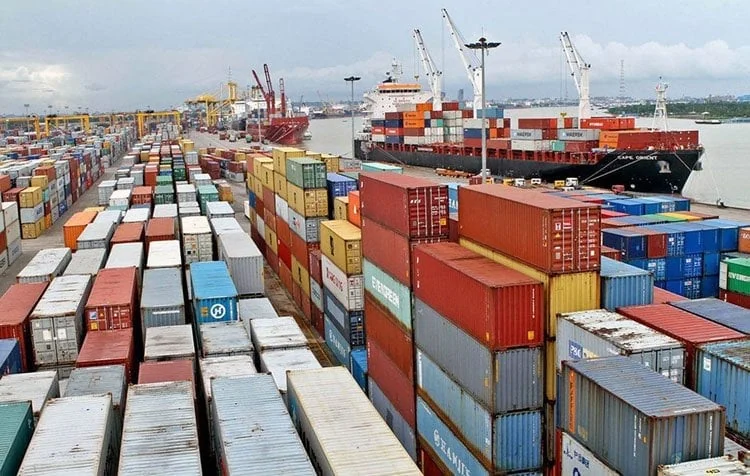
Comprehensive and multifaceted development and modernisation initiatives are underway, involving reputed local and international port and shipping operators, to transform Chattogram Port, the country’s principal maritime gateway, into a competitive regional shipping hub, says BSS report.
Driven by targeted efforts to streamline logistics, upgrade physical infrastructure and strengthen international partnerships, these initiatives aim to address longstanding operational bottlenecks, reduce vessel turnaround and container dwell times, and transform Chattogram Port, which handles approximately 92 percent of Bangladesh’s seaborne foreign trade, into a highly competitive regional shipping hub by 2030.
Recognising Chattogram’s untapped geographical and economic potential, strategic location and extensive hinterland, the government of Prime Minister Tarique Rahman has taken bold and time-befitting initiatives, in line with expert recommendations, to transform the region into a regional shipping and logistics hub by engaging globally renowned port operators to manage operational and under-construction container terminals at Chattogram Port.
The mega project to transform Shah Amanat International Airport in Chattogram into a regional aviation hub, various initiatives to modernise and upgrade Chattogram Port, and the construction of Matarbari Deep Sea Port as the country’s first offshore port are expected to usher in a new era for the country’s shipping, port and aviation sectors.
Japan’s keen interest in participating in and investing in the Matarbari facility, expressed during the Prime Minister’s recent visit to Japan under the Bay of Bengal Industrial Growth Belt (BIG-B) framework, is also expected to contribute to this transformation.
Sayed Refayet Hamim, Secretary of Chattogram Port, told BSS that despite its critical role in the economy, the port has long been plagued by rising operational costs and delays. Container dwell times exceed nine days, compared with less than two days at advanced ports, while vessel turnaround times average more than 2.5 days, considerably higher than global standards.
Previously, vessel turnaround times, a key indicator of port efficiency, ranged from 10 to 15 days. Many internationally reputed shipping companies, known as Main Line Operators (MLOs), had shown considerable reluctance to send ships and containers to Bangladesh due to unusual delays in vessel loading and unloading.
Records show that Chattogram Port handled a record 3.4 million TEUs (twenty-foot equivalent units) of containers, 138 million tonnes of general cargo and 4,273 vessels in 2025, accounting for roughly 92 percent of Bangladesh’s seaborne general cargo and 98 percent of its containerised trade.
Between January and July 2026, the port handled about 2.14 million TEUs of containers, according to port sources.
Port sources said that, through a newly established One-Stop Service Centre featuring API integration with Sonali Bank PLC, container and consignee billing has recently been integrated with the Terminal Operating System (TOS).
To incorporate global best practices and terminal management expertise, the government has actively engaged leading international port operators under public-private partnership (PPP) and government-to-government (G2G) frameworks.
Sayed Refayet Hamim said a landmark Memorandum of Understanding (MoU) was signed with the Port of Singapore Authority (PSA) during a high-profile ceremony attended by Finance and Planning Minister Amir Khasru Mahmud Chowdhury and Shipping Minister Sheikh Robiul Alam.
Additionally, Denmark-based APM Terminals is developing the Laldia Container Terminal (LCT) with an investment of US$550 million. The terminal is expected to be ready by 2030, adding more than 800,000 TEUs to annual handling capacity and boosting the country’s overall cargo-handling capacity by roughly 40 percent, he added.
He also said that on October 8, 2026, the Chattogram Port Authority (CPA), led by its Chairman Rear Admiral SM Moniruzzaman, signed a pivotal 15-year concession agreement with global operator DP World, represented by its Chairman Essa Kazim, to operate and modernise the New Mooring Container Terminal (NCT).
He said the deal transfers the operational management of NCT, which handles 44 percent of the port’s container traffic, while sovereign authority, land, and ownership of core assets remain fully vested in the Bangladeshi government.
“Under the financial terms of the NCT agreement, DP World will make an upfront payment of around Tk 600 crore (25 percent upon signing and 75 percent before operations commence) and invest more than Tk 1,000 crore over the first 10 years in modern equipment and technological upgrades,” he added.
The Port Secretary said the CPA would receive a royalty ranging from 40 percent to 67 percent per TEU, alongside a fixed annual fee of approximately Tk 10 crore from DP World. The agreement also includes a minimum annual volume guarantee of 1.23 million TEUs.
The agreement sets strict performance targets and provides for financial penalties if standards, including crane productivity and truck turnaround times, are not met for three consecutive months. It also includes provisions to ensure local employment, cybersecurity, data localization, and worker training, the sources said.
Recognizing the physical limitations of existing facilities, major infrastructure development is progressing rapidly on two main fronts.
The Executive Committee of the National Economic Council (ECNEC) has approved the Bay Terminal project involving Tk 13,525 crore, with implementation scheduled through June 2031. The project will feature new breakwaters, navigation channels, jetties, and rail and road links. It will be capable of accommodating vessels carrying 8,000 to 12,000 TEUs and will add 30 lakh TEUs to the port’s annual handling capacity.
Meanwhile, development of the Matarbari Deep Sea Port is being accelerated to accommodate vessels with deeper drafts and ease berth congestion at the main port. The initiative is also supported by an energy agreement with GGI Polar Power Plant to ensure a steady power supply for port operations.
He said that, alongside the expansion of physical infrastructure, crucial steps had been taken to establish a completely paperless operational ecosystem across Chattogram Port.
“Upgraded systems have eliminated manual intervention in delivery documentation, moving the entire process—from delivery order applications to final gate exit—onto a fully automated digital terminal operating system. The system enforces strict sequential validation to prevent procedural steps from being bypassed, eliminating document fraud and administrative irregularities. It also allows C&F agents and traders to track the status of their files remotely at any time,” he added.
To strengthen security and ensure regulatory compliance, the port’s terminal operating system has been integrated in real time with the National Board of Revenue’s ASYCUDA World system.
If customs authorities place a block or hold on any container at any stage, the information is immediately relayed to the system, automatically halting all subsequent handling activities until clearance is granted.
He said that through these multi-pronged initiatives, combining global concessions, deep-sea port development, the procurement of heavy equipment, and digital transformation, Chattogram Port was poised to become a more efficient, transparent, and resilient gateway for international trade by 2030.
Sayed Refayet Hamim said the Chattogram Port Authority (CPA) was planning a massive digital transformation aimed at turning all operational activities at Chattogram Port, the country’s main gateway for seaborne foreign trade, into a fully paperless ‘smart port’ by next December.
The initiative aims to modernize operations, reduce transportation costs, ensure transparency, and ease chronic traffic congestion around the port’s entry and exit points, he added.