


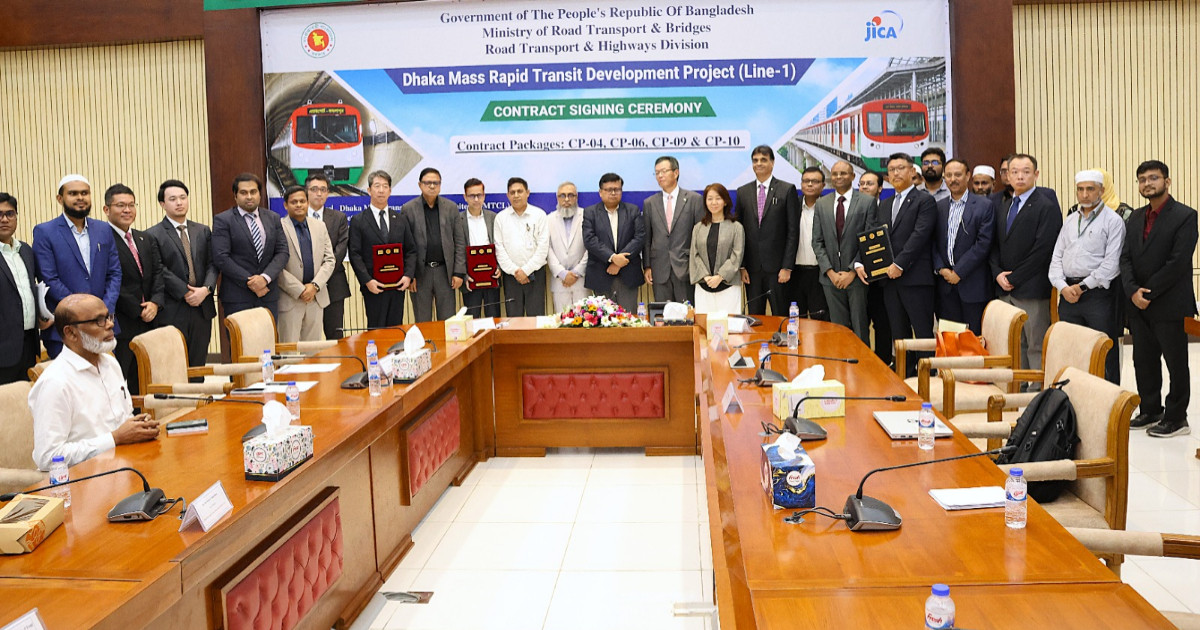
Agreements cover 9.63km of underground railway, track installation and advanced operating systems as MRT Line-1 construction moves forward
The Bangladesh government has signed four major construction contracts for the country’s first underground metro rail, covering 9.63 kilometres of tunnels and stations, railway tracks, electrical infrastructure and advanced train control systems under the MRT Line-1 project.
The agreements, signed on Wednesday, mark a fresh step in the implementation of the long-awaited project, which is expected to improve connectivity across Dhaka, reduce pressure on road transport and cut commuting time in the capital.
The contracts were signed at the Metro Rail Building in the MRT Line-6 depot area in Uttara’s Diabari. The project is being implemented by Dhaka Mass Transit Company Limited (DMTCL) with joint financing from the Bangladesh government and the Japan International Cooperation Agency (JICA).
The four packages cover two underground civil construction sections, track and electrical works, and the installation of signalling, telecommunications and other operational systems needed to run the metro service.
Four packages cover tunnels, stations and operating systems
Under Contract Package CP-04, a 4.447-kilometre underground section will be constructed from the northern end of Rampura underground station to Notun Bazar station.
Another 5.182-kilometre underground section, extending from the northern end of Nadda underground station to Airport station, will be built under CP-06.
Together, the two packages will deliver 9.629 kilometres of underground railway infrastructure.
Contract Package CP-09 covers the installation of railway tracks, including rails, turnouts, points and crossings, along with the necessary electrical facilities.
The fourth package, CP-10, involves installing the signalling and telecommunications infrastructure, platform screen doors and an Enterprise Resource Management System (ERMS).
The signalling system will use Communication-Based Automatic Train Control (CBATC) technology, while the telecommunications network will include an optical fibre-based transmission system and LTE-based radio communications.
Platform screen doors will be installed at stations, while the enterprise resource management system will support the project’s operational and management requirements.
Government presses for timely completion
Road Transport and Highways Division Secretary Dr Mohammad Ziaul Haque, who attended the signing ceremony as chief guest, said expanding the metro rail network and developing a modern, safe and environment-friendly urban transport system were among the government’s priorities.
He described MRT Line-1 as a major addition to Dhaka’s public transport infrastructure and said its implementation would open a new chapter in the country’s mass transit system.
He also thanked the Japanese government and JICA for their longstanding financial and technical cooperation in the project.
Highlighting the significance of the four contracts, the secretary urged the contractors to maintain construction quality and workplace safety while complying with labour laws and other relevant regulations.
He stressed that the work must be completed within the stipulated timeframe to prevent construction-related disruption from prolonging public suffering.
Environmental protection and the welfare of residents living near construction sites should also receive priority, he said, emphasising effective coordination among the project authority, engineers, consultants and contractors.
Japan reaffirms infrastructure support
Japanese Ambassador to Bangladesh Saida Shinichi reaffirmed Japan’s commitment to supporting Bangladesh’s infrastructure development through continued bilateral cooperation.
He praised the longstanding friendship and development partnership between the two countries and thanked the Bangladesh government for initiatives to overcome the project’s previous implementation stagnation and accelerate construction activities.
He said Japan remained interested in continuing its support for Bangladesh’s infrastructure development through mutual cooperation and partnership.
DMTCL Managing Director Md Shaugatul Alam delivered the welcome address. JICA Bangladesh Office Chief Representative Junko Takahashi, senior government officials, project consultants and representatives of the contracting companies also attended the ceremony.
Once implemented, MRT Line-1 is expected to strengthen Dhaka’s urban transport network by providing an alternative to road-based commuting and improving connections between key areas of the capital.