


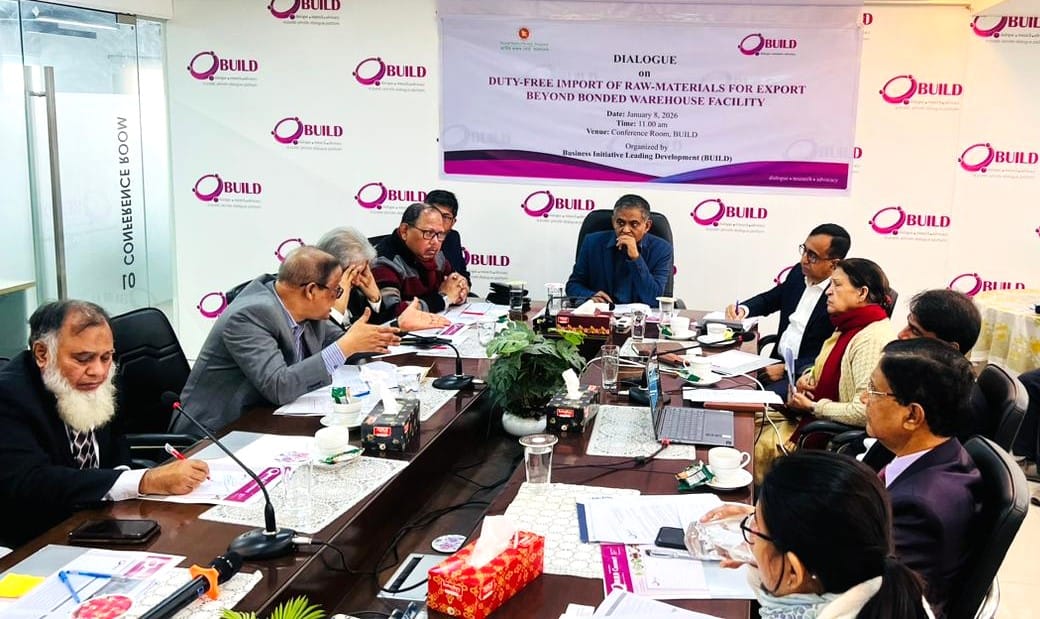
Business Initiative Leading Development (BUILD) has called for an expansion of duty-free raw material import facilities for non-bonded exporters, warning that existing rules risk constraining small and emerging exporters and limiting export diversification.
At a high-level dialogue held on Thursday titled “Duty-Free Import of Raw Materials beyond Bonded Warehouse Facility”, BUILD discussed implementation challenges surrounding the newly issued SRO 384/2025 and proposed reforms aimed at boosting export competitiveness, according to an official statement.
The event was attended by policymakers, officials from the National Board of Revenue (NBR) and private sector representatives.
Presenting the keynote paper, Md Nooruzzaman, senior research associate at BUILD, said non-bonded exporters would be required to import raw materials duty-free against a 100 per cent bank guarantee, a requirement he warned could strain cash flows as guarantees are released only after export proceeds are realised.
He noted that while exporters must meet a minimum 30 per cent value addition threshold and comply with VAT requirements, the facility currently applies to only eight sectors, including furniture, electronics and light engineering, leaving significant export potential untapped.
Comparing Bangladesh’s system with international practices such as Vietnam’s duty-suspension model and India’s deferred duty mechanism, BUILD recommended introducing more flexible financial instruments to ease exporters’ financial burden.
The study also proposed aligning SRO 384 with the forthcoming Import Policy Order 2025–28, replacing bank guarantees with alternatives such as sponsor guarantees, removing sector-specific restrictions, and fully automating the process through integration of the ASYCUDA and iVAS systems to improve efficiency and competitiveness.
The session was moderated by Dr Wasel Bin Shadat, research director at BUILD. Mohammad Naziur Rahman Miah, first secretary at the NBR, said the formulation of SRO 384 had been challenging and described it as a “living document” that could be revised over time.
He said the initial inclusion of eight sectors was based on demonstrated demand and could be expanded as more sectors come forward. He also highlighted progress in automation, noting that about 83 per cent of UP processes are already automated, with customs, BGMEA and other agencies gradually being integrated.
Industry representatives raised concerns over VAT compliance, licensing requirements and the effectiveness of duty drawback mechanisms. Md Shahidulla, senior deputy secretary of the Bangladesh Plastic Goods Manufacturers and Exporters Association (BPGMEA), said VAT authorities remain a key control point and that exporters seeking benefits must hold Import Registration Certificate (IRC) and Export Registration Certificate (ERC) licences, which differ from bonded warehouse licences.
Several speakers criticised the 100 per cent bank guarantee requirement as inconsistent with global practice and called for greater emphasis on value addition rather than procedural conditions such as UP, UD and bank guarantees. They also urged shorter lead times, phased release of guarantees, inclusion of additional sectors such as cement and agro-processing, and improved coordination among government agencies.
In her concluding remarks, BUILD chief executive officer Ferdaus Ara Begum said the organisation would compile the recommendations and submit them to the NBR to support necessary reforms. She said the aim was to ensure small and medium-sized enterprises benefit from the policy, reduce reliance on a narrow range of export products, and promote broader export diversification.