


Social safety net services in Bangladesh will no longer be delivered outside digital platforms in the future, said Prime Minister’s adviser on finance and planning, Rashed Al Mahmud Titumir.
Speaking at a roundtable in the capital on Wednesday, Titumir said the government is moving toward a fully digital system to ensure efficiency, transparency and eliminate leakages in welfare distribution.
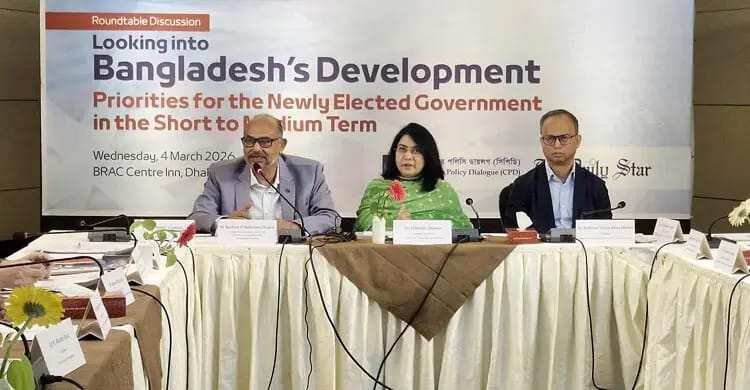
The discussion, titled “Looking into Bangladesh’s Development: Priority for the Newly Elected Government in the Short to Medium Term,” was jointly organised by the Centre for Policy Dialogue and The Daily Star at BRAC Inn Centre.
‘One citizen, one card’ vision
Titumir said the government is developing a “digital public infrastructure” where all services and databases will be interconnected through interoperability.
“Our target is ‘one citizen, one card’. This will ensure that no leakages occur in the system,” he said.
He noted that the current social protection system suffers from three major problems: exclusion errors, inclusion errors and fragmentation of programmes. These issues, he said, can be addressed through digital identification and unified service delivery.
Strengthening safety nets amid inflation
Highlighting the impact of prolonged inflation, the adviser said many middle-income households are slipping into lower-income brackets, while lower-income groups are falling below the poverty line.
In this context, he stressed the need to strengthen and gradually universalise social protection programmes. The government has already taken steps to introduce a “family card” system, aimed at enhancing women-focused social safety initiatives.
Revenue reforms and fiscal stance
On fiscal policy, Titumir said neither expansionary measures nor strict austerity would be appropriate under the current economic conditions.
“There is only one way—prevent wastage,” he said.
He also criticised overreliance on large taxpayers for revenue collection, describing dependence on LTU-based tax collection as a “chronic problem.” He called for broadening the tax base and improving the tax-GDP ratio to ensure sustainable revenue mobilisation.
Power subsidy ‘unsustainable’
Referring to Tk 60,000 crore in subsidies in the power sector, Titumir termed the burden “unsustainable.” He suggested renegotiating contracts, reducing system losses and strengthening domestic capacity to ease fiscal pressure.
The event was moderated by CPD Executive Director Dr Fahmida Khatun, with welcome remarks from Daily Star Editor Mahfuz Anam. Business leaders and policy experts, including representatives from BGMEA, BTMA, DCCI and BASIS, also participated in the discussion.