


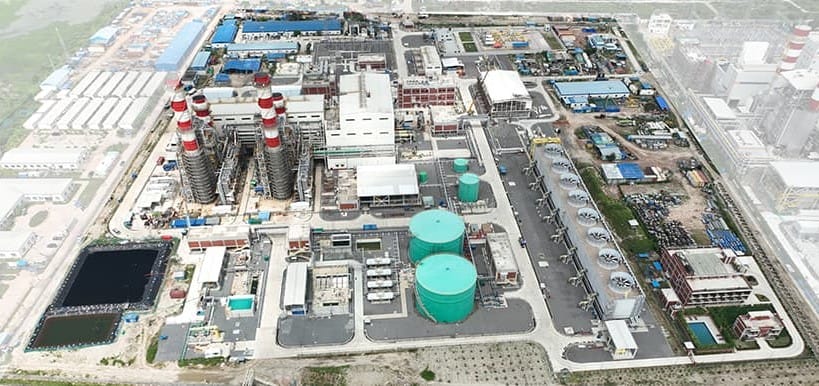
A Japanese-backed JERA power plant in Bangladesh has emerged as a growing financial liability, with soaring tariffs and mounting unpaid bills raising fresh concerns over the country’s energy planning and policy decisions.
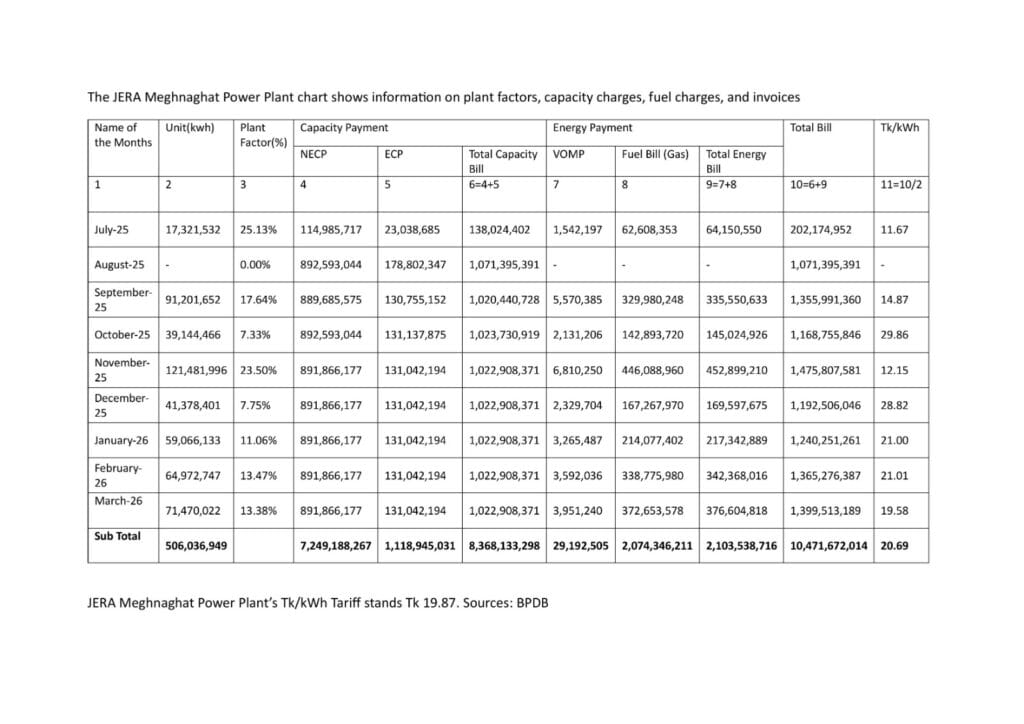
The 718MW JERA Meghnaghat Power Plant, financed by institutions including the Asian Development Bank (ADB) and the Japan Bank for International Cooperation (JBIC), has seen its average generation tariff rise to Tk19.87 per kilowatt-hour during the eight months since it began commercial operation on 28 July, 2025.
The plant’s output has remained far below capacity because of an acute natural gas shortage.
Its load factor peaked at just 25% in its first month and has since failed to recover. Generation costs have fluctuated sharply, rising from Tk11.67 per unit in July 2025 to as high as Tk29.86 in October 2025, before easing to Tk19.58 in March 2026.
Despite limited production, the plant has continued to receive capacity payments. In August 2025 alone, it was paid Tk107.13 crore without generating any electricity.
What JERA Says
According to a letter sent in March 2026 by JERA Meghnaghat Power Limited (JMPL) to the state-owned Bangladesh Power Development Board (BPDB), unpaid invoices have reached approximately Tk951 crore.
The company said it had issued eight invoices totalling Tk1,053 crore under its long-term power purchase agreement, of which only Tk102 crore had been settled. Around Tk697 crore is already overdue, with some payments delayed by nearly six months.
JMPL warned that it faces a “high risk of default” on obligations to lenders, suppliers and staff.
A loan repayment of $37 million (Tk454 crore) is due on 25 June, 2026, and the company said it requires at least Tk574 crore by mid-June to meet its commitments.
Policy Tensions and External Pressure
The project has been controversial from the outset. Although approved during the tenure of the Awami League government, its commercial operation was initially delayed over concerns about fuel supply.
Officials said international lenders, including the ADB and the Japan International Cooperation Agency (JICA), later pressed the interim administration to allow the plant to begin operations despite continuing gas shortages.
Critics argue that the decision has added to Bangladesh’s fiscal strain, particularly as the country faces rising fuel import costs linked to global instability.
Dispute Raises Investor Concerns
The dispute has exposed deeper structural weaknesses in the country’s power sector, where capacity payments to idle plants and delayed settlements have become increasingly common.
JMPL warned it may escalate the matter to the government and seek remedies under contractual agreements if payments are not made promptly.
It also said a required Letter of Credit from BPDB, intended to guarantee payments, remains outstanding.
Experts Criticise Project Planning
Transparency advocates and energy specialists have sharply criticised the project.
Iftekharuzzaman, executive director of Transparency International Bangladesh (TIB), described any pressure to settle payments in exchange for budgetary support as “a form of corruption” and called for an amicable resolution given the plant’s limited ability to generate electricity.
Energy expert and researcher Professor Dr. Izaj Hossain questioned JERA’s decision to acquire the plant from India’s Reliance despite known gas constraints, suggesting capacity payments should be renegotiated.
Meanwhile, Professor Dr. M Shamsul Alam, energy advisor at Consurmers Association of Bangladesh (CAB), described the plant as “an example of systemic failure,” criticising authorities for approving new gas-fired capacity despite forecasts of fuel shortages since 2018.
A Test for the Sector
The controversy comes as Bangladesh grapples with rising energy costs and growing pressure on public finances. The current government has already indicated that electricity tariffs may rise again in the coming months.
For international lenders and investors, the outcome of the dispute may serve as a key test of the country’s reliability as an investment destination.
For now, the JERA Meghnaghat plant stands as a costly symbol of the risks associated with poorly aligned energy planning and financing.
According to Rezaul Karim, chairman of the Bangladesh Power Development Board (BPDB), the country has around 12,500 MW of gas-fired power generation capacity, but only about 5,000 MW is currently operational due to gas shortages.
“We have already raised concerns with the Asian Development Bank, questioning why the agency invested in a JERA power plant despite the known unavailability of gas,” he told Just Energy News.