


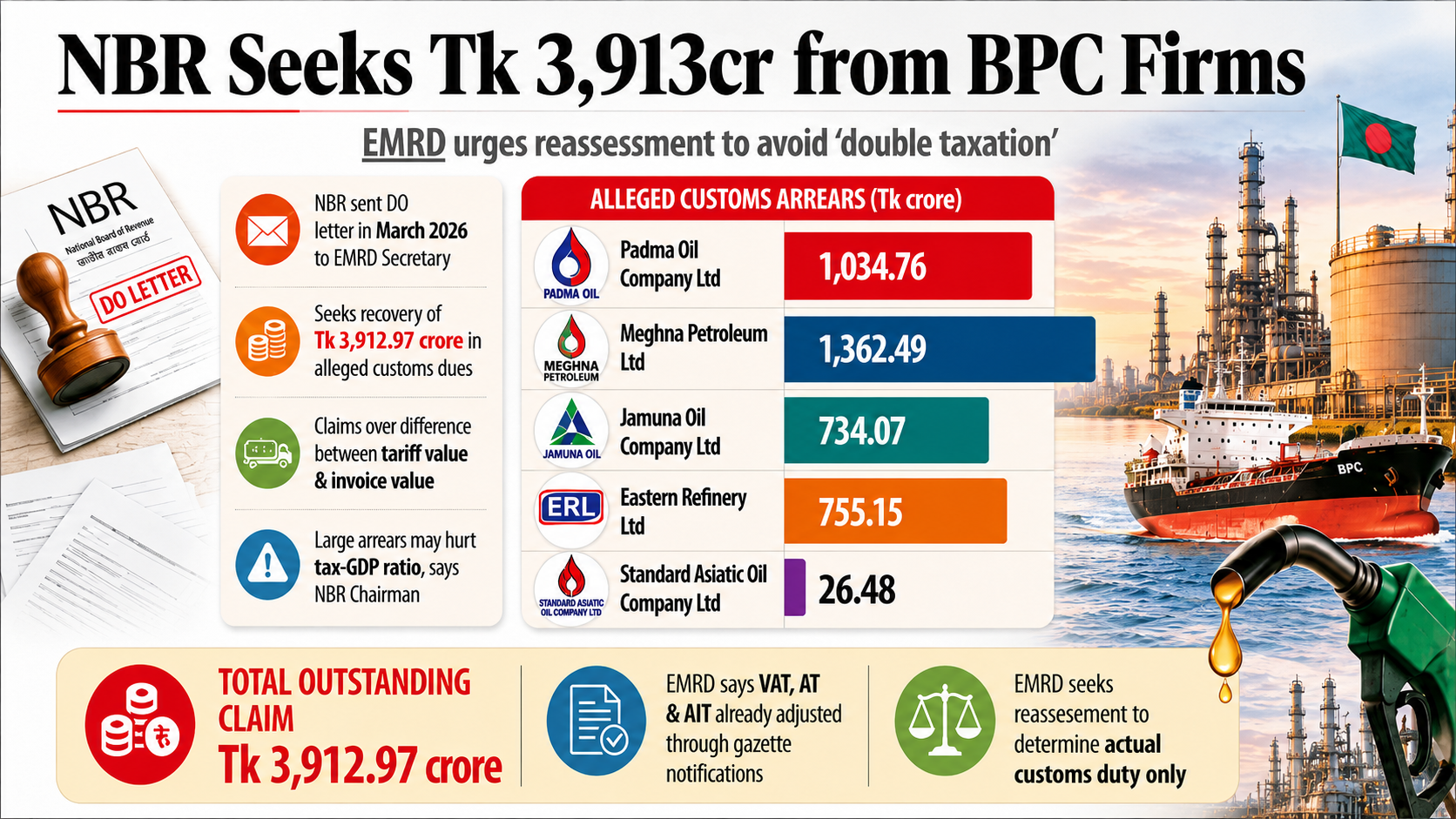
The National Board of Revenue (NBR) has sought to recover nearly Tk3,913 crore in alleged unpaid customs duties from subsidiaries of the state-owned Bangladesh Petroleum Corporation (BPC), prompting the Energy and Mineral Resources Division (EMRD) to request a reassessment of the claims to avoid what it describes as “double taxation.”
In a demi-official (DO) letter sent to the EMRD secretary Mohammad Saiful Islam in March 2026, the NBR chairman Md. Abdur Rahman Khan sought urgent intervention to realise Tk3,912.97 crore in outstanding customs dues from five BPC subsidiaries over fuel imports made under bonded warehouse facilities.
According to the letter, Padma Oil Company Ltd, Meghna Petroleum Ltd, Jamuna Oil Company Ltd, Eastern Refinery Ltd and Standard Asiatic Oil Company Ltd paid duties and taxes on tariff values rather than the higher invoice values when releasing imported petroleum products.
The NBR said customs authorities subsequently assessed claims based on the difference between tariff values and invoice values.
The alleged outstanding amounts include Tk1,362.49 crore from Meghna Petroleum, Tk1,034.76 crore from Padma Oil, Tk755.15 crore from Eastern Refinery, Tk734.07 crore from Jamuna Oil, and Tk26.48 crore from Standard Asiatic Oil Company. The claims relate to petroleum fuel imports through 146 mother vessels covered by 695 bills of entry.
The NBR chairman noted that customs authorities had continued releasing imported fuel consignments on time, considering the strategic importance of energy security and the government-owned nature of the imports.
However, he warned that such a large volume of unrealised revenue could adversely affect the country’s tax-to-GDP ratio.
The letter also linked the revenue recovery drive to the government’s fiscal needs, stating that additional revenue is required to support public welfare programmes, including family cards, farmer cards and canal excavation projects.
“In the above context, I request your kind initiative to provide the necessary instructions to deposit the amount due to the government treasury,” the DO letter stated.
In response, Rafiqul Islam, senior assistant secretary of the EMRD sent a separate DO letter to the NBR chairman seeking a reassessment of the customs claims imposed on BPC for imported fuel products.
Citing a BPC memorandum dated 27 April, 2026, the EMRD argued that the government had already collected the applicable taxes and duties through the existing tariff-based pricing mechanism and subsequent VAT adjustments.
According to the ministry, BPC paid 10% customs duty, 15% VAT, 5% advance tax (AT), and 2% advance income tax (AIT) on tariff values for imported petroleum products, including diesel, octane, furnace oil, Jet A-1 and crude oil.
The EMRD said VAT and the Motor Spirit Consumption Tax (MUSC) at the trader level, along with VAT and advance tax paid during imports, had already been adjusted through treasury challans submitted to the Customs, Excise and VAT Commissionerate in Chattogram.
It added that advance income tax paid at the import stage had also been adjusted through BPC’s final income tax returns.
“As a result, the government has collected full revenue in this case and BPC has no arrears in VAT, Advance Tax and Advance Income Tax sectors,” the letter stated.
The EMRD warned that including VAT, AT and AIT in customs claims calculated on invoice values would effectively amount to double taxation.
The ministry also referred to recommendations made by a customs committee, which reportedly suggested a separate verification process to determine actual unpaid customs duty while excluding taxes already adjusted under gazette-based pricing mechanisms.
Based on those recommendations, the EMRD requested the NBR to determine the actual outstanding customs duty on invoice values while excluding VAT, advance tax and advance income tax already paid at the import stage.
Officials familiar with the matter said the dispute stems from differences between invoice values and tariff values used to assess taxes on fuel imports before June 2025, when domestic fuel prices were fixed on the basis of tariff values.
Energy sector insiders said the issue could have significant financial implications for BPC and its subsidiaries at a time when Bangladesh is already facing elevated fuel import costs and pressure on foreign exchange reserves.