


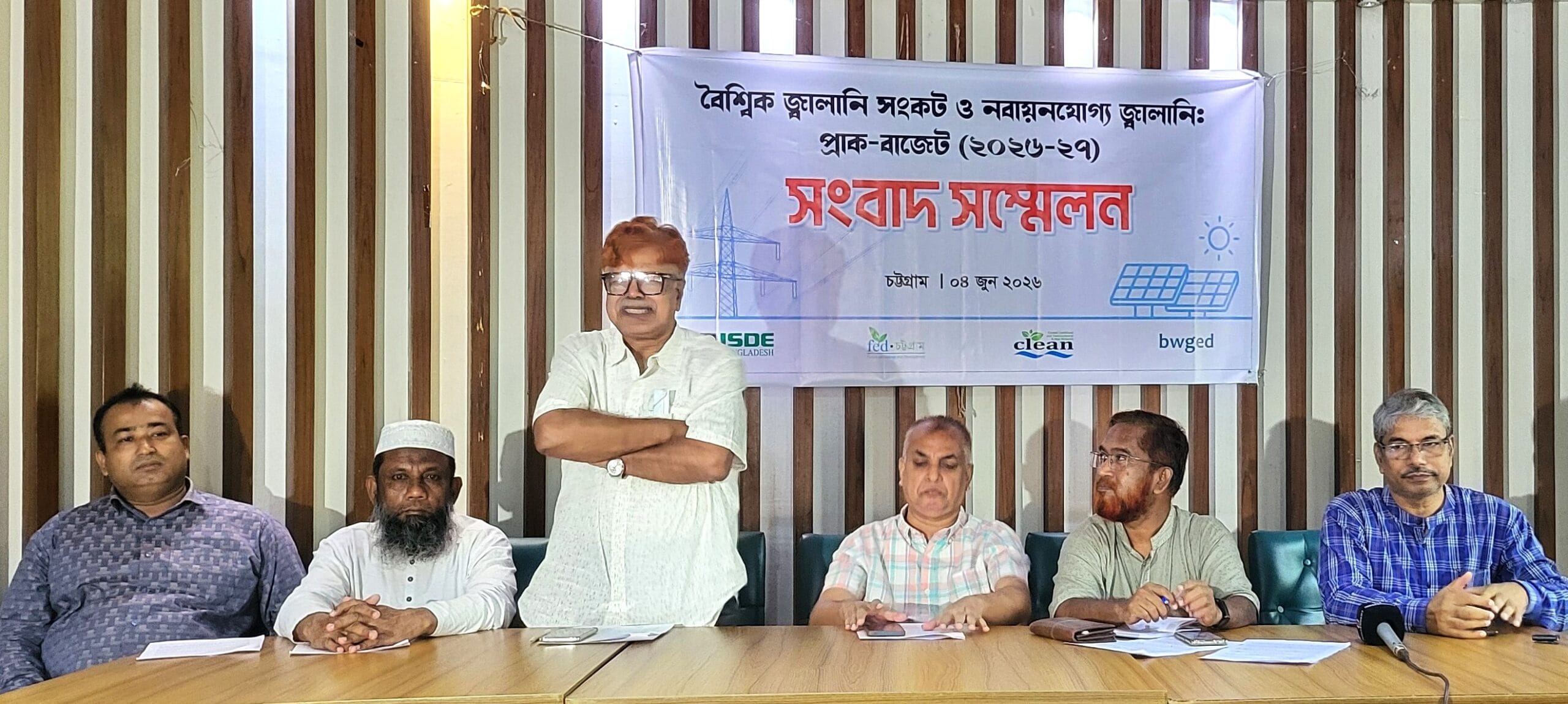
Environmental and energy advocacy groups in Bangladesh have urged the government to prioritise renewable energy in the upcoming 2026–27 national budget, warning that continued dependence on imported fossil fuels is exposing the country to mounting economic and energy security risks.
The call came at a pre-budget press conference titled “Global Energy Crisis and Renewable Energy”, organised in Chattogram on Thursday by the Campaign for Energy and Environment (CLEAN), ISDE Bangladesh and the Bangladesh Working Group on Ecology and Development (BWGED).
Speakers at the event said volatility in global oil, liquefied natural gas (LNG) and coal markets — compounded by geopolitical tensions — has sharply increased electricity generation costs and subsidy pressures in import-dependent countries such as Bangladesh, contributing to a rising cost of living for consumers.
Professor Dr Khaled Misbahuzzaman, president of Poribesh Protibesh Forum-Chattogram and a professor at the Institute of Forestry and Environmental Sciences at the University of Chittagong, said Bangladesh had “no alternative” to renewable energy if it wanted to ensure long-term energy security and address the impacts of climate change.
“Fossil fuel-dependent development is becoming increasingly risky for the environment, economy and public health,” he said, calling for greater investment in renewable energy research, innovation and technology development in the national budget.
He also stressed the importance of universities and research institutions in developing domestic technologies and skilled manpower for the sector.
SM Nazer Hossain, vice-president of the Consumers Association of Bangladesh (CAB) central committee and executive director of ISDE Bangladesh, said fluctuations in international fuel prices were repeatedly placing pressure on Bangladesh’s economy.
He criticised what he described as long-standing weaknesses in power sector planning, unnecessary expenditures and import-dependent policies, arguing that ordinary consumers were being forced to bear the burden of high electricity costs.
“To ensure energy security, Bangladesh must increase investment in renewable energy while also addressing inequalities in electricity distribution,” he said, adding that structural reforms were urgently needed within the Rural Electrification Board (REB) and the Palli Bidyut Samities (PBSs) to ensure reliable electricity supply in rural areas.
Hossain said recent assessments of power supply conditions ahead of Eid-ul-Azha had revealed continuing disparities between urban and rural electricity services, with many grid-connected rural areas still suffering prolonged outages.
Speakers noted that Bangladesh’s power sector remains heavily dependent on gas, oil and coal, making the economy highly vulnerable to fluctuations in global fuel markets. They warned that rising capacity payments, fuel import costs and subsidy burdens were creating long-term fiscal pressures.
They also highlighted persistent weaknesses in rural electricity infrastructure, citing manpower shortages and management limitations within the REB and PBSs. According to the speakers, even minor storms and rainfall often disrupt electricity supply in rural areas for extended periods.
Despite Bangladesh’s significant renewable energy potential, speakers said the sector still accounts for only a small share of national electricity generation.
They argued that initiatives such as rooftop solar systems, solar irrigation, agrivoltaics, floating solar projects, net metering and community-owned energy systems could help improve energy security, reduce foreign currency expenditure, create jobs and support environmental protection.
The conference presented an 11-point set of recommendations for the 2026–27 budget, including increased budgetary allocation for renewable energy, reduced taxes and duties on solar equipment, easier access to green financing, expansion of net metering, greater use of solar energy in agriculture, discouraging new fossil fuel-based projects and modernising the national power grid.
The proposals also called for community-based energy transition programmes, reforms of the REB and PBS systems, the creation of a renewable energy research fund and a clear budget-backed roadmap to significantly increase the share of renewable energy in the country’s power mix by 2030.
Environmental activists, energy experts, students, renewable energy entrepreneurs, civil society representatives and journalists attended the event. Speakers concluded that renewable energy must be placed at the centre of Bangladesh’s national development strategy to ensure economic stability, energy security and a climate-resilient future.