


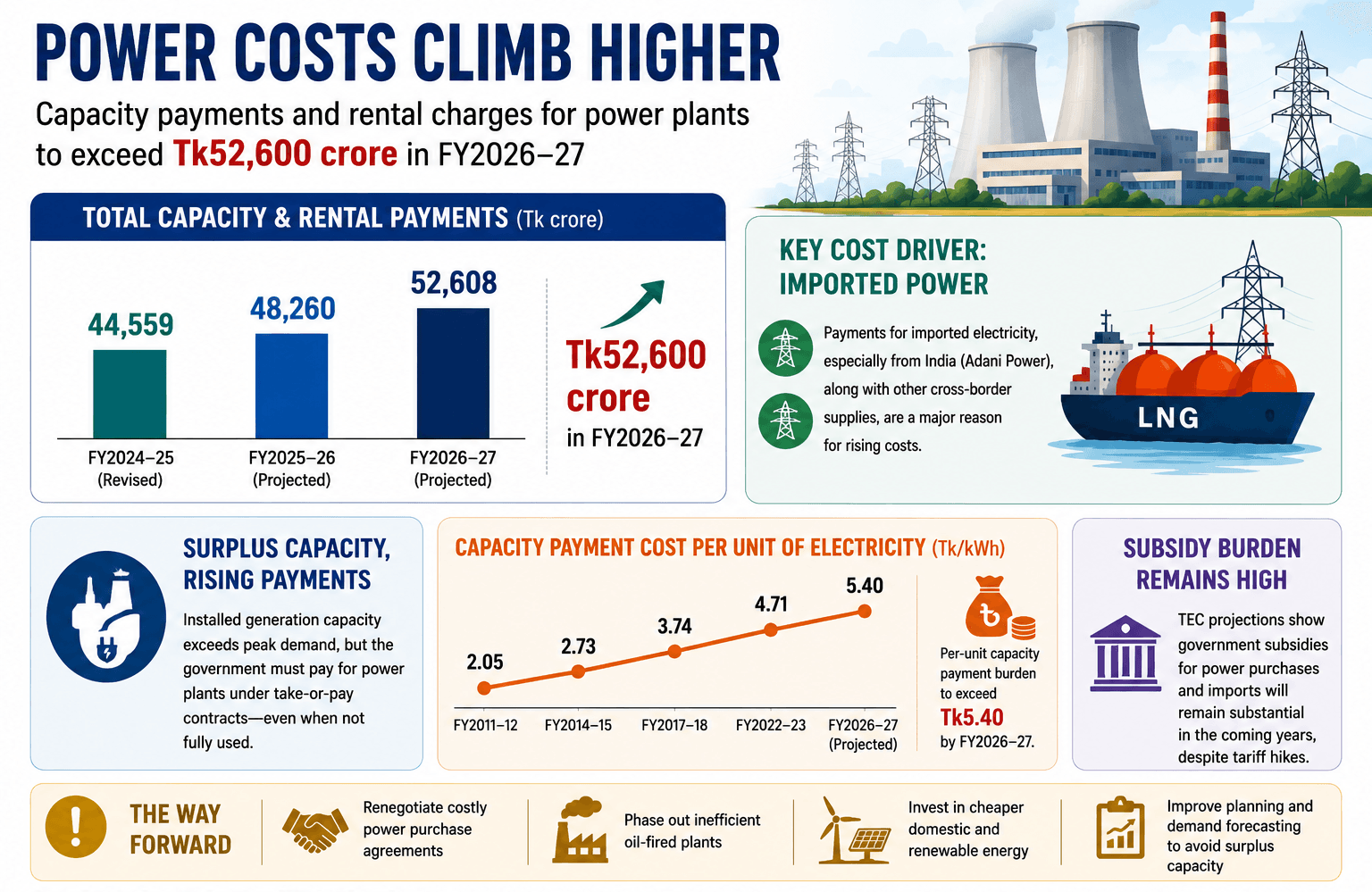
Spending on capacity payments and rental charges for power plants is projected to exceed Tk52,608 crore in fiscal year 2026-27, highlighting the growing financial burden of maintaining surplus generation capacity and imported electricity supplies.
Data compiled by Bangladesh Energy Regulatory Commission’s Technical Evaluation Committee (TEC) show that total capacity and rental payments are expected to rise from Tk44,559 crore in the revised budget for FY2024-25 to Tk48,260 crore in FY2025-26 and further to Tk52,608 crore in FY2026-27.
The figures underscore the power sector’s increasing reliance on fixed capacity payments — charges paid to power producers regardless of whether electricity is actually dispatched.
Imported power emerges as a major cost driver
A significant portion of the increase is linked to imported electricity, particularly supplies from India.
Payments for power imported from Adani Power’s Jharkhand plant are expected to remain among the largest components of Bangladesh’s import-related electricity costs.
Since the plant began commercial operations, payments associated with the project have risen sharply, making it one of the costliest sources of imported electricity in the national grid. The government will pay Tk 5,357 crore to the Adani-sponsored plant in the coming fiscal year 2026-27.
Bangladesh also continues to incur substantial costs for electricity imported through high-voltage direct current (HVDC) interconnections with India, power purchases from Tripura, cross-border imports from private Indian producers, and newer regional trading arrangements involving Nepal and Bhutan.
The cost of imported electricity has increased significantly over the past decade as Bangladesh turned to regional power trade to address supply shortages and support growing demand.
Capacity payments rise despite surplus generation
Energy sector experts say the rising expenditure reflects a structural imbalance in the country’s power sector, where installed generation capacity has expanded far faster than demand.
Over the past 15 years, then ousted Awami Leage government approved numerous rental and quick-rental oil-fired plants, LNG-based facilities and large private-sector projects under long-term contracts that guarantee fixed payments to operators.
Although the country’s installed generation capacity now exceeds peak demand, the government remains obligated to make payments under take-or-pay agreements.
TEC data show that the capacity payment burden per unit of electricity has also risen steadily, from around Tk2.05 per kilowatt-hour in FY2011-12 to a projected Tk5.40 per unit in FY2026-27.
Mounting pressure on electricity tariffs
The growing financial burden comes as Bangladesh has repeatedly increased electricity tariffs at both wholesale and retail levels in an effort to reduce subsidy requirements.
Officials argue that higher tariffs have become necessary because of rising fuel import costs, foreign exchange pressures and escalating capacity payment obligations.
Energy economists, however, caution that consumers are increasingly bearing the cost of idle generation capacity rather than actual electricity consumption.
They note that many power plants remain underutilised due to lower-than-expected industrial demand, fuel supply constraints and transmission bottlenecks, while fixed contractual payments continue regardless of plant utilisation.
Subsidy burden remains elevated
TEC projections indicate that government subsidies for electricity generation, imports and purchases will remain substantial in the coming years despite repeated tariff hikes.
Analysts say Bangladesh may eventually need to renegotiate costly power purchase agreements, phase out inefficient oil-fired plants and accelerate investment in cheaper domestic and renewable energy sources to ease mounting fiscal pressure on the power sector.
BERC Chairman Jalal Uddin said on June 3, 2026, that capacity payments determine the cost of power generation.
“Therefore, BERC will issue separate instructions to power plants regarding adjustment of capacity payments to help minimise subsidies in the power sector, in line with the recommendations of the respective committees,” he said.