


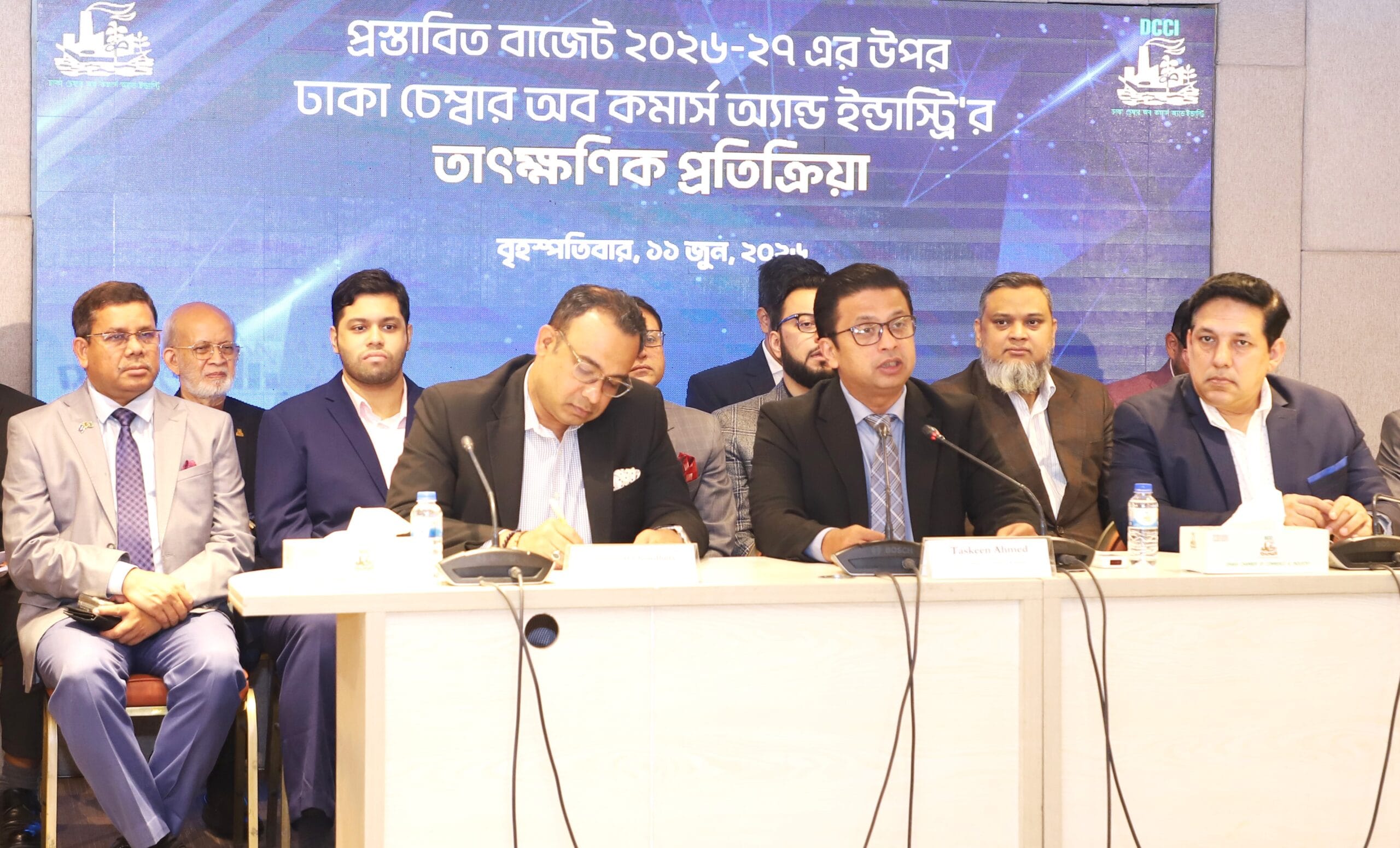
The proposed national budget for Bangladesh for the financial year 2026–27 has been described as broadly business- and investment-friendly by Dhaka Chamber of Commerce & Industry (DCCI) President Taskeen Ahmed, who cautioned that its success will depend on strong revenue mobilisation and effective implementation of reforms.
Speaking at DCCI’s initial reaction event held at its auditorium in Dhaka on 11 June 2026, Ahmed said the budget’s direction appears supportive of private sector growth, but achieving its ambitious targets will be challenging under current economic conditions.
Budget size and development spending
The proposed budget stands at BDT 9,38,000 crore, marking a 19.04% increase compared with the previous fiscal year. The government’s revenue growth target of 30.34% was described as highly ambitious, while concerns were raised that increased reliance on borrowing could place pressure on the banking sector and potentially restrict private credit growth.
At the same time, the proposed Annual Development Programme (ADP) of BDT 3,00,000 crore—30% higher than the previous year—was welcomed. However, the DCCI highlighted weak implementation performance, noting that the current fiscal year’s ADP execution rate stands at just 36.19%, underscoring long-standing capacity constraints.
Tax and compliance reforms
The chamber welcomed several tax-related measures, including the recognition of withholding tax as advance tax, reduced withholding tax on industrial raw materials to 4%, and a 0.5% rate on 60 essential commodities. The introduction of a five-year advance tax framework and incentives for healthcare, renewable energy and electric vehicle sectors were also positively received.
DCCI supported efforts to broaden the tax base without increasing VAT rates, alongside the introduction of quarterly online VAT filing. However, it criticised the decision to keep the tax-free income threshold unchanged amid inflationary pressures, and the top personal income tax rate fixed at 35%. It recommended raising the tax-free threshold to BDT 500,000.
The reduction of customs duties on point-of-sale (POS) machines and the removal of advance tax on their import were described as important steps towards promoting cashless transactions.
CMSME sector support
Support for cottage, micro, small and medium enterprises (CMSMEs) was another key highlight. The allocation of BDT 5,000 crore under a BDT 60,000 crore Bangladesh Bank stimulus package was welcomed.
The DCCI also praised the exemption of turnover tax for businesses with annual turnover up to BDT 50 lakh, and up to BDT 70 lakh for women entrepreneurs and persons with disabilities. The introduction of small e-loans of up to BDT 50,000 was also seen as a positive step.
It further suggested introducing a simplified flat turnover tax structure and a separate VAT return format to ease compliance for small businesses.
Investment climate and industrial policy
Measures aimed at improving the investment climate were broadly supported, including tax reductions on electric vehicles, mobile phones, refrigerators, air conditioners and other technology products.
Proposals to establish Free Trade Zones were also welcomed as a potential boost to trade and investment.
In addition, customs duty and VAT incentives for local production of electric buses, trucks and e-bikes were praised, alongside support for vendor industries. The DCCI also highlighted key governance reforms, including plans for a single-window service system, faster processing of work permits and investor visas, and reductions in withholding tax on foreign loan interest from 20% to 10%.
Energy and power sector concerns
In the energy sector, the chamber welcomed VAT exemptions on electric vehicles until 2030, reduced advance income tax at registration, and zero-duty import facilities for EV charging infrastructure.
However, it warned that proposed measures for gas exploration and well drilling were insufficient given rising demand. It also called for a long-term, clearly defined energy pricing framework to avoid inefficiencies associated with short-term subsidies.
The event was also attended by DCCI Senior Vice President Razeev H. Chowdhury, Vice President Md. Salem Sulaiman, and other board members.