


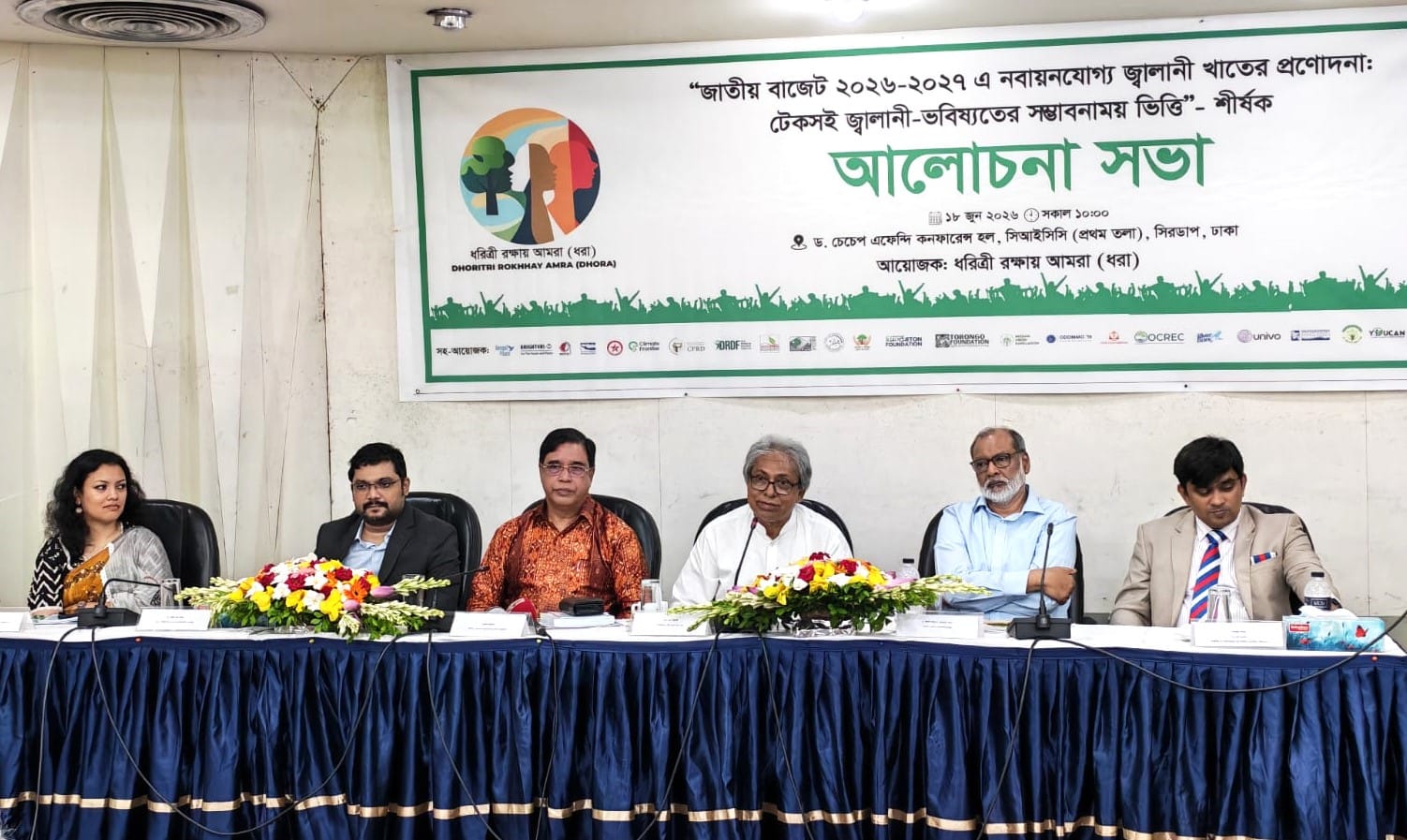
Bangladesh’s latest budget incentives for the renewable energy sector could strengthen the country’s energy security, reduce dependence on fossil fuels and accelerate the transition to a sustainable energy future, but a clear and time-bound roadmap is essential to realise these goals, speakers said at a discussion in Dhaka on Thursday.
The discussion, titled “Renewable Energy Incentives in the National Budget 2026-27: A Promising Foundation for a Sustainable Energy Future,” was organised by environmental and climate advocacy group Dhoritri Rokkhay Amra (DHORA) at the CIRDAP auditorium in the capital.
The event was attended by the Chairman of the Bangladesh Energy Regulatory Commission (BERC), Jalal Ahmed, as chief guest. The session was chaired by DHORA Co-Convener M.S. Siddiqui, while the keynote paper was presented by Shafiqul Alam, Lead Energy Analyst at the Institute for Energy Economics and Financial Analysis (IEEFA).
Speaking at the event, Ahmed said expanding renewable energy is no longer only an environmental or climate imperative for Bangladesh but also a strategic necessity for ensuring energy security, conserving foreign exchange reserves and maintaining export competitiveness.
He noted that Bangladesh’s export-oriented garment industry would need to significantly increase its use of renewable energy by 2030 to retain market access in the European Union. According to Ahmed, the government’s target of generating 7,000 megawatts of renewable energy by 2030 remains achievable if budgetary incentives and policy support are implemented effectively.
He stressed the need for a comprehensive roadmap, removal of policy barriers, stronger investment facilitation and a shift in institutional attitudes to accelerate the country’s energy transition.
M.S. Siddiqui said renewable energy expansion would require not only government initiatives but also greater private-sector investment and innovative business models. He called for stronger public engagement, economic valuation of environmental benefits and removal of barriers to technology adoption and investment.
Presenting the keynote paper, IEEFA’s Shafiqul Alam said renewable energy currently accounts for only 2.3% of Bangladesh’s electricity generation, compared with a global average of around 34%.
He warned that the country’s dependence on imported energy has risen from 47.7% to 62.5%, creating significant challenges for long-term energy security.
Alam said the FY2026-27 budget’s proposed duty and tax exemptions on solar panels, inverters, lithium batteries and other renewable energy equipment would provide a major boost to the sector. The measures could reduce rooftop solar installation costs by between 15% and 20%, encouraging wider adoption across industrial and commercial users.
Drawing on experiences from countries including Pakistan, he said rooftop solar systems can significantly reduce reliance on imported energy when supported by appropriate policies and investment frameworks.
However, he stressed the need for a clear roadmap covering battery energy storage systems, financing under Renewable Energy Service Company (RESCO) models, participation of small entrepreneurs and the development of quality installation and maintenance standards.
DHORA Member Secretary Sharif Jamil said Bangladesh could build a secure and renewable energy-based future if the government maintained its positive policy stance and ensured effective implementation. He also called for faster deployment of renewable energy projects on unused government land and increased international cooperation and investment.
Among the special guests were Professor Dr Mohammad Tamim, Vice-Chancellor of Independent University, Bangladesh; Professor Emeritus Dr Ijaz Hossain of BUET; Engineer Md Mujibur Rahman, Director (Renewable Energy) at SREDA; Professor Dr Sakib Bin Amin of North South University; Tanzina Dilshad, Programme Manager for Energy and Environment at the European Union Delegation to Bangladesh; and Abul Kalam Azad, Coordinator of the Just Energy Transition Network Bangladesh.
Speakers highlighted the need for a more investment-friendly environment, long-term policy stability, grid modernisation, greater investment in energy storage technologies and wider deployment of renewable energy solutions at the local level.
They also emphasised the importance of making incentive schemes more accessible to small and medium-sized enterprises, households and local service providers.
The discussion was attended by energy experts, researchers, academics, development practitioners, students, environmental activists and media representatives.
Concluding the event, speakers said the renewable energy incentives announced in the FY2026-27 national budget could play a significant role in enhancing Bangladesh’s energy security and reducing import dependence. However, they cautioned that successful implementation would depend on a clear roadmap, skilled workforce development, research and innovation, and further policy reforms.
They also called for increased public and private investment in rooftop solar systems, battery energy storage and electric vehicles, alongside coordinated efforts by the government, development partners, businesses and civil society to ensure a just, inclusive and sustainable energy transition.