


Bangladesh’s proposed national budget for FY2026-27 has increased funding for the agriculture sector, but experts have cautioned that persistent challenges facing farmers could limit the impact of the additional spending unless implementation and support mechanisms are strengthened.
The concerns were raised at a roundtable discussion in Dhaka on Wednesday, where policymakers, agricultural economists and industry representatives examined the implications of the proposed budget for Bangladesh’s crop agriculture sector.
Participants said farmers continue to struggle with rising input costs, post-harvest losses, climate-related risks, inadequate market access and weak implementation of development programmes, despite increased public investment in agriculture.
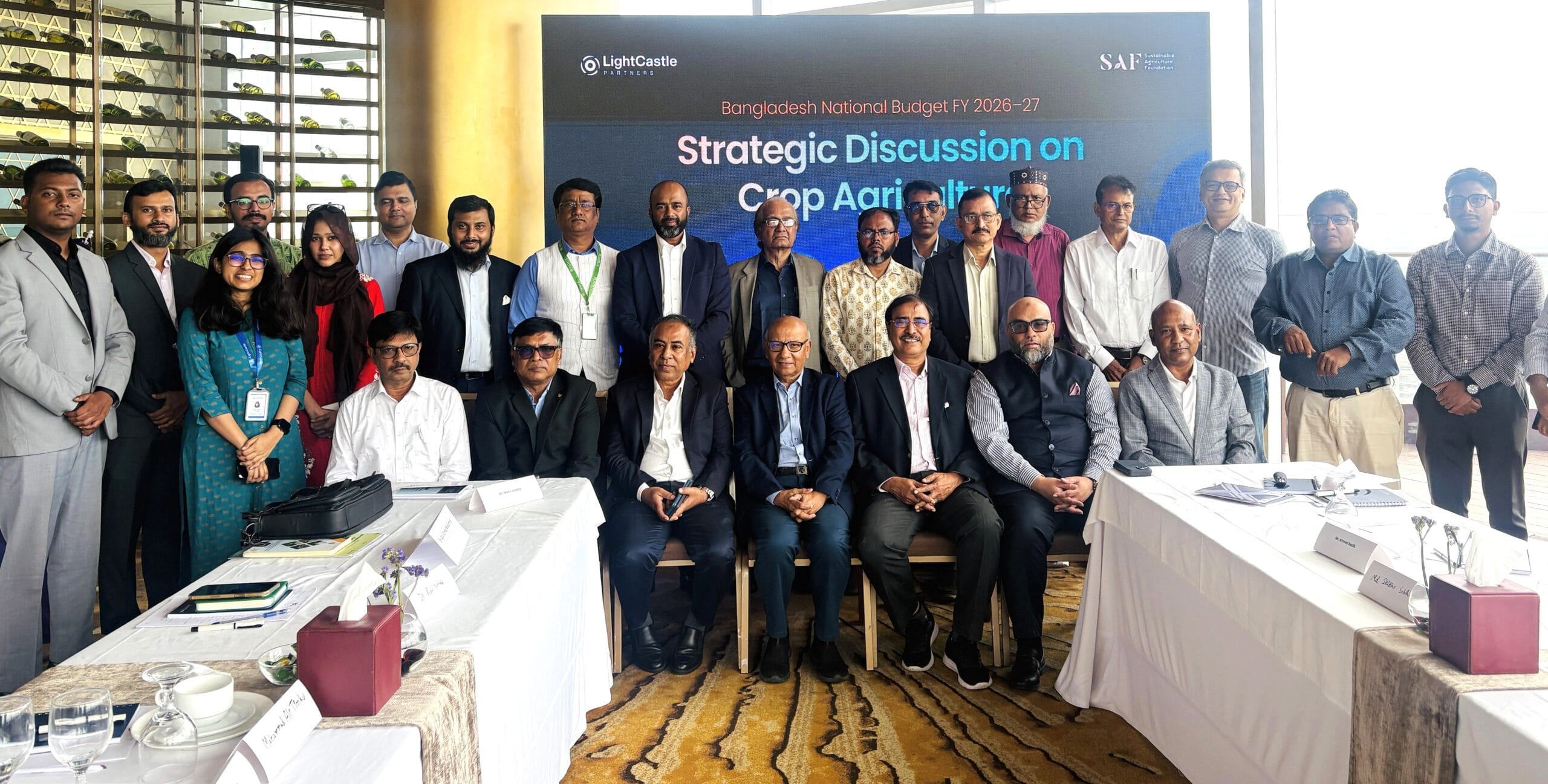
The discussion, titled “National Budget FY2026-27: Strategic Discussion on Crop Agriculture”, was jointly organised by consultancy firm LightCastle Partners and the Sustainable Agriculture Foundation (SAF) Bangladesh at a hotel in the capital’s Gulshan area.
Agriculture remains a cornerstone of Bangladesh’s economy, underpinning food security, rural employment, agro-industrial development and export growth. According to figures presented at the event, the value of agricultural production grew at an average annual rate of 3.54% between 1999 and 2019.
However, speakers noted that agriculture’s contribution to Bangladesh’s gross domestic product has fallen from nearly 38% in the 1970s to 11.2% today, reflecting broader structural changes in the economy.
A keynote presentation by Zeeshan Abedin, Social Research and Impact Adviser at LightCastle Partners, showed that the proposed FY2026-27 budget allocates Tk 28,881 crore to the Ministry of Agriculture, including Tk 7,946 crore for development expenditure. The allocation marks an increase from the original Tk 27,224 crore allocated in FY2025-26.
The government has also proposed Tk 17,001 crore in agricultural subsidies, covering fertiliser support and other assistance programmes.
The presentation highlighted a significant increase in development spending, with greater emphasis on water management, irrigation systems, post-harvest infrastructure and farmer support through the expansion of the Farmer Card programme. Tax reductions on agricultural inputs have also been proposed to ease production costs.
Despite these measures, participants expressed concern over declining implementation rates of development projects. While Annual Development Programme (ADP) implementation reached 93% in FY2022-23 and 95% in FY2023-24, it fell sharply to 60% in FY2024-25 and 62% in FY2025-26.
Md Habibullah, Director of the Administration and Finance Wing at the Department of Agricultural Extension (DAE), said government initiatives such as the Farmer Card pilot programme and investments in post-harvest infrastructure demonstrate a strong commitment to supporting farmers and modernising the sector.
Anwar Faruque, a board director of Bangladesh Krishi Bank and former Agriculture Secretary, welcomed several measures in the proposed budget, including lower duties on essential commodities, tax relief on fertiliser inputs and the expansion of the Farmer Card scheme.
However, he stressed that the effectiveness of these measures would ultimately depend on whether benefits reach farmers directly and help reduce production costs.
Other speakers argued that Bangladesh must strengthen programme implementation, improve climate resilience, modernise agricultural markets and expand post-harvest management systems to ensure sustainable growth.
They also called for greater support for smallholder farmers, who continue to face disproportionate risks from climate change, volatile input prices and market inefficiencies.
The roundtable brought together more than 30 policymakers, agricultural scientists, economists, entrepreneurs and development practitioners, who agreed that budgetary allocations alone would not be sufficient unless accompanied by effective execution and targeted support for farmers.