


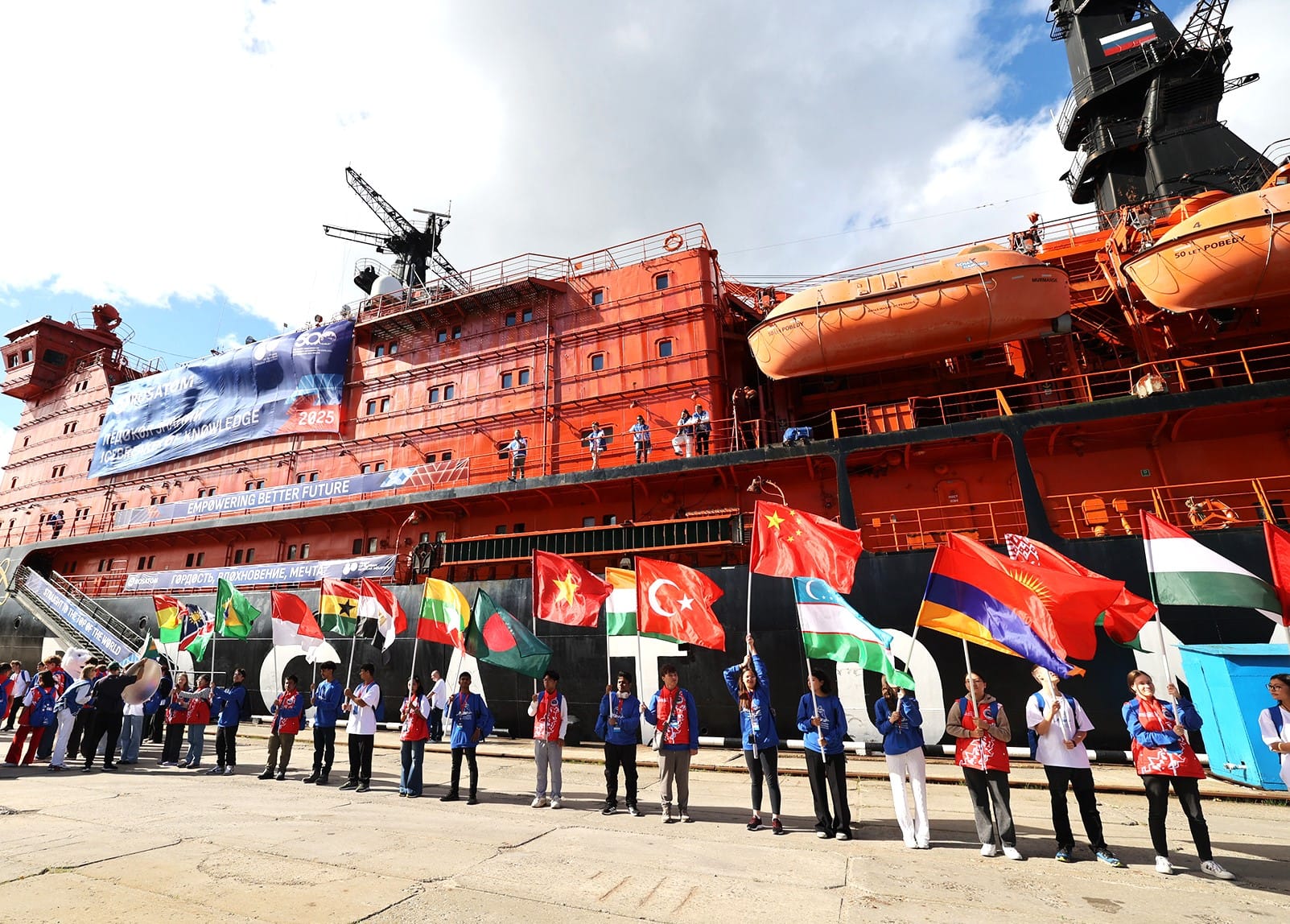
A Bangladeshi secondary school student has won a place on an Arctic expedition to the North Pole after emerging victorious in an international science competition organised by Russia’s state nuclear energy corporation, Rosatom.
Md. Malekul Salehin Prottoy, a Year 10 student at Rajshahi Cadet College, was selected as one of the winners of the seventh edition of Rosatom’s Icebreaker of Knowledge educational programme, beating nearly 5,000 contestants aged 14 to 16 from 22 countries.
The winners were announced on 23 June at Moscow’s Museum of Atomic Energy. Prottoy is set to join students from around the world on an expedition aboard the 50 Let Pobedy (“50 Years of Victory”), the world’s largest nuclear-powered icebreaker, which will travel to the North Pole in August.
The competition consisted of three stages, including a science quiz covering nuclear energy, Arctic exploration and emerging technologies, educational webinars led by experts, and a final presentation on the theme, How Nuclear Technologies Are Changing the World Today. Finalists were evaluated by an international panel of specialists in science, education, the nuclear industry and Arctic research.
“I still find it hard to believe that this opportunity has become a reality for me,” Prottoy said after the announcement.
“Taking part in such an expedition is not just a journey, but a chance to step beyond the familiar and see how vast the world of science can be. It is a truly inspiring experience, one that I want to turn into motivation for the future.”
The expedition is designed to bring together high-achieving students from different countries to learn about the Arctic, nuclear technology and scientific research. Participants will take part in lectures, workshops, scientific experiments and interactive sessions with experts while experiencing Rosatom’s fleet of nuclear-powered icebreakers.
Rosatom launched the Icebreaker of Knowledge initiative to promote science, technology, engineering and mathematics (STEM) education among young people and encourage careers in science and engineering. The programme also highlights the use of nuclear technology in Arctic navigation, research and international scientific cooperation.