


Renewable energy helped the global economy avoid an estimated USD$480 billion in fossil fuel costs during 2025, underlining its growing role as a shield against volatile energy markets, according to a report released today by the International Renewable Energy Agency (IRENA).
The agency’s Renewable Power Generation Costs in 2025 found that renewables not only remained the cheapest source of new electricity in most markets but also delivered substantial economic savings as higher gas prices and geopolitical tensions pushed up the cost of fossil fuels.
More than 90% of utility-scale renewable energy capacity added last year generated electricity at a lower cost than the cheapest new fossil fuel alternative, the report said.
IRENA said the savings demonstrate how existing renewable power assets are increasingly acting as a buffer against global energy price shocks. During 2025, renewable electricity generation displaced billions of dollars’ worth of coal and gas imports, reducing exposure to fuel price volatility.
“The decline in renewable energy costs is delivering a powerful economic dividend,” said IRENA Director-General Francesco La Camera. “Every additional megawatt of renewables strengthens economic protection against fuel-price volatility, shielding consumers, businesses and public finances from higher costs.”
The report highlighted the strategic value of renewable energy following disruption to shipping through the Strait of Hormuz in early 2026, which drove up energy import prices across parts of Europe and Asia. Countries with larger renewable energy fleets were better insulated from rising fuel costs during the market turmoil.
Across Indonesia, Thailand and the Philippines, renewable electricity generation avoided around USD 5.7 billion in coal and gas purchases during 2025. At the higher fuel prices seen during the peak of the crisis between March and May 2026, those same savings would have increased to USD 6.5 billion, according to IRENA.
Across 20 major economies—representing around four-fifths of global renewable electricity generation—renewables prevented an estimated USD 377 billion in fossil fuel purchases during 2025. China accounted for the largest share of savings at USD 177 billion, followed by the United States (USD 35 billion), Brazil (USD 32 billion), Germany and India (both USD 18 billion), and Japan (USD 15 billion).
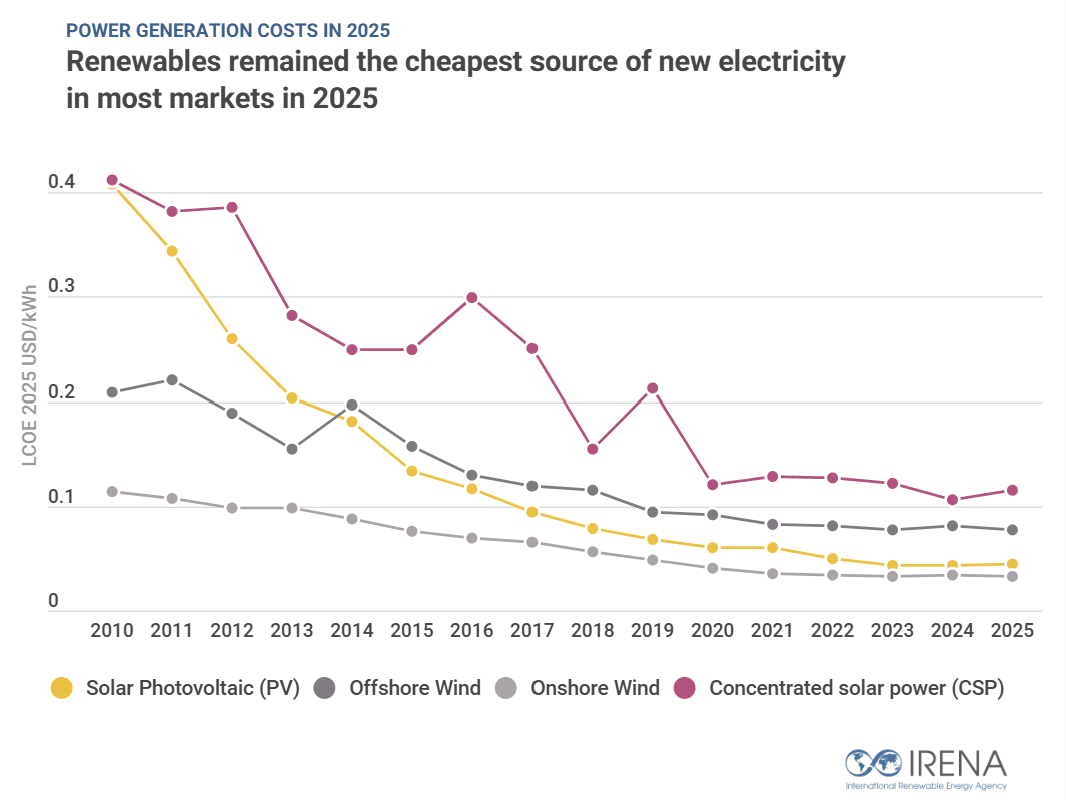
The report also found that renewable electricity continues to outperform fossil fuels on cost. Solar photovoltaic (PV) power remained at USD 44 per megawatt hour (MWh), while onshore wind fell to USD 33/MWh and offshore wind to USD 78/MWh.
In contrast, new gas-fired generation became increasingly expensive. IRENA said shortages of gas turbines doubled the capital cost of new combined-cycle plants in the United States, while electricity from new gas-fired power stations approached USD 100/MWh in markets such as Germany, Italy and Japan.
Since 2010, the cost of solar PV has fallen by 89%, onshore wind by 71%, and offshore wind by 63%, largely driven by expanding manufacturing capacity.
However, IRENA warned that the rapid pace of cost reductions is expected to slow. Global investment in clean technology manufacturing has fallen from a quarterly peak of USD 70 billion in 2023 to around USD 35 billion by the end of 2025, while higher commodity prices, shifting trade policies and industry restructuring are likely to put upward pressure on project costs in the near term.
Despite these headwinds, the agency expects renewable energy to remain the world’s lowest-cost source of new electricity, with costs forecast to continue declining gradually through to 2035.