


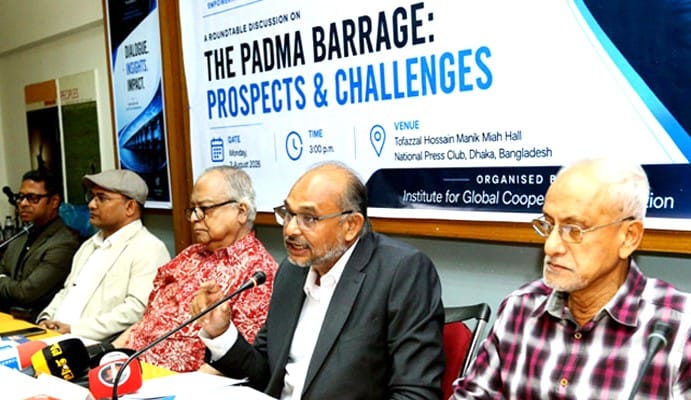
The completion of the proposed Padma Barrage project could increase Bangladesh’s gross domestic product (GDP) by an additional 0.5 to 1 percentage point through higher agricultural output, irrigation expansion and renewable energy generation, Finance and Planning Adviser Prof Rashed Al Mahmud Titumir said on Monday.
Speaking at a roundtable titled “Padma Barrage: Prospects and Challenges” at the National Press Club, the adviser said the project would enable the storage of nearly 2.9 billion cubic metres of water, providing year-round support for agriculture while also creating new opportunities for hydropower generation and regional development.
The discussion was organised by the Institute for Global Co-operation Foundation.
According to Titumir, the stored water would not only strengthen irrigation but also facilitate the production of an estimated 113 megawatts of clean hydropower.
The government also plans to develop seven modern townships along the river corridor as part of a sustainable urbanisation initiative linked to the project.
Highlighting the project’s impact on agriculture and river restoration, the adviser said the barrage would help maintain dry-season flows in the Hisna, Mathabhanga, Gorai, Madhumati, Chandana, Barashia, Baral and Ichamati rivers.
This, he said, would ensure regular irrigation for about 4.69 million hectares of farmland across the greater Kushtia, Faridpur, Jashore, Khulna, Barishal, Pabna and Rajshahi regions.
He said the project would also help address the growing freshwater shortage in the south-western districts of Satkhira, Khulna and Bagerhat by reducing salinity intrusion and mitigating arsenic contamination.
Increased freshwater flow, he added, would contribute to protecting the ecosystem, forest resources and biodiversity of the Sundarbans, while supporting sediment management, easing waterlogging in Bhobodaha and recharging groundwater reserves.
Referring to the historical context of transboundary water management, Titumir said the 1977 Ganges agreement marked the beginning of practical water resource cooperation. Building on that foundation, he said, the government is pursuing the Padma Barrage as part of a broader development strategy aimed at balancing economic growth with environmental sustainability.
The adviser said the government aims to complete the first phase of the project by 2029 and the entire Padma Barrage project by 2033. He added that the government would implement the project in accordance with international law and principles of justice and fairness while safeguarding the country’s overall interests.