


Government seeks greater competition in fuel market, while experts call for more LNG, domestic gas and renewable power
Bangladesh is preparing to allow qualified private companies to import and market fuel oil alongside state-owned enterprises, as the government seeks to strengthen supplies and increase competition in the energy market.
Power, Energy and Mineral Resources Minister Iqbal Hasan Mahmud said the government was drafting a common policy to allow private-sector participation, rejecting suggestions that the initiative was intended to benefit a particular company.
“This is being misinterpreted. We are not doing this to favour any particular company. We are developing a policy so that everyone can do business,” he said.
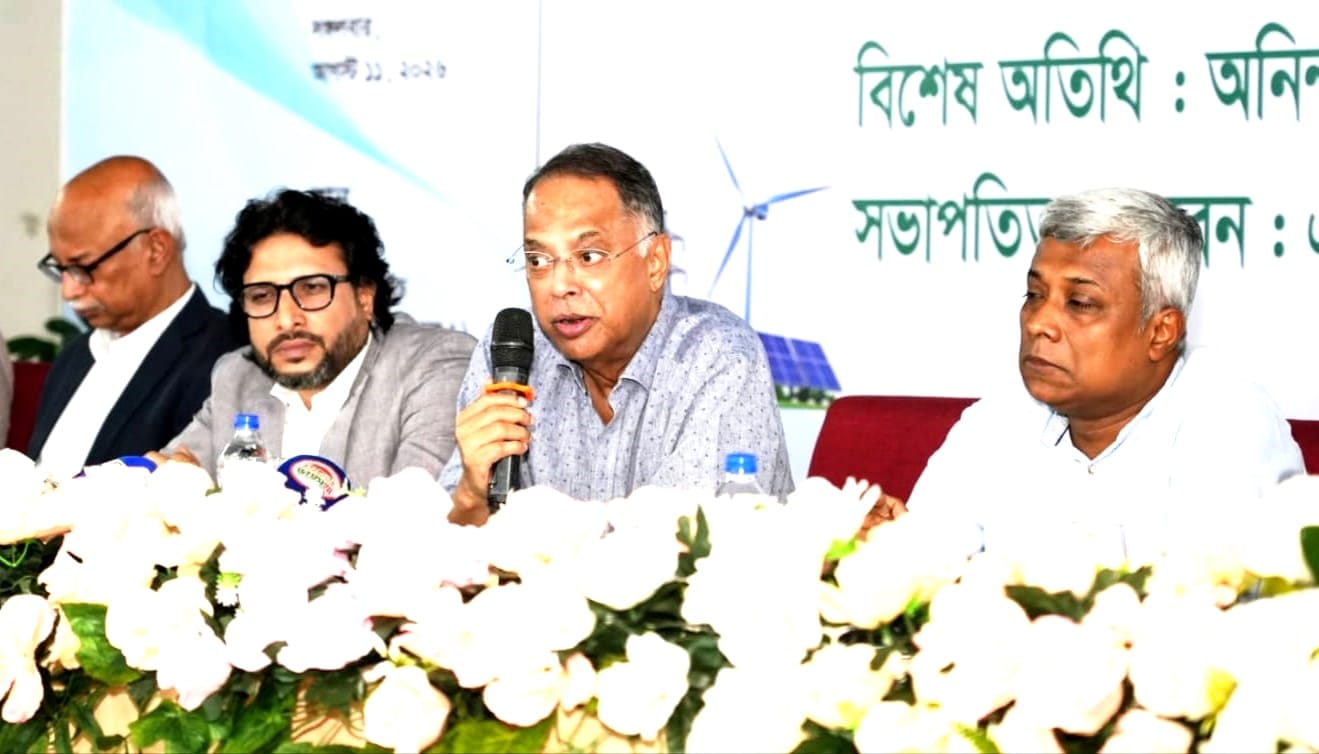
Mr Mahmud was speaking at a seminar on the energy crisis organised by the Forum for Energy Reporters Bangladesh (FERB) at Dhaka Club on Tuesday.
The proposal follows recent concerns over fuel supplies amid conflict in the Middle East. Despite adequate stocks, long queues formed at petrol stations and reports emerged of black-market and online fuel sales.
Mr Mahmud said the government had discussed greater private-sector participation with the Prime Minister after the disruption. He argued that allowing private companies to operate alongside state-owned businesses would improve competition and strengthen the country’s fuel supply system.
He cited India, where private and state-owned companies compete in the fuel market, as an example.
The minister also said Bangladesh was seeking international investment to expand domestic gas exploration. He said the government was optimistic about working with Malaysia’s state-owned energy company Petronas on gas development in Bhola following discussions between the two countries.
An offshore oil and gas bidding round is also under way and is due to close in November. Mr Mahmud said a government delegation planned to visit Houston to encourage major international energy companies to participate.
Gas shortages put pressure on industry
The government acknowledged that inadequate gas supplies were causing serious difficulties for industry.
Mr Mahmud said low gas pressure was affecting production and companies’ cash flow, increasing the risk of loan defaults.
“I do not want any businessperson’s name to appear in the banks’ red-ink ledger because of us,” he said.
He said the government was prioritising measures to limit the impact of the LNG supply shortage on industry and was considering a meeting involving the Prime Minister, industrialists and energy experts.
State Minister for Power and Energy Anindya Islam Amit acknowledged a significant gap between electricity and energy demand and available supply.
“We are not denying this reality. Nor can we avoid responsibility for the crisis,” he said, apologising on behalf of the government to people affected by the shortages.
Bangladesh has installed electricity generation capacity of about 30,000 megawatts, but insufficient fuel is preventing many power plants from operating at full capacity.
Gas demand, including domestic production and imports, is about 1,200 million cubic feet per day (mmcfd), while output from domestic fields is falling by around 150mmcfd each year.
Mr Amit said LNG imports could not be increased immediately, even if the necessary funds were available, because Bangladesh lacked sufficient infrastructure.
A new floating storage and regasification unit (FSRU) normally takes 30 to 36 months to become operational. The government is aiming to bring additional capacity online in less than two years.
Work is under way on the country’s third and fourth FSRUs. Bangladesh is also planning a land-based LNG terminal at Matarbari, where land has been identified and a tender issued to appoint a transaction adviser.
Government plans LPG and solar expansion
The government is considering greater involvement in the LPG market after a sharp increase in prices.
Mr Amit said consumers did not always obtain LPG at the rates set by the Bangladesh Energy Regulatory Commission. The government therefore plans to import LPG in bulk and use existing infrastructure and manpower to help stabilise the market.
It also plans to expand renewable power generation, with a target of around 10,000MW over the next four and a half years.
Rooftop solar is expected to account for between 40% and 60% of the additional capacity, with the remainder coming from land-based projects.
Mr Mahmud said investment-friendly policies, including a five-year tax holiday, had been introduced to attract private investment in rooftop solar.
The government is also considering additional coal-fired power plants, although Mr Mahmud acknowledged that international financing for coal projects was becoming increasingly difficult.
Experts call for more domestic gas
Energy experts at the seminar said additional LNG imports and FSRUs were necessary to address the immediate supply shortage but warned that they would not provide a long-term solution.
Dr Ijaz Hossain, a former professor at Bangladesh University of Engineering and Technology (BUET), said the energy crisis was compounded by a shortage of foreign currency.
“It will be difficult to resolve the energy crisis without ensuring macroeconomic stability,” he said.
Dr Hossain called for domestic gas production to be increased rapidly and maintained at around 2,000mmcfd. He also recommended expanding solar power and battery storage while gradually reducing dependence on furnace-oil-fired generation.
He forecast that Bangladesh’s gas demand could reach at least 4,600mmcfd by 2030.
Meeting that demand would require greater domestic production and additional LNG import capacity, he said, but securing the dollars needed to pay for LNG would remain a major challenge.
Professor M Tamim, vice-chancellor of Independent University, Bangladesh, said there was no single solution to the crisis.
He called for increased domestic gas production, fuel imports where necessary, greater use of coal-fired power plants and the rapid addition of 2,000MW to 3,000MW of solar capacity.
Prof Tamim also urged the government to reconsider its reliance on Bangladesh Petroleum Exploration and Production Company (BAPEX) for gas exploration.
International companies should be brought in to provide technology, expertise and investment, he said. Advanced technology could also be used to extract gas from promising layers of older fields, while the Chhatak gas field could be considered for development.
Business leaders urge policy certainty
Shamsul Alam, energy adviser to the Consumers Association of Bangladesh, said the new government needed to break with past practices and make fundamental changes to the power and energy sectors.
He identified the absence of rational energy pricing as one of the sector’s main problems and called for clearer benchmarks for electricity generation costs and investment conditions.
Azam J Chowdhury, chairman of East Coast Group, said Bangladesh should avoid relying excessively on any single energy source and instead use a combination of renewable energy, oil, gas and LNG.
The private sector should play a larger role alongside the government, he said.
Bangladesh should increase LNG imports in the short term while developing a large land-based LNG terminal at Matarbari in the longer term, Mr Chowdhury said. Such a facility could help establish Matarbari as a regional energy hub.
He also urged the government to consult industry and other stakeholders before introducing new energy policies, warning that uncertainty could discourage investment.
“Economic development is not possible if energy prices are kept artificially low,” he said, calling for a competitive energy mix that could provide reliable supplies at sustainable prices.
Mr Chowdhury also advocated partnerships between BAPEX and international companies to strengthen exploration expertise and attract long-term investment.
David Hasnat, president of the Bangladesh Independent Power Producers Association (BIPPA), said gas shortages were preventing around 7,000MW of electricity generation.
He called for the third FSRU to be completed within two years and said a land-based LNG terminal would be essential for long-term energy security.
The seminar, titled ‘Energy Sector Crisis: Prospects and Ways Forward’, was chaired by FERB chairman M Azizur Rahman. FERB executive director Serajul Islam Siraj delivered the welcome address.
Senior government officials, energy experts, private-sector investors and business leaders attended the event.