


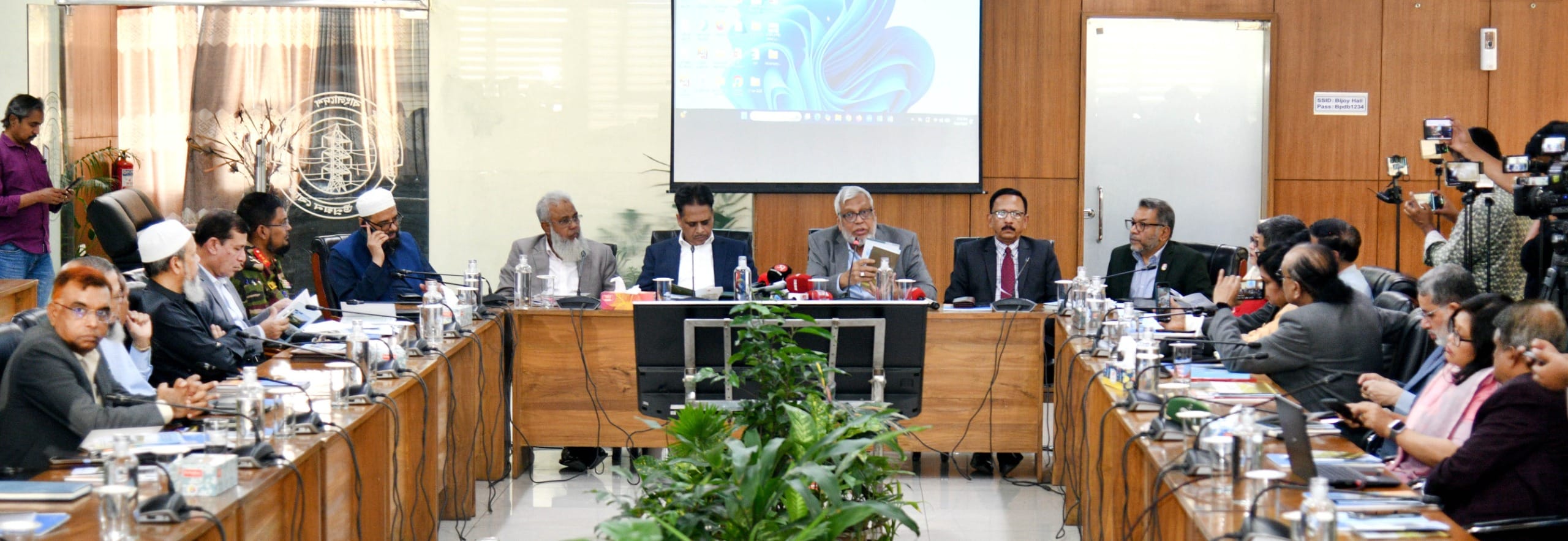
Bangladesh’s interim government has failed to dismantle entrenched cartels in road construction tenders, largely due to experience requirements that repeatedly favour the same contractors, senior adviser Muhammad Fouzul Kabir Khan has acknowledged.
Speaking at his final press conference on Tuesday afternoon at the Power Building in Dhaka, Dr Khan said: “We could not break the syndicates in road tenders. Because of experience criteria, the same people continue to win contracts repeatedly.”
Dr Khan serves as adviser to the interim government overseeing the ministries of Power, Energy and Mineral Resources, Road Transport and Bridges, and Railways. Before the press briefing, he unveiled Energy for Change, a publication by the Forum for Energy Reporters Bangladesh (FERB).
Reflecting on his tenure at the Road Transport and Bridges Ministry, Dr Khan identified traffic congestion as the sector’s most pressing problem, alongside road accidents and pollution caused by unfit vehicles. He said a new scrapping policy is being introduced under which vehicles will be scrapped after two or three repeat offences. Previously, authorities lacked an effective mechanism to remove unfit vehicles from roads.
He also said the deadline for families to claim compensation following fatal road accidents has been extended from one month to three months, acknowledging that bereaved families often miss the earlier deadline due to mourning.
Dr Khan cited the reopening of the Mirpur-10 metro rail station, damaged during the July movement, as one of the interim government’s major challenges. Initial estimates suggested the repair would cost more than Tk 500 crore and take around a year. “We reopened it in three months at a cost of just Tk 18 crore,” he said.
Turning to the rail sector, he highlighted an acute shortage of locomotives and rolling stock. “We have expanded rail lines, but we lack engines and coaches,” he said, noting that new locomotives typically take two years to procure. He added that Bangladesh has requested China to provide 20 locomotives free of cost, while contracts have been signed with an Indian company for 200 broad-gauge coaches, with the first 20 expected to arrive in March.
Dr Khan claimed operational efficiency in Bangladesh Railways has improved, reducing costs from Tk 2.50 to Tk 1.84 per taka earned. He also said railway hospitals, previously limited to railway staff, have been transferred to the Health Ministry and are now open to the general public.
On the broader economy, Dr Khan rejected earlier fears that Bangladesh was heading towards a Sri Lanka-style crisis. “When we took office, it was said the country would collapse. But the situation is now better,” he said, adding that outstanding dues across ministries have been reduced.
Addressing the power and energy sector, Dr Khan described dismantling “institutionalised corruption” as the interim government’s most significant achievement. He said corruption had evolved into a legal and administrative architecture over many years, and the government’s first task was to break that structure.