


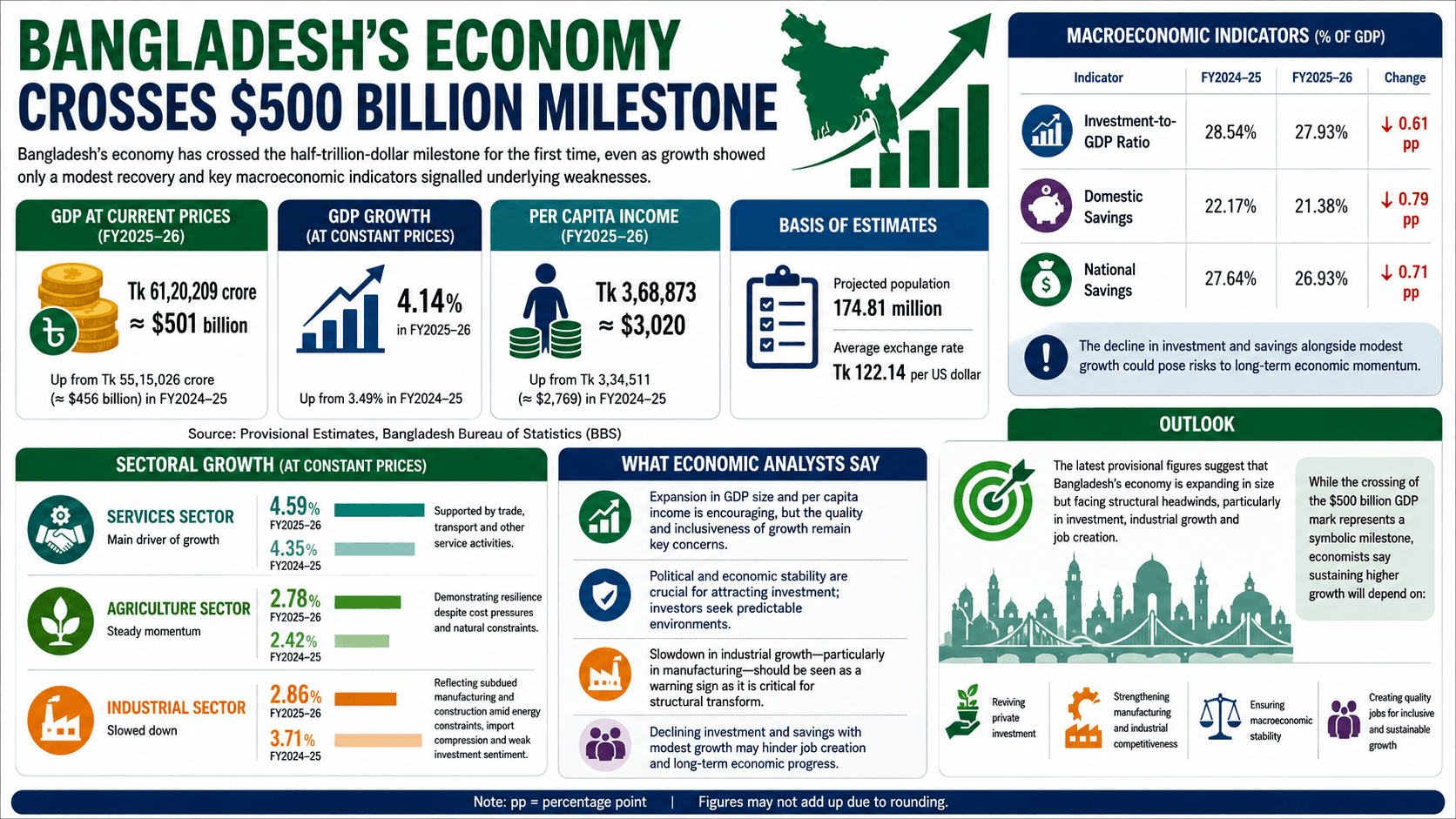
Bangladesh’s economy has crossed the half-trillion-dollar milestone for the first time, even as growth showed only a modest recovery and key macroeconomic indicators signalled underlying weaknesses.
The country’s gross domestic product (GDP) expanded by 4.14 percent at constant prices in FY2025–26, slightly improving from 3.49 percent in the previous fiscal year, according to provisional estimates released by the Bangladesh Bureau of Statistics (BBS) on Tuesday.
At current market prices, the size of the economy rose to Tk 61,20,209 crore — approximately $501 billion — in FY26, up from Tk 55,15,026 crore, or $456 billion, a year earlier, marking a significant nominal expansion.
Per capita income crosses $3,000
Per capita income also recorded a notable increase, rising to Tk 3,68,873, or $3,020, from Tk 3,34,511 ($2,769) in FY25, reflecting continued expansion in economic activity despite a challenging macroeconomic environment.
The estimates were based on a projected population of 174.81 million and an average exchange rate of Tk 122.14 per US dollar.
Sectoral growth uneven
Sector-wise data reveal a mixed performance across the economy.
The services sector remained the main driver of growth, expanding by 4.59 percent, up from 4.35 percent in the previous fiscal year, supported by trade, transport and other service activities.
The agriculture sector maintained steady momentum, growing by 2.78 percent, slightly higher than 2.42 percent a year earlier, demonstrating resilience despite cost pressures and natural constraints.
However, the industrial sector slowed, registering growth of 2.86 percent, down from 3.71 percent in FY25, reflecting subdued manufacturing and construction activities amid energy constraints, import compression and weak investment sentiment.
Investment, savings ratios decline
Despite the uptick in GDP growth, macroeconomic fundamentals showed signs of strain.
The investment-to-GDP ratio declined to 27.93 percent in FY26 from 28.54 percent in the previous year, indicating a slowdown in capital formation, particularly in the private sector.
Similarly, domestic savings fell to 21.38 percent of GDP, while national savings dropped to 26.93 percent, both down from the previous fiscal year.
Economists warn that declining investment and savings alongside modest growth could pose risks to long-term economic momentum.
Economic analysts have said that while the expansion in GDP size and per capita income is encouraging, the quality and inclusiveness of growth remain key concerns.
They said political and economic stability are crucial for attracting investment, noting that investors typically seek predictable environments.
According to them, the slowdown in industrial growth — particularly in manufacturing — should be seen as a warning sign as it is critical for structural transform.
Outlook
The latest provisional figures suggest that Bangladesh’s economy is expanding in size but facing structural headwinds, particularly in investment, industrial growth and job creation.
While the crossing of the $500 billion GDP mark represents a symbolic milestone, economists say sustaining higher growth will depend on reviving private investment, strengthening manufacturing, and ensuring macroeconomic stability.