


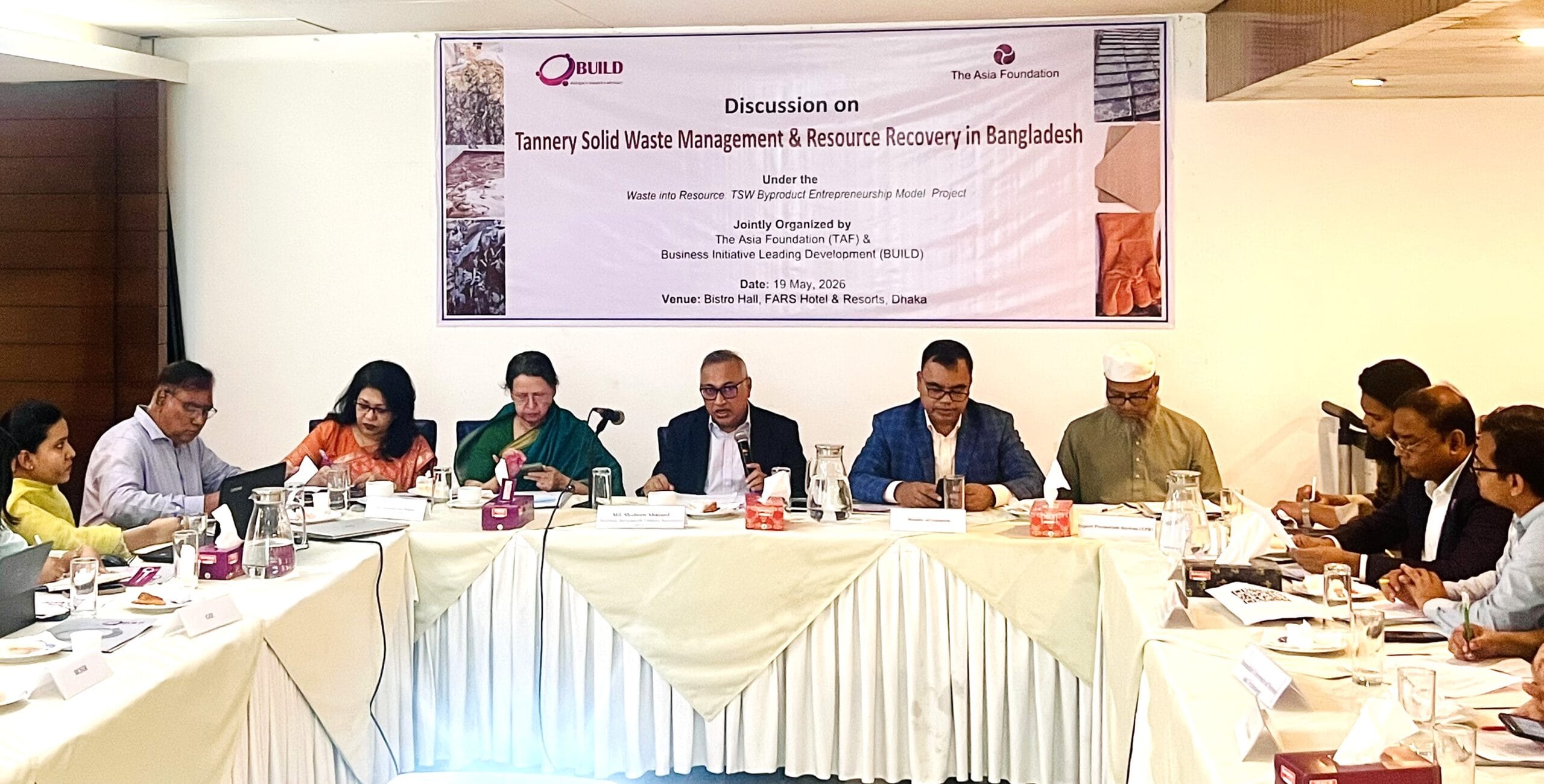
Industry leaders, government officials and environmental experts have called for urgent reforms to tackle Bangladesh’s growing tannery waste problem, warning that poor environmental compliance is undermining the country’s leather export potential.
The discussion took place at a focus group event in Dhaka organised by Business Initiative Leading Development (BUILD) with support from The Asia Foundation under the project “Waste into Resource: TSW Byproduct Entrepreneurship Model.”
Held at FARS Hotel & Resorts, the event brought together representatives from government ministries, industry associations, SMEs, financial institutions and academia to discuss the management of tannery solid waste (TSW) and opportunities for resource recovery in Bangladesh’s leather industry.
Speakers said the relocation of tanneries from Hazaribagh to Savar had failed to deliver the expected environmental and commercial benefits. Exporters continue to struggle to secure premium international prices due to ongoing non-compliance with environmental standards.
Although the Central Effluent Treatment Plant (CETP) at the Savar Tannery Estate is considered the largest in South Asia, participants said weak estate management and poor waste handling remain major obstacles.
According to industry representatives, Bangladesh has significant potential to manufacture value-added products from tannery waste — including poultry feed, industrial materials, glue, gelatin and fertiliser — but continues to rely on imports because of inadequate infrastructure and fragmented supply chains.
Ferdaus Ara Begum, chief executive of BUILD, said nearly half of all tannery solid waste in Bangladesh is discarded without treatment, creating severe environmental risks.
“Improved compliance with environmental standards, proper treatment and utilisation of waste, and stronger collaboration among government agencies, industry stakeholders and development partners are critical,” she said.
Research presented during the event estimated that Bangladesh generates between 73,000 and 90,000 tonnes of tannery solid waste annually, much of which is disposed of without scientific treatment.
Md. Shaheen Ahamed, chairman of the Bangladesh Tanners Association, said achieving international certification standards such as Leather Working Group (LWG) approval depends on effective management of both liquid and solid waste.
He also expressed concern over plans to transfer management of the Tannery Industrial Estate Dhaka (TIED) from the Bangladesh Small and Cottage Industries Corporation (BSCIC) to the Bangladesh Economic Zones Authority (BEZA), warning that SMEs could face additional bureaucratic burdens.
Meanwhile, A. M. Sajjad Hossain Khan of The Asia Foundation stressed the importance of innovation and inclusion in developing a circular economy for the leather sector.
He said integrating SMEs and informal businesses into formal waste recovery systems could reduce environmental damage while creating sustainable economic opportunities.
Academics and entrepreneurs also highlighted emerging innovations in the sector. Mohammed Mizanur Rahman discussed his patented research on converting tannery waste into biodiesel and biogas, but said limited financing remains a barrier to commercialisation.
Entrepreneurs attending the forum complained of raw material shortages, inflated costs caused by middlemen, and a lack of dedicated industrial plots and formal policy recognition for tannery waste recycling businesses.
Participants concluded that converting tannery waste into commercially viable products could play a significant role in Bangladesh’s export diversification strategy while helping improve environmental compliance in the leather sector.
The event ended with calls for evidence-based policy reforms and stronger collaboration between government agencies, industry and development partners to support a more sustainable and competitive leather industry.