


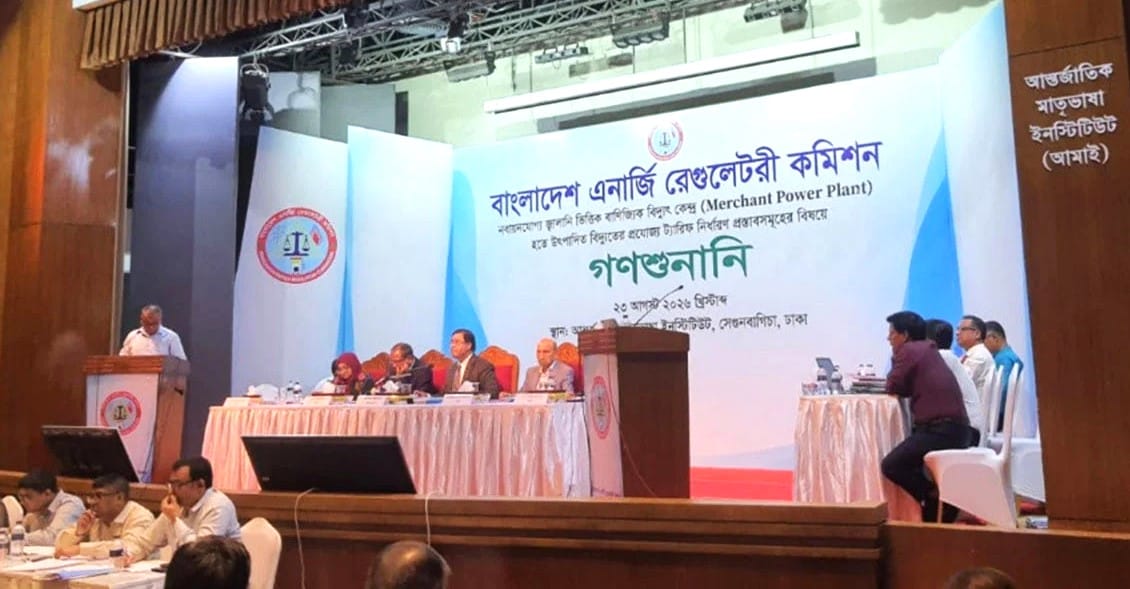
The Bangladesh Energy Regulatory Commission’s (BERC) Technical Evaluation Committee has recommended a generation tariff of Tk6.48 per unit for electricity produced by privately owned, solar-based merchant power plants, along with an average distribution charge of Tk1.17 per unit.
The proposals were discussed at a public hearing on merchant power plant tariffs, transmission and distribution charges at the International Mother Language Institute in Segunbagicha, Dhaka, on Sunday.
Merchant power is a new model for Bangladesh’s electricity market, designed primarily to encourage renewable-energy investment. Under the system, private developers can build power plants and sell electricity directly to eligible customers while using the national transmission and distribution networks. A plant located in Rangpur, for example, could supply a customer in Dhaka or Chattogram by paying the relevant wheeling and network charges.
Government-owned distribution companies would also be allowed to purchase up to 20% of the electricity generated by such plants at the regulator’s recommended tariff.
Utilities warn of losing industrial customers
The Bangladesh Power Development Board (BPDB) and distribution companies, including Northern Electricity Supply Company (Nesco), raised concerns about losing large industrial customers to merchant power producers.
They argued that industrial consumers currently pay relatively high electricity tariffs, helping utilities recover the cost of supplying cheaper electricity to residential customers. If large users shift to merchant plants, utilities could face a significant revenue shortfall.
They also warned that customers could use solar-generated electricity during daylight hours and rely on utility power at other times. This could leave conventional generation capacity underused during the day while forcing utilities to operate more expensive peaking plants at night, ultimately increasing their average generation costs.
Dr Shamsul Alam, energy adviser to the Consumers Association of Bangladesh (CAB), challenged the utilities’ arguments.
He said the distribution companies had failed to adequately justify charges higher than their existing tariffs. He also questioned the technical committee’s rationale for recommending a weighted average distribution charge of Tk1.17 per unit.
Dr Alam said that, at an exchange rate of Tk123 to the US dollar, solar electricity costs about Tk3.80 per unit in India and Tk3.90 in Pakistan. Any higher tariff in Bangladesh, he argued, should be supported by clear evidence.
He also criticised the use of historical independent power producer (IPP) prices as a benchmark, saying past tariffs should not automatically be treated as a legitimate reference point. In his view, the benchmark should instead be established through a transparent regulatory process following public consultation.
Industry seeks tax breaks for renewable power
Business groups called for tax and VAT exemptions for merchant power projects for at least 10 years.
BGMEA Vice-President Bidia Amrut Khan said Bangladesh’s garment exports could come under serious pressure if the industry failed to shift towards renewable energy.
She said European markets were increasingly imposing renewable-energy requirements, while competing garment-producing countries such as India and Vietnam were moving faster in this area.
To help the industry move towards net zero, she proposed tax-free treatment for solar power for the next decade and said Bangladesh should ensure that at least 20% of its electricity comes from renewable sources by 2030.
The Bangladesh Sustainable and Renewable Energy Association (BSREA) also called for simpler policy procedures and tax concessions on imported solar panels and related equipment.
Its president, Mostafa Al Mahmud, said wider adoption of renewable energy would be difficult without a more supportive investment and import regime.
Solar producers seek lower open-access charges
BSREA proposed reducing the open-access tariff for merchant power plants to Tk0.50 per unit for the first five years to attract private investment in renewable energy.
The association also called for compensation for “deemed generation” when a plant is ready to produce electricity but cannot supply the grid because of faults in a distribution company’s network or substations.
It proposed a minimum 20-year tenure for merchant power plant agreements, arguing that investors need greater certainty before committing capital.
The group also called for renewable electricity to receive priority in grid dispatch.
BSREA proposed allowing government-owned utilities to use up to 100% of surplus or unused electricity from merchant power plants, with payments based on the average tariff determined by BERC.
It further sought quarterly, post-paid collection of open-access charges and a tripartite legal agreement involving the power ministry, project developers and investors to strengthen investor protection.
The association proposed that transmission losses be shared between the BPDB and the government. For electricity transferred between voltage levels, such as from 132kV to 33kV, it suggested fixed wheeling charges that would be adjusted against the open-access tariff.
Battery storage proposed
BERC’s technical committee has also proposed requiring solar-based merchant power plants to install battery energy storage equivalent to 10-20% of their generation capacity.
The storage systems would allow electricity generated during the day to be retained and supplied later, including at night, when demand continues but solar generation falls.
The committee said battery storage would improve the reliability of solar power and allow a greater share of renewable electricity to be integrated into the grid.
Proposed transmission and distribution charges
The hearing also considered charges proposed by the BPDB and other utilities.
For transmission at 230kV, 132kV and 33kV, the proposed charges were 46 paisa, 49 paisa and 78 paisa per unit, respectively. The Power Grid Company of Bangladesh currently charges 31 paisa per unit for transmission.
For distribution at 0.4kV, proposed charges ranged from Tk1.33 to Tk1.76 per unit. Nesco proposed the highest charge at Tk1.76, followed by WZPDCL at Tk1.65, DPDC at Tk1.58, DESCO at Tk1.45 and BPDB at Tk1.33.
At the 33kV level, the proposed charges ranged from 69 paisa per unit for Nesco to Tk1.14 for BPDB.
BSREA also called for equal tax and duty treatment for solar equipment and grid-connected infrastructure imported by merchant power producers, independent power producers and corporate or industrial solar consumers.
It proposed amendments to SRO 181 to establish uniform tax and duty exemptions and the introduction of SRO 400 to bring the relevant tariff down to zero.
The association further urged government intervention where an off-taker fails to pay a merchant power plant for electricity supplied. It said the authorities should take necessary measures, including, where appropriate, suspending the operations of a defaulting industrial establishment.
The hearing was chaired by BERC Chairman Jalal Ahmed, with commission members Abdur Razzaq, Md Mizanur Rahman, Dr Syeda Sultana Razia and Brigadier General (retd) Mohammad Shahid Sarwar also attending.
Among those who took part were Power Division Deputy Secretary Mohammad Solaiman, Bangladesh Economic Association member Syed Mizanur Rahman and BUET professor Hasib Chowdhury.
The BPDB and other utilities presented their proposals before the technical committee outlined its recommendations.
At the close of the hearing, a participant said the commission had heard the views of all stakeholders and invited anyone wishing to make further submissions to do so in writing.
BERC will review the submissions before making its final decision.
The new open-access framework is being seen by renewable-energy investors as both an opportunity and a challenge. Industry representatives argue that a predictable, long-term regulatory regime could help merchant power projects attract investment, strengthen energy security and improve the competitiveness of export-oriented industries while supporting Bangladesh’s renewable-energy targets for 2030 and 2041.