


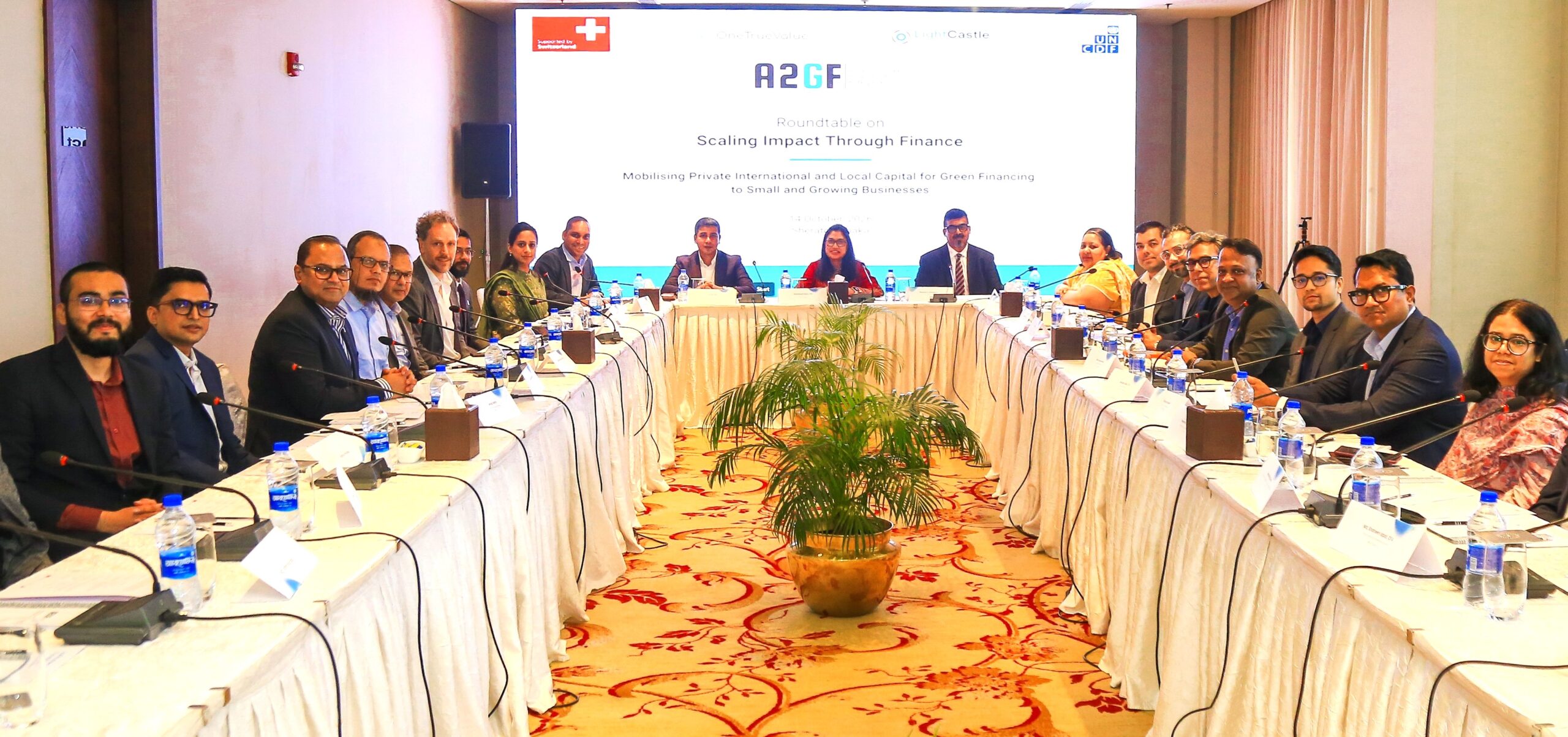
Bangladesh needs to channel more domestic investment into green and inclusive businesses, as green finance accounts for only around 6% of total sustainable finance disbursed by banks and financial institutions, a roundtable in Dhaka has heard.
The discussion, titled Scaling Impact Through Finance, was organised by LightCastle Partners, with support from the Embassy of Switzerland in Bangladesh and in partnership with Truvalu Bangladesh and the United Nations Capital Development Fund (UNCDF).
Held at Hotel Sheraton in Dhaka, the closed-door meeting brought together senior representatives from venture capital firms, corporations, fund-of-funds, non-bank financial institutions (NBFIs), commercial banks and market-enabling organisations to explore ways to mobilise domestic capital for impact-oriented small and growing businesses (SGBs).
Banks and finance companies disbursed Tk960.04 billion in sustainable finance during April–June 2026, of which Tk61.58 billion went to green finance, highlighting the gap between broader sustainable financing and investment specifically directed towards environmentally beneficial activities.
Participants examined why green businesses and growth-stage small and medium-sized enterprises (SMEs) continue to struggle to secure finance, and how investment structures could encourage more domestic capital to support Bangladesh’s green transition and inclusive economic growth.
Opening the roundtable, Ameena Chowdhury, senior programme manager at the Embassy of Switzerland in Bangladesh, said the focus should now be on mobilising domestic capital at scale, with catalytic financing helping attract private investment rather than replacing it.
“Bangladesh has moved beyond asking why impact investing matters. The real question now is how we bring domestic capital to work at scale,” she said.
Two investment vehicles under the A2GF framework were presented as potential channels for directing capital towards underserved businesses.
Bijon Islam, chief executive of LightCastle Partners, outlined the company’s forthcoming Bangladesh-based impact fund, which will invest in businesses with strong commercial prospects and measurable social or environmental outcomes.
“Bangladesh has short-term volatility, but we still have long-term positive growth,” he said, pointing to an estimated financing gap of more than $70 billion for micro, small and medium-sized enterprises.
One way to address the shortfall is to reduce investment risks through catalytic capital, enabling it to attract additional private-sector funding, he added.
Willem Grimminck, managing director of OneTrueValue, presented the ORE II Fund, which invests in high-potential small and medium-sized enterprises in climate-vulnerable markets, with a particular focus on renewable energy and businesses capable of delivering measurable climate benefits alongside commercial growth.
“As a foreign investor, I can choose from multiple countries, and Bangladesh is the country where I want to be now,” he said.
He added that impact investment should also strengthen business competitiveness, protect jobs and help companies expand.
“For every factory that survives in this environment, we can maintain jobs and help these companies grow,” he said.
The two funds are intended to build investment track records among underserved businesses and create a pipeline of commercially viable enterprises that could eventually attract mainstream financing from banks and institutional investors.
The 90-minute discussion, moderated by Bijon Islam and Sharawwat Islam, CFA, managing director of Truvalu Bangladesh, focused on practical barriers preventing growth-stage SMEs and green businesses from accessing finance.
Bankers and NBFI executives considered the constraints that keep these enterprises outside conventional lending criteria and explored possible ways for financial institutions to participate, including direct lending, co-financing alongside investment funds and risk-sharing arrangements.
Sharawwat Islam closed the session by summarising the key barriers and proposed solutions and outlining potential next steps to strengthen cooperation between investors, financial institutions and impact-oriented businesses.