


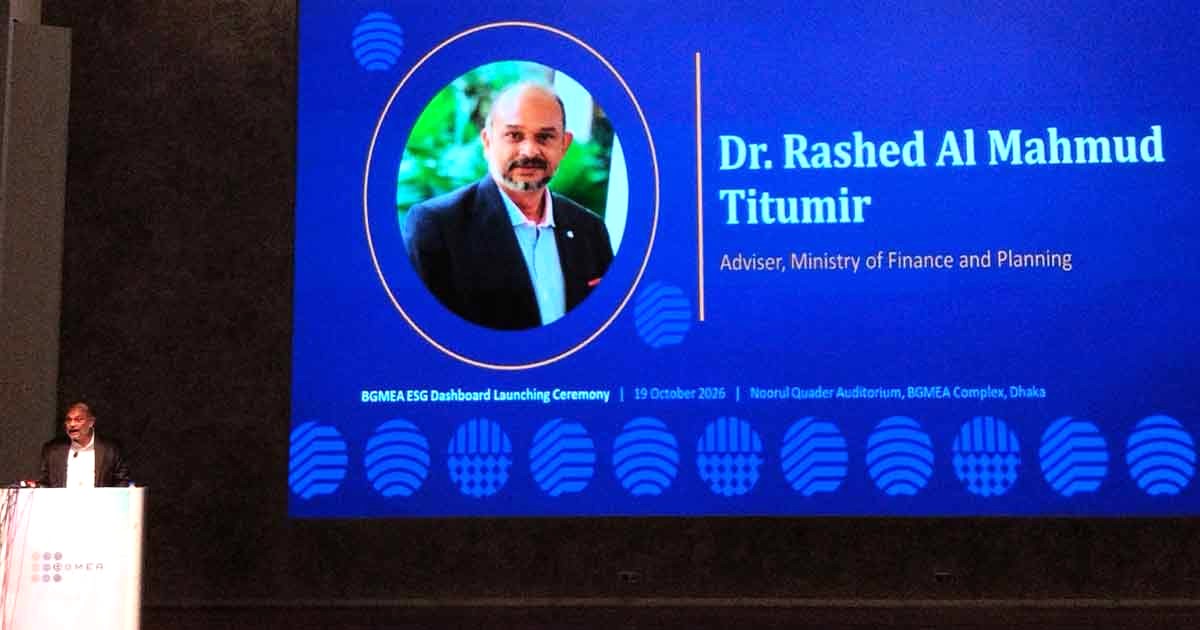
Bangladesh has spent more than $8 billion in additional costs over the past eight months to tackle the energy crisis triggered by the war in the Middle East, Economic and Planning Adviser Rashed Al Mahmud Titumir said on Monday.
The additional expenditure has added to the country’s economic challenges, prompting the government to prioritise energy security, investment, job creation and structural reforms, he said.
Titumir was speaking at the inaugural ceremony of a programme on environmental, social and governance (ESG) issues for garment factories organised by the Bangladesh Garment Manufacturers and Exporters Association (BGMEA) in Uttara, Dhaka.
He said the government was pursuing plans to develop Matarbari into an energy hub while encouraging more investment in the country’s southwestern region.
To improve the investment climate, the government has identified five priority areas for reform: policy continuity, a business-friendly environment, financing, energy security and seamless connectivity.
The adviser said the government planned to ensure tax policy stability for five years to give investors greater predictability.
He also referred to a Tk60,000 crore package to support closed industrial units, saying its lending rate of 7 percent was below the prevailing inflation rate. He expressed hope that borrowing costs would fall further to improve the business and investment climate.
Energy and infrastructure plans
The government is pursuing several initiatives to strengthen energy security, including renewable power generation, exploration for new gas fields, LNG and LPG supplies, and the installation of floating storage and regasification units (FSRUs).
Titumir said initiatives involving Japan and China were being pursued to establish FSRUs.
On connectivity, he said the government expected to complete projects related to the Chattogram-Dhaka Expressway by 2029, alongside measures to expand rail freight capacity and improve coordination between broad-gauge and metre-gauge railway networks.
The government aims to generate employment by directing financing towards investment and productive activities, he said. Higher employment and production would help expand domestic revenue without increasing tax rates, creating room for greater spending on education and healthcare.
Inflation, jobs remain key challenges
Titumir identified the fragile economy inherited by the government, high inflation and unemployment as three major challenges.
He said around 40 percent of the population had been outside employment, education or training, with women accounting for about 60 percent of that group.
The government has initiated measures including agricultural loan waivers and the Family Card programme to support low-income households, strengthen social protection and ease the pressure of rising living costs, he added.
He also highlighted a government target to raise public spending on education and healthcare to 5 percent of gross domestic product (GDP), saying expanded social protection and investment in human capital would support long-term economic development.
Referring to growth projections, Titumir said the International Monetary Fund had forecast Bangladesh’s economic growth at 4.7 percent. However, he cautioned that the growth outlook could weaken if the planned reforms were not implemented.
He also said discussions were continuing with international stakeholders over extending the country’s preparation period for graduation from the least developed country (LDC) category, expressing hope for progress by 2029.
ESG compliance vital for garment exports
Turning to the garment sector, the adviser stressed that manufacturers needed to go beyond low-cost production to remain competitive in international markets.
Factories must improve energy efficiency, working conditions, environmentally friendly technology and reporting practices to meet environmental, social and governance standards, he said.
He called for investment to help factories, particularly smaller ones, strengthen their capacity to comply with international requirements.
At the same time, he cautioned against imposing excessive burdens on manufacturers in developing countries through international standards and non-tariff trade barriers.
BGMEA President Mahmud Hasan Khan and Danish Ambassador to Bangladesh Christian Brix Møller also spoke at the event.