


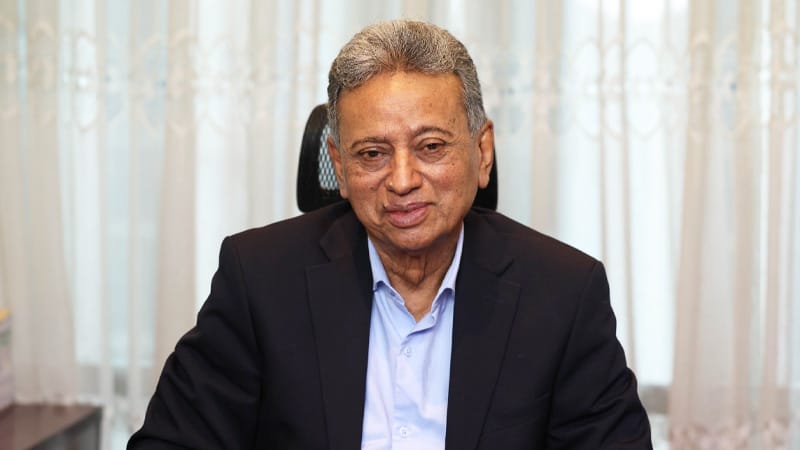
Finance and Planning Minister Amir Khosru Mahmud Chowdhury on Sunday said the previous government’s loan programme with the International Monetary Fund (IMF) was “completely against public interest”, asserting that Bangladesh would negotiate a new arrangement without compromising the country’s economic interests.
“Our main concern is not obtaining money; it is protecting the country’s interests,” Amir Khosru told reporters at the Secretariat. “The government will not enter into any programme with the IMF that harms the economic interests of the people.”
He said protecting the interests of Bangladesh and its people would remain the government’s overriding priority in negotiations with the Washington-based lender.
Describing the IMF programme signed by the previous government as “entirely against public interest”, the finance minister said the new administration was seeking a fresh programme that reflects Bangladesh’s current economic realities while fully safeguarding national interests.
His remarks came as a 12-member IMF mission, led by Bangladesh Mission Chief Ivo Krznar, began discussions with government officials in Dhaka on a proposed new loan programme. The delegation is scheduled to hold a series of meetings with key ministries and agencies throughout the week.
The mission’s first meeting on Sunday was with Finance Secretary Md Khairuzzaman Mozumder, followed by discussions with Finance Division officials and Bangladesh Bank representatives on the government’s macroeconomic priorities and reform agenda.
A scheduled meeting between the IMF delegation and the finance minister at 1:00pm was cancelled after Amir Khosru left to attend the funeral prayers of former Speaker and former Acting President Barrister Jamir Uddin Sircar, Finance Ministry officials said.
Bangladesh is seeking a new three-year IMF programme worth between $4 billion and $4.5 billion to help preserve macroeconomic stability and ease pressure on the country’s external financing position.
The government formally requested the new programme in a letter sent to the IMF on June 9. The letter said the economic and policy assumptions underpinning the previous programme were no longer valid because of changes in the domestic political economy, heightened global uncertainty and emerging economic challenges.
It also reaffirmed the government’s commitment to reforms, while stressing that implementation should be phased and aligned with Bangladesh’s evolving economic circumstances.
The Awami League government secured a $4.7 billion IMF support package in 2023, which was expanded to $5.5 billion during the interim administration in June 2025. Bangladesh received $3.64 billion in five instalments, but the sixth tranche was never released despite nearly a year of negotiations. The programme was subsequently cancelled by mutual agreement.
Visa policy overhaul
The finance minister also said the government was working to modernise Bangladesh’s visa policy to facilitate the entry of foreign tourists, investors and skilled professionals.
He said the proposed changes were intended to improve the country’s investment climate, strengthen its global competitiveness and support a more efficient, service-oriented immigration system without compromising national security.
The proposed overhaul follows a cabinet decision on July 2 to revise the 2006 visa policy. A cabinet committee headed by the finance minister has been tasked with finalising the draft.
IMF discussions continue
Among Sunday’s key agenda items was a possible second programme under the IMF’s Resilience and Sustainability Facility (RSF). Officials discussed its potential framework, conditions and preparatory work, while also reviewing progress under the first RSF programme.
The IMF mission is also expected to discuss the FY2026-27 budget and medium-term fiscal framework, GDP growth targets, revenue mobilisation, subsidies, social protection reforms, the Annual Development Programme (ADP), financing for major development projects, public sector pay and recruitment, and plans to streamline welfare schemes, including the Family Card and Farmer Card programmes.