


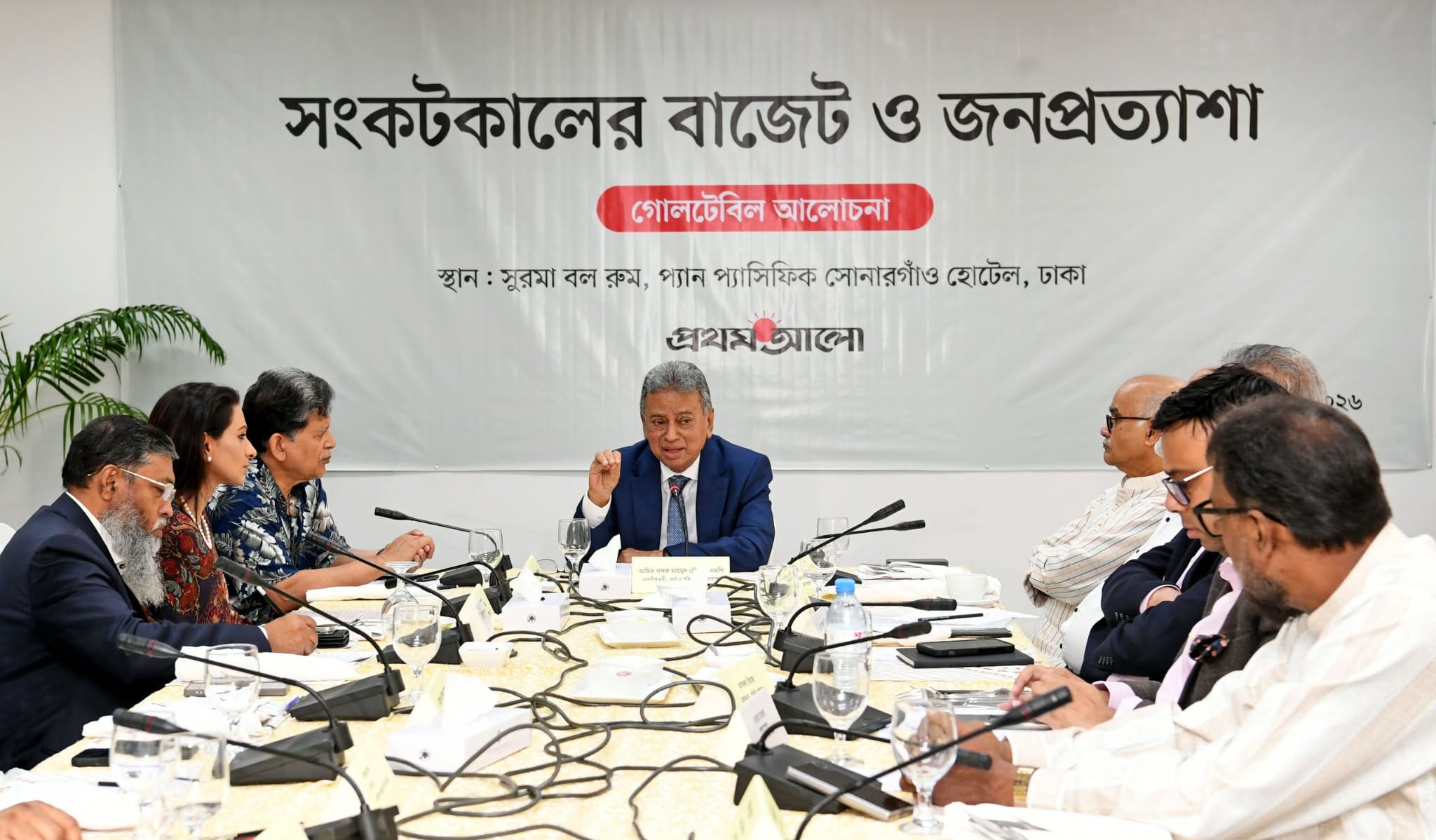
Finance Minister Amir Khasru Mahmud Chowdhury has said the government has launched an extensive reform programme aimed at moving Bangladesh away from an oligarchic and patronage-based economy towards a welfare state and a more humane economic system focused on ordinary citizens.
He made the remarks while speaking as chief guest at a roundtable discussion titled “Budget in Times of Crisis and Public Expectations”, organised by Prothom Alo at the Pan Pacific Sonargaon Dhaka on Thursday.
The finance minister said the democratisation of the economy was not merely a political slogan but a core philosophy of the current government.
He said special emphasis was being placed on bringing marginalised communities — including rural blacksmiths, potters and handloom weavers — into the mainstream economy after decades of exclusion from national budgetary priorities.
He also announced that the upcoming national budget would include dedicated projects and funding to promote the creative economy, including theatre, culture, music, painting and artificial jewellery, and to help monetise those sectors. The government plans to establish “theatre districts” in major cities beyond Dhaka and strengthen Bangladesh’s soft power by branding and promoting the country’s culture, films and music in global markets, similar to neighbouring countries.
Mr Chowdhury said the government was taking strict measures to reduce the cost of doing business, excessive charges in ports and transport systems, and bureaucratic harassment. He added that the number of approvals and permits required for businesses and development projects would be significantly reduced.
According to the minister, the government aims to bring the country’s entire economic and administrative system under digital automation within the next year. Plans are also underway to introduce a “One Citizen, One Card” initiative to integrate all public services. He said all development projects would be monitored daily from inception to completion and implemented within fixed timelines.
On financial sector reforms, the finance minister said the government was strengthening the capital and bond markets as alternatives to high-interest bank loans. He claimed that international investment bankers, fund managers and the International Finance Corporation had shown strong interest in Bangladesh’s financial reforms.
He further said large companies above a certain capital threshold would be required to list on the stock market. The government is also working on issuing “Bangladesh Bonds” both domestically and internationally, with projected interest rates ranging between 6 and 9 per cent.
Mr Chowdhury said the government would verify the actual market share of multinational corporations such as The Coca-Cola Company and PepsiCo, as well as major tobacco firms, to prevent tax evasion and ensure fair tax collection.
To simplify taxation for small businesses, restaurants and shopkeepers, and reduce harassment by tax officials, the government plans to introduce a simplified annual flat-rate tax system. He also said sweeping reforms were being introduced in tax policymaking through a new bill aimed at forming a policy body comprising experts with knowledge of the global economy, domestic trade and human-centred profitability — rather than relying solely on tax collectors.
Calling on citizens to remain patient over the next two years, the finance minister said the government’s primary goal was not simply to increase GDP growth but to ensure that economic growth translated into tangible improvements in people’s lives.
He said Prime Minister Tarique Rahman had demonstrated strong political commitment to the reform agenda, adding that the government was working around the clock to complete all deregulation measures within the next six months.
“Within the next two years, Bangladesh will emerge as a truly welfare-oriented state,” he said.
The discussion, moderated by journalist Shawkot Hossain, was attended by several prominent economists, business leaders and policy experts, including Hossain Zillur Rahman, Debapriya Bhattacharya, Selim Jahan and Simin Rahman.