


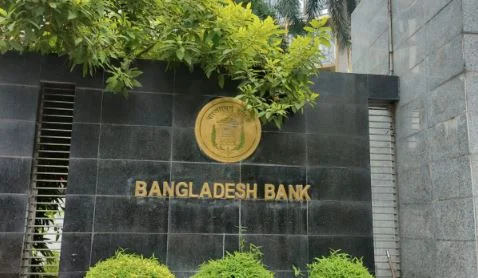
Bangladesh Bank has kept its policy rate unchanged at 9.5 percent for the October-December quarter, citing persistent risks to inflation despite a recent moderation in price pressures.
The central bank announced the contractionary monetary policy for the second quarter of FY27 on Wednesday, keeping its key rates unchanged as it seeks to bring inflation under control without further weakening economic activity.
Deputy Governor Dr Habibur Rahman announced the policy at a press briefing in Dhaka.
The Standing Lending Facility (SLF) rate has also been retained at 11 percent, while the Standing Deposit Facility (SDF) rate remains at 7.5 percent.
The Monetary Policy Committee (MPC), at its 14th meeting on September 23, decided to keep the rates unchanged.
According to Bangladesh Bank, there is still insufficient evidence that the recent decline in inflation will be sustained over the longer term.
It warned that higher global energy prices, possible disruptions in the Strait of Hormuz, further adjustments to administered fuel prices at home and the potential impact of a new pay structure could renew inflationary pressures.
The central bank said an early easing of monetary policy could raise inflation expectations and prolong the process of bringing inflation back to the target.
Growth remains under pressure
Economic activity also remains weak, with real GDP growth estimated at 4.14 percent in FY26.
Growth in the third quarter of FY26 was estimated at only 2.2 percent, while industrial production contracted by 0.28 percent during the period, according to the monetary policy statement.
Bangladesh Bank said it has taken measures to support economic recovery, including a Tk60,000 crore incentive package.
Of the package, Tk20,000 crore has been earmarked for reopening closed factories. The central bank also highlighted refinancing schemes for agriculture, cottage, micro, small and medium enterprises (CMSMEs) and export diversification.
However, it said monetary policy alone cannot remove supply-side constraints and stressed the need for structural reforms alongside financial support to boost investment and production.
Private credit growth stays weak
Private-sector credit growth remained subdued at 4.75 percent in August 2026, reflecting weak investment demand, high borrower risk and vulnerabilities in the banking sector.
Bangladesh Bank noted that interbank interest rates and yields on government securities declined after it cut the policy rate by 50 basis points to 9.5 percent on August 2.
But the lower rates have yet to translate into a significant recovery in private-sector borrowing.
The banking sector’s non-performing loan ratio rose to 32.78 percent in June, underscoring the need for bank restructuring, stronger governance, capital recovery and tighter credit discipline, the central bank said.
Remittances provide external-sector support
The country’s external position improved significantly in FY26, with the overall balance of payments recording a surplus of $6.6 billion.
However, the overall balance turned into a deficit in the first two months of FY27, mainly because of a deficit in the financial account.
Remittance inflows rose 18.90 percent during the period, providing some relief to the external sector. A relatively stable exchange rate also helped contain imported inflation.
Bangladesh Bank identified prolonged conflict in the Middle East and possible disruption in the Strait of Hormuz, high global fuel and fertiliser prices, tight global monetary conditions, domestic energy and infrastructure constraints, fiscal pressures and weaknesses in the banking sector as key risks to the economy.
The central bank said its main challenge was to support economic activity without disrupting the ongoing process of reducing inflation.
It said future monetary policy decisions would be based on data and a close assessment of both domestic and global economic conditions.