


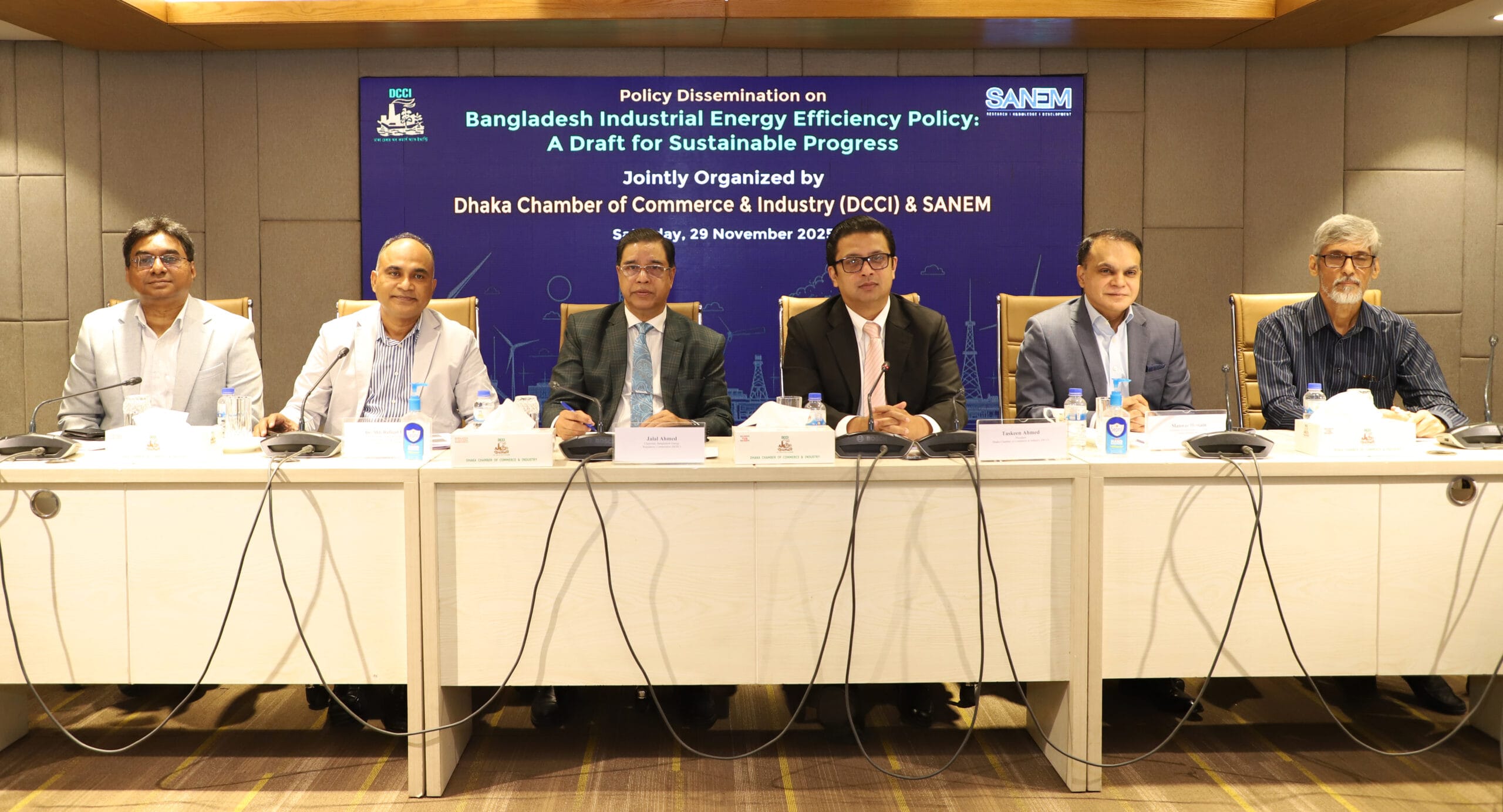
Bangladesh’s business leaders, energy regulators, researchers, and policymakers have reiterated that ensuring energy security is now the most critical priority for sustaining industrial growth.
The call came at a Policy Dissemination event titled “Bangladesh Industrial Energy Efficiency Policy: A Draft for Sustainable Progress”, jointly organised by the Dhaka Chamber of Commerce & Industry (DCCI) and the South Asian Network on Economic Modeling (SANEM) at the DCCI Auditorium.
Jalal Ahmed, Chairman of the Bangladesh Energy Regulatory Commission (BERC), attended the programme as chief guest.
In his welcome remarks, DCCI President Taskeen Ahmed said uninterrupted energy supply has emerged as one of the biggest challenges for the industrial sector, which accounts for more than 35% of GDP. Despite using 19% of national gas, industries are facing what he described as an “existential crisis.”
He noted that after a record 178% gas price hike in FY2023-24, a further 33% increase this year has severely impacted key sectors including textiles, steel, and fertilisers, cutting their production by 30-50%. Many SMEs have also been forced to scale back sharply.
He stressed that reliable energy is now a prerequisite for sustainable industrialisation, urging the government to reduce reliance on fossil fuels, expand renewable energy, establish a detailed sustainable energy framework, and curb wastage.
Chief Guest Jalal Ahmed warned that Bangladesh has made little progress in offshore or onshore gas exploration despite repeated calls. With growing dependence on imports, rising energy subsidies continue to strain the budget.
He said the country’s current energy efficiency level is only around 30%, and improving electricity efficiency could significantly ease shortages. He also called on the RMG sector to adopt renewable solutions more aggressively.
Policy gaps and sectoral insights
Presenting the keynote, Dr Selim Raihan, Executive Director of SANEM and Professor of Economics at the University of Dhaka, said that although Bangladesh has an energy master plan, the lack of supportive and clearly defined policies undermines industrial progress.
Energy efficiency, he noted, lacks uniform definitions and incentive frameworks across sectors.
Findings from DCCI-SANEM focus groups highlighted priorities including awareness, energy audits, financing, grid modernisation, logistics expansion, increased gas and electricity supply, and better implementation mechanisms. Participants also stressed the need for mandatory energy audits.
Dr Raihan proposed a three-pronged strategy — structural, supply-side, and regulatory — to strengthen the sector.
Dr Md Rafiqul Islam of BEPRC said energy security is as vital as food and national security. With energy imports reaching $20 billion last fiscal year, he urged greater emphasis on domestic resources and increased private-sector engagement.
Power Grid Bangladesh PLC Chairman Dr M. Rezwan Khan called for revising the tariff structure to differentiate peak and off-peak use.
He said fuel purchase constraints, not just system inefficiencies, are a major reason for load shedding.
Industry voices: production disruptions and fiscal pressure
Industry leaders expressed deep concern over production losses.
Anwar Group Chairman Manwar Hossain warned that production disruptions nearing 50% in many industries pose a serious risk to the economy.
BCMA President Mohammed Amirul Haque said the LPG sector, despite its potential contribution to energy security, faces nearly 10% taxation that needs review.
BSREA President Mostafa Al Mahmud said demand is rising by 20% annually, but implementation remains weak. With industries consuming half of all electricity, he called for mandatory energy audits.
Engr Md Serajul Mawla highlighted that 2,300 LPG autogas stations could generate 700-800 MW of power with the right policy support.
Sustainability and financing challenges
BGMEA Vice President Vidiya Amrit Khan said renewables account for only 4% of the national grid, putting Bangladesh at a competitive disadvantage as global buyers push for sustainability. She also noted the lack of green financing for renewable projects.
IDCOL Deputy CEO S. M. Monirul Islam recommended issuing green bonds to bridge financing gaps and strengthen policy implementation.
Former DCCI leaders Malik Talha Ismail Bari, M. Bashirullah Bhuiyan, and M. S. Siddiqui also shared observations during the open-floor session.
DCCI Vice President Md Salem Sulaiman, board members, and representatives from public and private institutions attended the event.