


The government expects to resolve its differences with the International Monetary Fund (IMF) over the ongoing loan programme by January-February next year, as it seeks to align the fund’s conditions with Bangladesh’s economic realities and its own development priorities.
Finance Minister Amir Khosru Mahmud Chowdhury said two working groups comprising government and IMF representatives were working to reconcile the differences, ruling out any plan to withdraw from the programme.
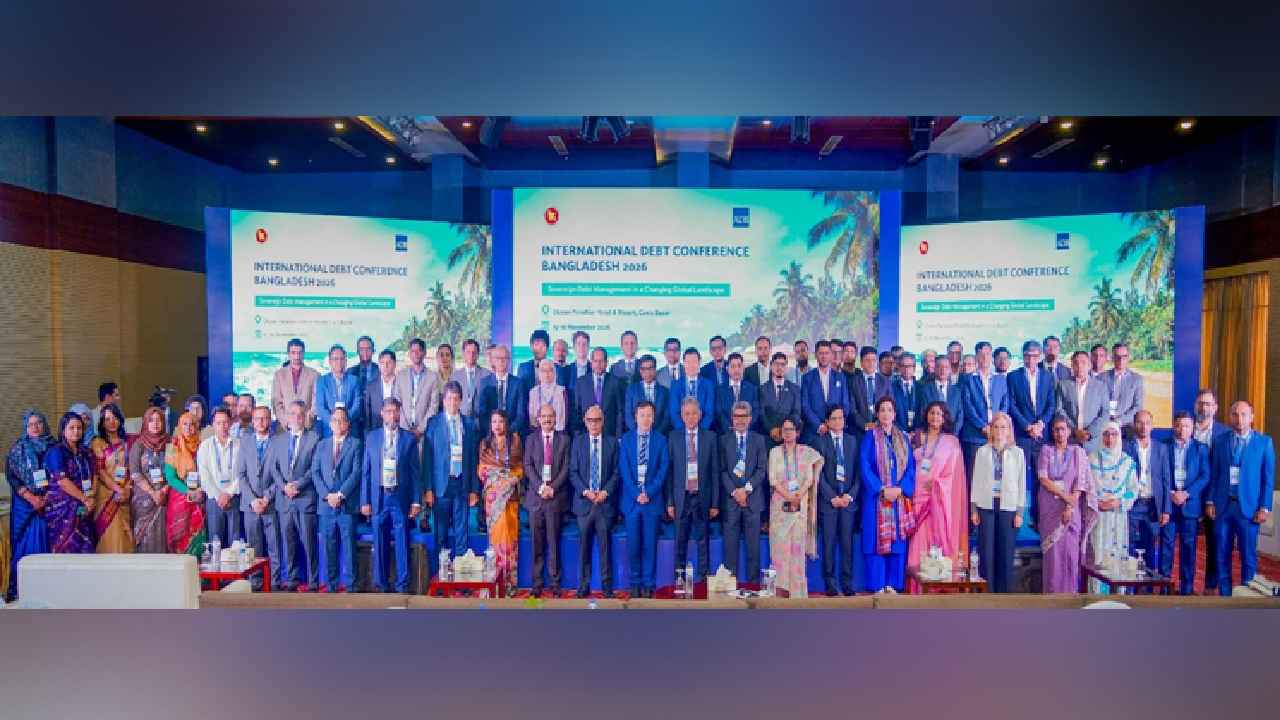
“We are not moving away from the IMF programme. We are working to align it with the country’s present economic situation, people’s interests and the government’s development priorities,” he told reporters after inaugurating the first International Debt Conference Bangladesh 2026 in Cox’s Bazar on Sunday.
The minister said the programme was negotiated under the previous unelected government, and the conditions agreed upon then could not be implemented overnight by the present elected government.
Sudden implementation of some of those conditions could put additional pressure on ordinary people, disrupt businesses and hurt the wider economy, he said.
The government was also coordinating its development priorities with the World Bank, the Asian Development Bank (ADB) and the Japan International Cooperation Agency (JICA) to ensure that assistance from development partners reflected the country’s needs.
Khosru was responding to questions about the rationale for continuing with the IMF programme despite the availability of alternative financing and the fund’s stringent conditions.
At the two-day conference, jointly organised by the Finance Division and the ADB, the minister also outlined the government’s approach to managing public debt, stressing that the key challenge was weak revenue mobilisation and inefficient use of borrowed funds, rather than the volume of debt alone.
“What matters is not how much we borrow, but how effectively we use the money,” he said, arguing that loans should finance projects capable of generating economic growth and returns sufficient to support repayment.
He said the government inherited a heavy debt burden when it took office in February, alongside high interest payments, depleted foreign exchange reserves and substantial reliance on Bangladesh Bank financing to meet the budget deficit.
To illustrate the changes, he said government borrowing from Bangladesh Bank had fallen from Tk56,750 crore on June 30, 2024, to Tk482 crore on June 30, 2026.
Foreign exchange reserves, calculated under the IMF’s BPM6 methodology, rose to more than $30 billion in June this year from around $20.5 billion on July 31, 2024, he added.
The cost of government borrowing has also declined. The interest rate on 91-day Treasury bills fell from around 12 percent in June 2025 to below 10 percent in June 2026 and now stands at 8-9 percent, according to the minister.
However, the debt-servicing burden is set to grow. External principal and interest payments amounted to $4.5 billion in FY26 and could rise to around $5.5 billion by FY30, he said.
To contain repayment risks, the government plans to rely more on long-term bonds and sukuk instead of expensive short-term borrowing.
Khosru identified revenue mobilisation as the most important reform for ensuring debt sustainability. Expanding the tax net, reducing unjustified tax exemptions and digitising VAT and income tax collection are among the priorities.
He also stressed the need to restore discipline in the banking sector, improve scrutiny of development projects and avoid financing budget deficits through money creation.
The government is preparing its first annual borrowing plan and a new medium-term debt strategy to make borrowing decisions more transparent and predictable for domestic and foreign investors.
It also wants to deepen the domestic bond market by attracting pension funds, insurance companies and foreign investors, reducing excessive reliance on banks for long-term financing.
The government is exploring access to international capital markets through instruments such as dollar-denominated eurobonds, sukuk, Samurai and Panda bonds, as well as green and blue bonds.
The minister said sustainable debt management would be essential to achieving the government’s ambition of building a $1 trillion economy by 2034 and ensuring a smooth graduation from the least developed country (LDC) category in 2029.
The two-day conference has brought together experts from the IMF, World Bank and ADB, along with representatives from the United States, the United Kingdom, Malaysia, Indonesia, Pakistan and Sri Lanka, to discuss sovereign debt management, domestic bond markets, debt risks and alternative financing instruments.