


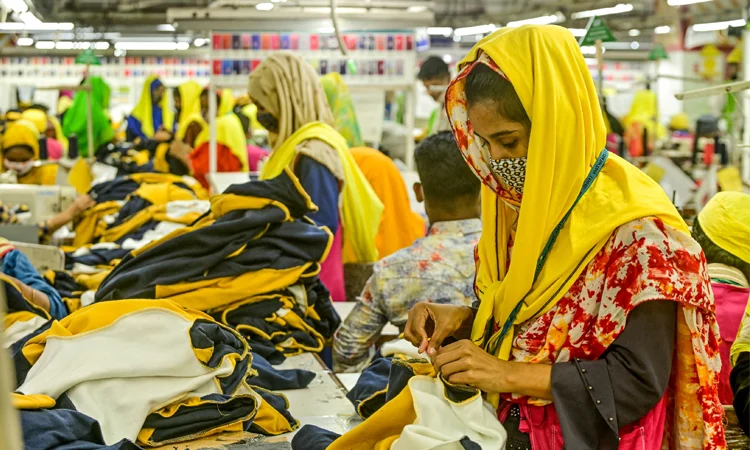
South Korean companies see significant investment opportunities in upgrading Bangladesh’s ready-made garment (RMG) industry, says BSS report.
Bangladesh’s RMG may enhance value addition and strengthen the country’s global competitiveness by expanding the use of man-made fibres (MMF), functional textiles, automated sewing equipment and garment accessories
Talking to BSS, Deputy Director of the Korea Trade-Investment Promotion Agency (KOTRA) in Dhaka Lee Sung-hoon (Daniel Lee) said Korea’s advanced expertise in man-made fibres, technical textiles and industrial automation aligns closely with Bangladesh’s strategy to transform its apparel sector from a volume-driven industry into a higher-value manufacturing hub.
“Bangladesh’s RMG sector, accounts for around 84 percent of the country’s exports and about 10 percent of GDP, but the industry remains largely dependent on natural fibres with a value-added ratio of approximately 30 percent,” he added.
There is considerable scope for Bangladesh to move up the value chain. Korea is globally competitive in man-made fibres and functional and technical textiles, which aligns precisely with Bangladesh’s policy of increasing the share of MMF in garment production, he said.
Lee said cooperation could also expand significantly in automated sewing equipment, garment and footwear accessories, enabling Bangladeshi manufacturers to improve productivity, diversify products and meet changing global demand.
He noted that Korean companies are particularly interested in supporting Bangladesh’s transition toward higher-value apparel as international buyers increasingly demand functional fabrics, performance wear and sustainable textile products.
Lee said KOTRA is promoting cooperation in three key areas- product upgrading, process automation and compliance with emerging environmental and regulatory standards.
He said shifting production from natural fibres to man-made fibres and functional materials remains the most effective way to increase value addition.
Korean companies possess extensive expertise in both yarn and fabric production, creating opportunities for joint ventures and technology partnerships, he said.
Lee said Bangladesh’s textile machinery market is around US$2.1 billion, and investment in modern equipment is gradually recovering as foreign exchange reserves improve.
He said Korean manufacturers see growing demand for automated cutting and sewing systems, automated inspection technologies and energy-efficient factory management solutions. Bangladeshi buyers consistently rate Korean machinery highly for its balance of quality and price, he added.
The KOTRA official said regulatory compliance and environmental sustainability have become increasingly important for Bangladesh’s export-oriented garment industry as European market tightens supply chain on the issues of due diligence, eco-design and carbon emission requirements.
He said Korean legal, AI and ICT firms are working with KOTRA to help Bangladeshi garment manufacturers prepare for the European Union’s Digital Product Passport (DPP) requirements, which are expected to become a key compliance standard for exporters.
Bangladesh already has the world’s highest number of LEED-certified green garment factories, he said, adding that the next challenge is converting those environmental achievements into internationally recognized regulatory compliance.
Lee also said KOTRA is supporting Bangladeshi manufacturers in improving energy efficiency, rooftop solar and wastewater treatment as productivity and environmental performance increasingly go hand in hand.
Recalling the long-standing partnership between the two countries, Lee said Korea played a pivotal role in the birth of Bangladesh’s garment industry through Daewoo’s joint venture in 1978, when Bangladeshi workers received training in Korea to establish export-oriented apparel sector.
Today, around 70 percent of Korean manufacturing investment in Bangladesh remains concentrated in the textile and garment industries, making modernization of the sector a shared priority, he added.
Beyond garments, Lee identified pharmaceuticals and biotechnology, consumer goods, infrastructure, ICT and renewable energy as the other major sectors offering strong investment potential for Korean companies.
He said Bangladesh’s pharmaceutical industry, expected to grow rapidly in the coming years, offers opportunities for cooperation in active pharmaceutical ingredients (APIs), oncology medicines, vaccines and biologics.
In the consumer sector, he said the country’s expanding middle-income population is creating new demand for processed foods and K-beauty products, with Korean manufacturers increasingly partnering with local firms to develop Bangladeshi brands.
Lee also highlighted opportunities in smart infrastructure, intelligent transport systems, renewable energy, artificial intelligence and digital government services.
He said recently concluded negotiations on the Korea-Bangladesh Comprehensive Economic Partnership Agreement (CEPA) would provide a stronger institutional foundation for expanding trade, investment and technology cooperation.
Describing Bangladesh as an attractive investment destination, Lee said, Bangladesh’s has a large young workforce, growing domestic consumer market, globally competitive garment ecosystem and nearly five decades of Korean business experience.
He, however, said continued reforms in regulatory consistency, certification procedures, profit repatriation, infrastructure and policy predictability would further encourage Korean investment in Bangladesh.
Lee expressed optimism that restoration of political stability, conclusion of the CEPA negotiations and Bangladesh’s preparation for LDC graduation could open a new chapter in bilateral economic relations over the next few years.