


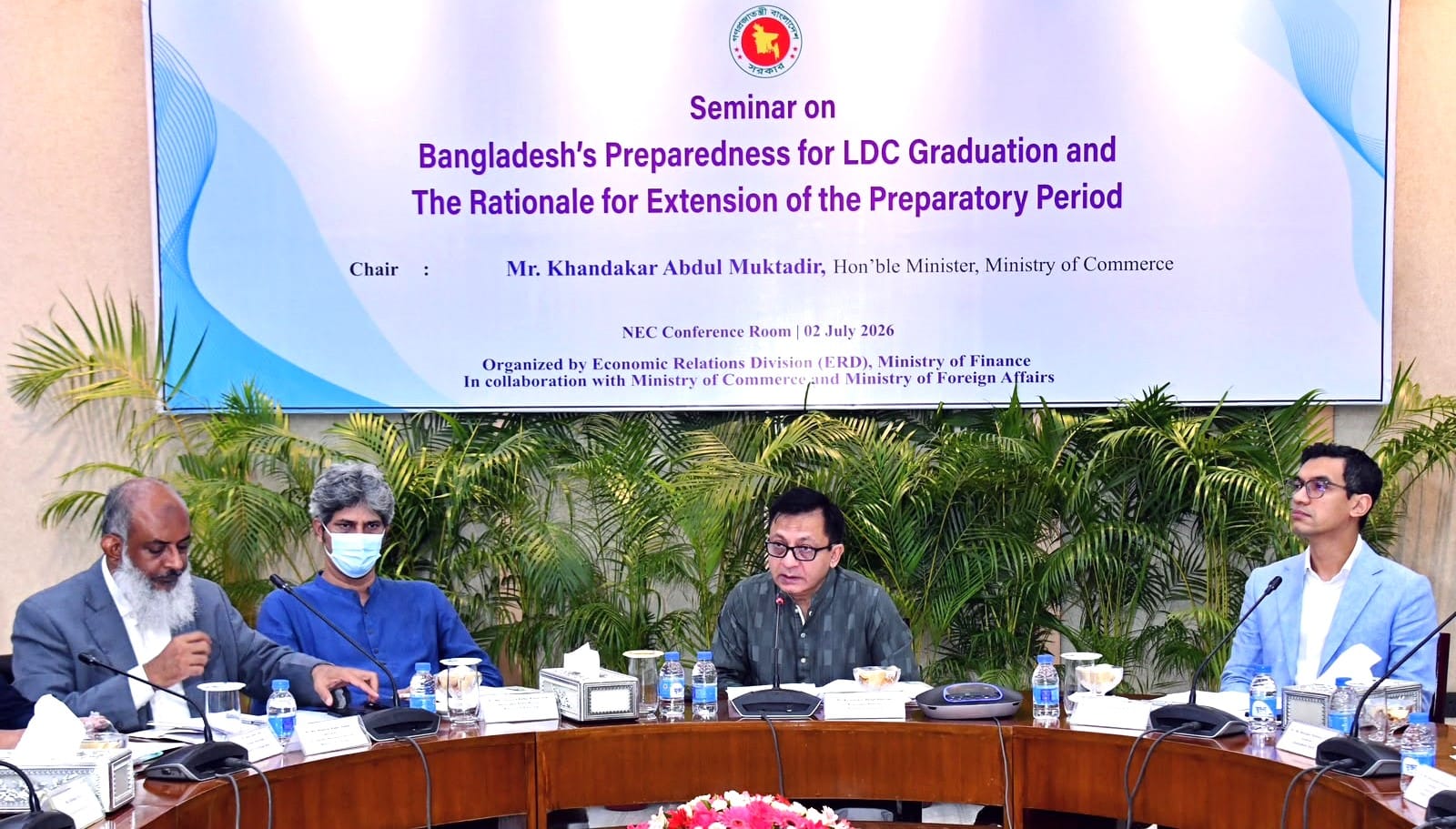
Bangladesh government has sought a three-year extension in LDC transition period category to ensure a smooth and sustainable transition rather than only to delay the process, Commerce Minister Khandaker Abdul Muktadir has said.
“The additional time is not intended to delay graduation. We need it to ensure a sustainable, stable and effective economic transformation,” he said on Thursday while addressing a seminar on the country’s LDC graduation preparedness at the NEC conference room in Agargaon.
Bangladesh has formally requested the UN Committee for Development Policy (CDP) to extend its preparatory period for LDC graduation by three years.
According to the government, the CDP has responded positively and submitted its assessment to the UN Economic and Social Council (ECOSOC), which is expected to consider the proposal before forwarding it to the UN General Assembly for final approval.
The commerce minister said Bangladesh had faced a series of global and domestic challenges during the transition period, including disruptions in international trade, geopolitical tensions, persistent inflationary pressures and supply chain disruptions, which had put pressure on the economy and constrained institutional capacity.
“Our immediate priority is to restore macroeconomic stability while strengthening the foundations for sustainable development,” he said.
Citing a graduation preparedness assessment conducted by the UN Office of the High Representative for the Least Developed Countries, Landlocked Developing Countries and Small Island Developing States (OHRLLS), Muktadir said the current global and domestic environment was not sufficiently conducive for graduation within the existing timeline, making additional preparation necessary.
The seminar titled “Bangladesh’s Preparedness for LDC Graduation and the Rationale for Extension of the Preparatory Period” was organised by the Economic Relations Division (ERD) of the Ministry of Finance in collaboration with the Ministry of Commerce and the Ministry of Foreign Affairs.
It was attended by diplomats, development partners, business leaders and policymakers.
Muktadir said the government had already adopted a roadmap comprising 25 priority reform measures covering macroeconomic stability, trade and investment reforms, deregulation, competitiveness, institutional strengthening and human resource development.
As part of efforts to improve the business climate, the minister said the government aims to reduce the time required to start a business from around one year to just 14 days, allowing companies to open letters of credit for importing machinery on the 15th day.
He also said steps were being taken to simplify business registration and licensing procedures by eliminating duplication and administrative bottlenecks to reduce both the time and cost of doing business.
State Minister for Planning Zonayed Saki said the government had inherited a fragile economy and a weakened financial sector and was working to restore macroeconomic stability and rebuild institutions. He stressed the need for continued support from development partners during the reform process.
ERD Secretary Md Shahriar Kader Siddiky presented the keynote paper outlining Bangladesh’s major economic, structural and external vulnerabilities, along with a time-bound roadmap for utilising the proposed extended preparatory period.
European Union Ambassador to Bangladesh Michael Miller said it was important that Bangladesh maintain the momentum of its reform agenda despite the changing global trade environment.
He also emphasised greater market openness and a level playing field as key elements for deepening trade relations between Bangladesh and the EU.
Participants, including diplomats, representatives of development partners, think tanks and business associations, underscored the importance of export diversification, financial sector reforms and broadening the tax base to ensure a successful and sustainable transition from LDC status.