


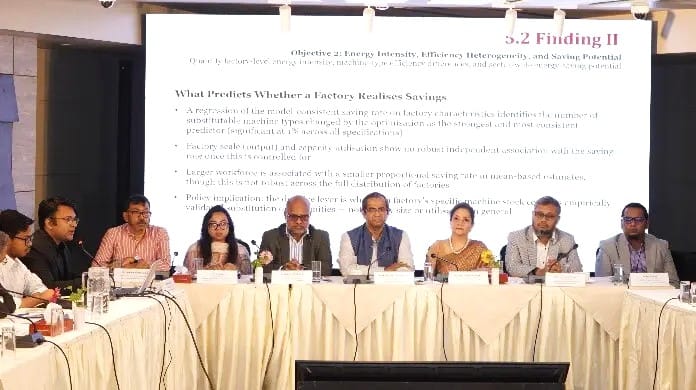
Bangladesh’s apparel industry needs an estimated Tk 13,209 crore in investment to modernise machinery and expand the use of renewable energy and environment-friendly technologies, according to a study by the Centre for Policy Dialogue (CPD).
The investment could facilitate the modernisation of 15,002 pieces of machinery in garment factories, with about Tk 6,604 crore required if 50 percent of the proposed upgrades are implemented.
The study estimates that replacing machinery with appropriate energy-efficient models could save up to 256,446 megawatt-hours of energy annually.
The findings were presented yesterday at a national dialogue on industrial decarbonisation organised at the BRAC Centre in Dhaka.
The study, titled “Renewable Energy as a Competitive Strategy for Industrial Carbon Emission Reduction in Bangladesh’s RMG Sector”, was based on data from 350 garment factories.
Larger factories bear bulk of investment
The study found that larger factories would account for the bulk of the required decarbonisation investment.
Factories employing an average of 2,105 workers account for about one-fourth of the surveyed factories but would require 70.9 percent of the total proposed investment.
Implementing half of the recommended investment would cost an average of Tk 73.1 crore for these larger factories.
In contrast, factories employing an average of 111 workers would account for only 0.3 percent of the total investment requirement.
The study also found significant differences in energy-saving potential across production sections.
Although around 85 percent of machinery capacity in the apparel sector is concentrated in sewing, machinery replacement there could generate only 2.9 percent of the potential energy savings because many sewing machines are technologically indispensable.
The cutting section, which accounts for only about 5.5 percent of machinery, could deliver 27.3 percent of the total potential energy savings through replacement.
Washing, dyeing most energy-intensive
Washing and dyeing were found to be the most energy-intensive sections, with energy intensity nearly twice that of the next-highest section.
As these sections rely heavily on gas-fired boilers and thermal processes, replacing machinery or using solar power alone would not be enough to fully decarbonise them.
However, rooftop solar power could help factories reduce energy costs.
According to the study, offsetting 10 percent of electricity consumption with solar power could reduce average energy costs by about 5.5 percent.
A 30 percent solar offset could lower average costs by around 15.7 percent, with savings ranging from 4.4 percent to 23.7 percent across factories.
Financing a major hurdle
The CPD identified financing as a major barrier to technological upgrades, particularly for small and medium-sized factories.
It recommended expanding concessional loans, blended finance and government support for these factories.
The think tank also proposed mandatory performance-based energy audits and standardised emissions reporting for factories.
It called for a standardised assessment framework for financial institutions to make it easier to approve loans for renewable energy and energy-efficiency projects.
RMG should get priority
CPD Research Director Khondaker Golam Moazzem said the government should form an emergency response team to implement urgent solutions to the country’s energy problems.
Given the need for quick decisions and implementation, the RMG sector should be prioritised in efforts to reduce industrial carbon emissions, he said.
ETI Bangladesh Director Munir Uddin Shamim said the apparel industry was facing an energy crisis even as it had received large orders ahead of Christmas.
“Production must continue by any means,” he said, stressing that factories and industry associations could not address the challenge alone and that all stakeholders needed to play a role.
He also called for better coordination in government policymaking on carbon emissions.
Bangladesh Knitwear Manufacturers and Exporters Association Executive President Fazle Shamim Ehsan said there was no alternative to renewable energy for export-oriented industries.
He noted that Bangladesh’s competitors, including Vietnam and China, were using 35-50 percent green energy.
Ehsan said financing facilities existed but were difficult for businesses to access, while high interest rates and lengthy approval processes discouraged investment in green technologies.
Bangladesh Sustainable and Renewable Energy Association President Mostafa Al Mahmud said decarbonisation in the apparel sector was not merely an environmental issue but also a matter of cost, sustainable investment and business competitiveness.
“There is no alternative to renewable energy for the country in the future,” he said.