


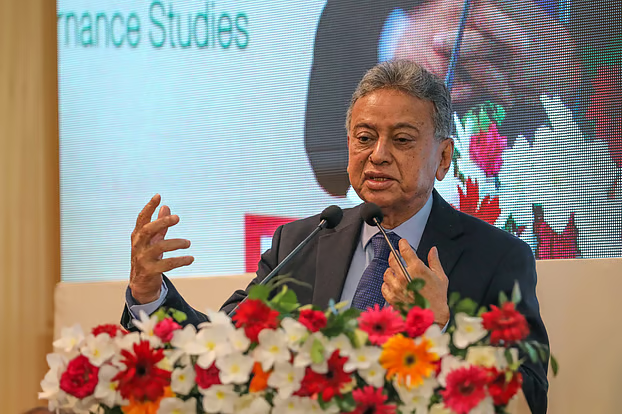
Finance Minister Amir Khosru Mahmud Chowdhury on Monday said Bangladesh’s long-struggling stock market is set to recover within the next two years, as the government rolls out sweeping reforms to rebuild investor confidence and improve governance.
Speaking at a post-budget discussion at the University of Asia Pacific in the capital, the minister described the current state of the capital market as deeply fragile but showing early signs of recovery.
“Effectively, there was no functioning stock market — it had been destroyed. We have begun rebuilding from that position,” he said.
He noted that a new leadership team has already been appointed at the market regulator based on professional competence rather than political considerations, signalling a shift toward stronger institutional integrity.
The government has launched a series of reforms simultaneously to enhance transparency, protect investors and attract quality listings, he said, adding that restoring confidence remains the top priority.
“Good companies are not coming to the market because of a lack of trust. Our first task is to bring that trust back,” the minister said.
He also pointed to growing interest from global investors, noting that international financial institutions, including JPMorgan, have already engaged with the government regarding potential investments.
Linking capital market reforms to the broader economic strategy, the finance minister said the proposed FY2026–27 budget aims to unlock new opportunities for young people, particularly in the digital economy.
He announced that several global payment platforms, including PayPal, are preparing to begin operations in Bangladesh, which is expected to facilitate cross-border transactions for freelancers and digital entrepreneurs.
“We have removed many of the barriers to bringing in foreign earnings. Up to $5,000 can now be received without formalities,” he said, adding that remittance channels have been made more accessible and user-friendly.
The minister underscored the government’s push toward full digitalisation, saying public services are being moved online in real time to reduce corruption and improve efficiency.
“As physical interaction declines, corruption will also decrease. We want people to access services from home, not run from office to office,” he said.
Outlining the philosophy behind the budget, Chowdhury said the government is shifting away from a “patronage-driven economy” toward a model of “economic democratisation” aimed at ensuring broader participation and equitable growth.
He said initiatives are underway to integrate marginalised groups — including artisans, small entrepreneurs and cultural practitioners — into the mainstream economy, alongside plans to develop a 160-acre theatre district in Purbachal to support the creative industry.
The discussion was organised by the Centre for Governance Studies (CGS) in collaboration with the University of Asia Pacific. Economist Selim Jahan, Transcom Group CEO Simeen Rahman and business leader Anwar-ul Alam Chowdhury (Parvez), among others, also spoke.