


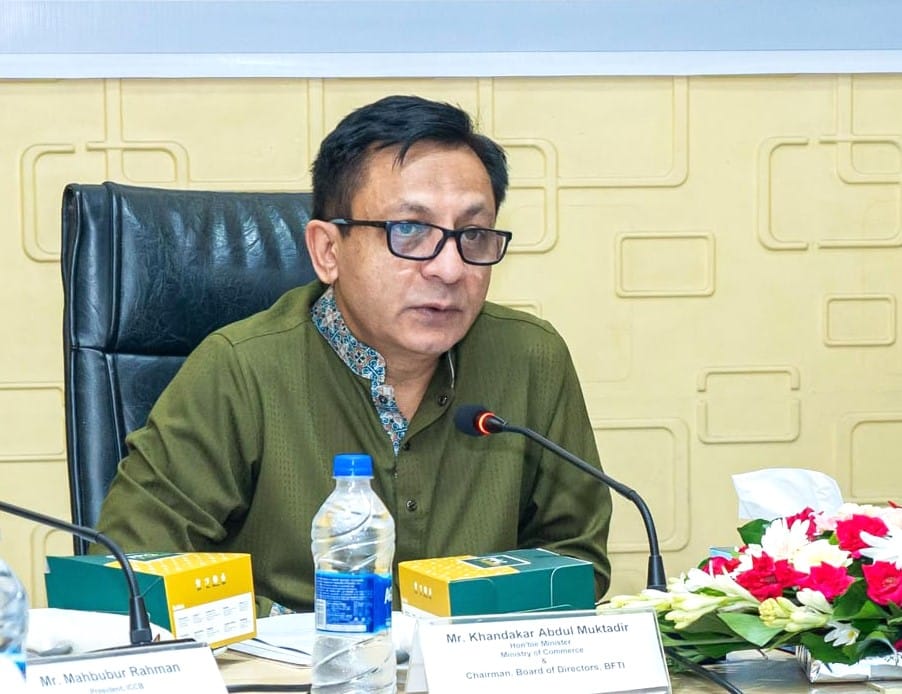
Recent changes to the United States’ tariff regime will have no additional impact on Bangladesh’s exports as the effective duty remains unchanged at 10 percent, Commerce Minister Khandaker Abdul Muktadir said on Sunday.
He also said the government is stepping up efforts to diversify the country’s export basket to reduce its heavy dependence on the ready-made garment (RMG) sector, with leather goods, shipbuilding, light engineering and information technology among the priority industries.
The minister made the remarks while speaking to reporters after a meeting at the Secretariat on setting the export target for fiscal year 2026-27.
Responding to a question on the latest US tariff measures, Muktadir said Washington had initially announced a 37 percent reciprocal tariff on Bangladeshi goods before reducing it to 19 percent. The measure was later struck down following a ruling by a US court.
He said the US administration subsequently invoked Section 122 to impose tariffs on balance-of-payments grounds for a limited period. Before that authority expired, however, a new 10 percent tariff was imposed under Section 301, citing labour-related issues.
“In practical terms, nothing has changed,” the commerce minister said, adding that the previous 10 percent tariff had simply been replaced by another 10 percent duty under a different legal framework.
Muktadir said the measure was not targeted at Bangladesh alone, noting that nearly 60 countries, including the European Union and the United Kingdom, are subject to similar tariffs.
“As a result, Bangladesh will not face any additional competitive disadvantage in the US market,” he said.
Turning to export diversification, the commerce minister said Bangladesh could no longer afford to rely overwhelmingly on a single sector.
He noted that about 85 percent of the country’s export earnings currently come from the RMG industry, describing such dependence as unsustainable for a country of nearly 180 million people.
The government has therefore identified leather and leather goods, footwear, shipbuilding, ship recycling, light engineering and information technology as priority sectors for renewed policy support, he said, adding that sector-specific initiatives would be announced soon.
Building new export industries is a gradual process that requires developing entrepreneurs, fully utilising existing production capacity and expanding market access, Muktadir said.
He expressed the hope that Bangladesh’s apparel exports could increase from the current $38-39 billion to $70-80 billion over the next four to five years, while exports from other sectors would eventually generate an additional $100 billion.
Addressing concerns over gas shortages raised by industrialists, the commerce minister said Bangladesh currently produces around 1,700 million cubic feet of natural gas per day (MMCFD) and imports another 900-950 MMCFD of liquefied natural gas.
He said the country’s two existing floating storage and regasification units (FSRUs) had reached their maximum capacity, limiting further LNG imports.
The Energy Ministry is working to add two more FSRUs, which would help ease supply constraints and enable industries to utilise idle production capacity, he said.
According to Muktadir, around 30 percent of the country’s installed industrial production capacity remains underutilised because of energy shortages. While increasing gas supply would improve capacity utilisation, he acknowledged that there is no immediate solution.
Explaining why the government has set a higher export target for FY2026-27 despite missing last year’s goal, the commerce minister said the policy uncertainty associated with the previous interim administration had largely been resolved following the installation of an elected government.
He also said uncertainty surrounding Bangladesh’s graduation from the UN’s Least Developed Country (LDC) category had eased after the country successfully completed two technical review stages under the UN system.
As a result, Bangladesh does not expect any major changes to its market access conditions over the next three years, he added.