


Around 1,300 more readymade garment factories in Bangladesh are ready to install rooftop solar systems if they can access green financing at an interest rate of 6.5 percent, according to the Centre for Policy Dialogue (CPD).
CPD Research Director Khondaker Golam Moazzem said about 500 garment factories are already prepared to invest in rooftop solar, while another 1,300 could join the transition if financing conditions are made more favourable.
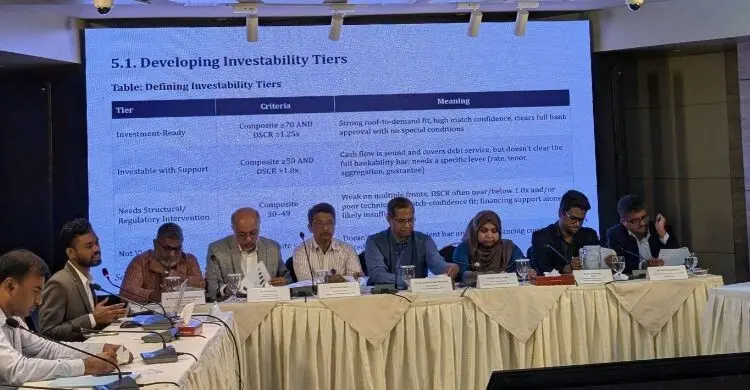
He made the remarks on Thursday at the fifth Bangladesh-China Renewable Energy Forum organised by the CPD at BRAC Centre Inn in Dhaka.
Speaking at a session titled “Rooftop Solar Power in RMG Factories: Potential for Chinese FDI,” Moazzem said affordable financing would be critical to scaling up renewable energy adoption in the garment sector.
The CPD presented a study titled “Industrial Rooftop Solar in RMG Sector” at the event. The research analysed data from 3,320 garment factories, including a direct survey of 350 factories representing about 10.5 percent of the country’s total garment factories.
The study found that renewable energy currently accounts for only 3 percent of the total electricity demand of 878 surveyed factories in Gazipur and Narayanganj.
Yet rooftop solar could potentially meet around 14 percent of the garment sector’s total electricity demand, it said.
The study estimated the total rooftop solar potential of the RMG and textile sectors at around 2,815 megawatts, requiring an investment of about Tk 126.69 billion, or $1.03 billion.
Of this, around $188.2 million could be invested in solar installations at 2,303 non-adapter factories with a capacity of 300 kilowatts or more, according to the research.
Rooftop solar is also significantly cheaper than grid electricity, with the average generation cost estimated at only Tk 3.04 per kilowatt-hour, less than half the cost of purchasing electricity from the national grid.
However, financing remains a major obstacle.
The CPD study found that industrial rooftop solar projects become commercially unattractive to banks when financed at interest rates above 10.5 percent. It therefore called for continued access to green finance and concessional loans.
“Everyone is engaged in crisis management. This crisis could have been less severe if we had expanded the use of renewable energy in industries much earlier,” Moazzem said.
He said the gradual shift of the garment sector towards rooftop solar was encouraging as it could both reduce pressure on the energy system and help the industry meet its decarbonisation commitments.
Moazzem said the garment sector has around 9.7 million square metres of rooftop space suitable for solar installations, with the potential to generate about 1,768MW of electricity.
He said the investment requirement was not particularly large.
“Only $188 million would be enough. We do not need a huge amount of money,” he said.
“About 500 factories can invest now. Another 1,300 factories can move to rooftop solar if they receive the necessary support,” he said, adding that more intervention would be required for more than 400 factories.
“If green finance is available at 6.5 percent interest, that would be the best option,” Moazzem said.
The study also highlighted growing pressure from international apparel buyers to reduce the carbon footprint of garment production.
Major global buyers, including H&M, Inditex, Walmart, Gap and Marks & Spencer, are encouraging factories to increase their use of renewable energy.
The CPD study said factories may need to increase renewable energy use to 35 percent by 2035 to align with relevant European Union requirements.
Industry representatives, however, said rooftop solar alone would not be sufficient to meet the overall energy demand of factories because of limited rooftop space.
Tanul Chakraborty, head of power and energy at Ha-Meem Group, said the group had already installed 29.2MW of rooftop solar across its factories.
“This meets only 15 percent of our total electricity demand and 6 percent of our total energy demand. That is the reality,” he said.
He said many factories occupy multi-storey buildings, leaving limited rooftop space for solar installations.
Citing one of the group’s factories at Jirani Bazar, Chakraborty said the facility had only enough rooftop space for a 272kW solar installation, despite having an electricity demand of around 1.5MW.
Representatives from the Bangladesh Investment Development Authority (BIDA), Bangladesh Rural Electrification Board (BREB), Bangladesh Sustainable and Renewable Energy Association, Bangladesh Knitwear Manufacturers and Exporters Association (BKMEA) and other stakeholders attended the forum.