


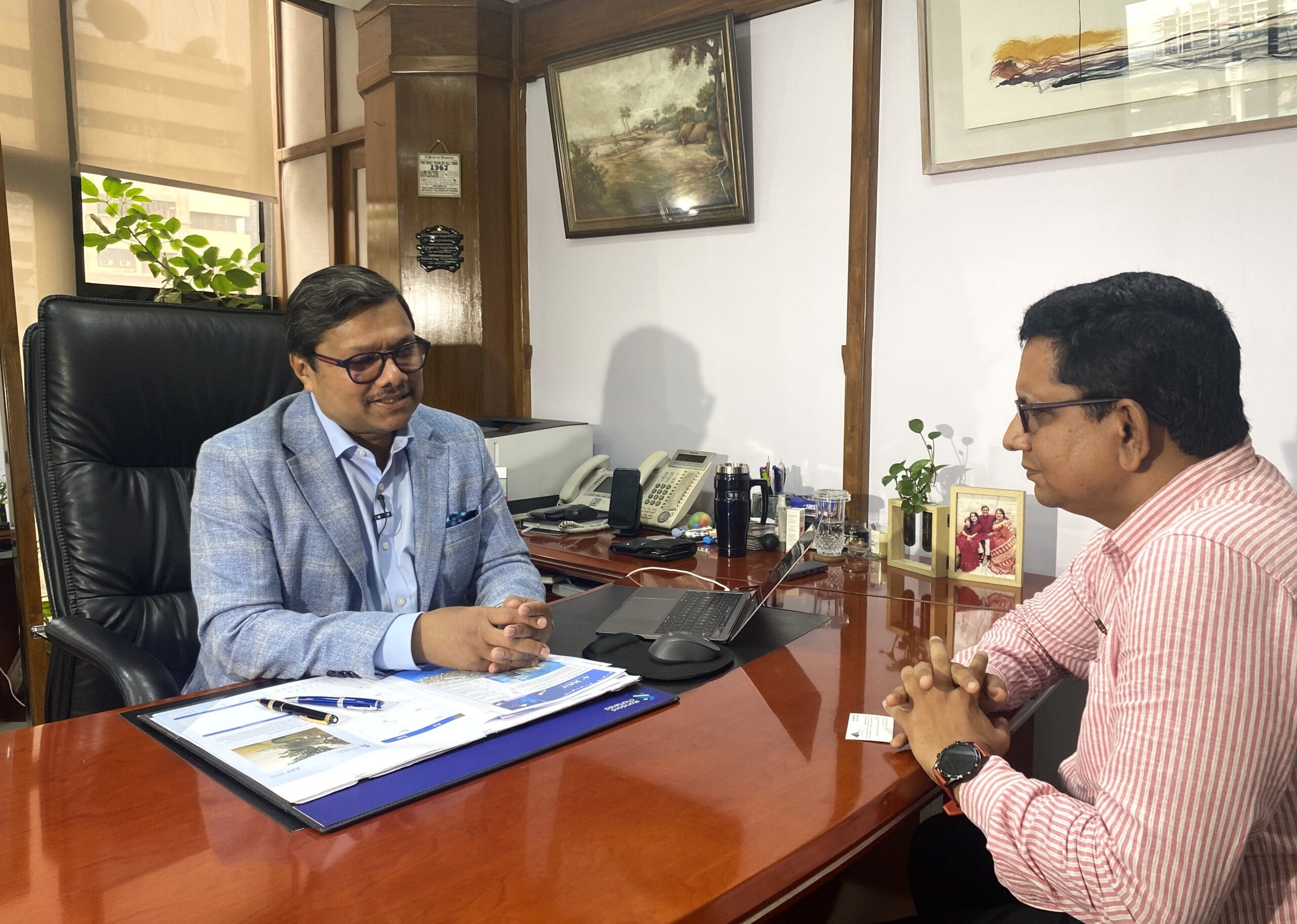
In an exclusive interview with Just Energy News, Summit Meghnaghat-1 and Summit Meghnaghat-2 Power Co. Ltd managing director and CEO Md Reaz Uddin responds to interim government’s allegations, defends the group’s financial integrity, and details plans to transform Bangladesh into a regional data hub.
Shamim Jahangir: During the previous interim government’s tenure, allegations were raised concerning the establishment and operational costs of Summit’s two Meghnaghat power plants. How do you respond to those allegations?
Md Reaz Uddin: I believe you are referring to the White Paper.
We have read and reviewed the White Paper. But when information is presented to the nation or an analysis is conducted, the people being evaluated should also be given an opportunity to explain their position.
They never spoke to us.
As a result, we believe the report was one-sided and was not entirely based on facts.
Regarding Summit Meghnaghat, they made a hypothetical calculation about what the cost would have been if the plant operated on oil.
But this power plant has never operated on oil. It has never entered commercial operation using oil. We have been operating on natural gas.
As I mentioned earlier, the plant ranks second on the merit-order list. In reality, the first- and second-ranked plants have almost the same generation cost.
The plant that achieved its Commercial Operation Date earlier was placed first, while ours was placed second.
Our generation cost is not more than around Tk3.50 per unit.
If you consider both energy costs and capacity payments, I have already explained the average levelised cost.
Therefore, we believe the comparison made in the White Paper was one-sided and created an unfair impression about Summit Group.
During the caretaker government’s tenure, we tried to raise objections, but we did not really get an opportunity to present our case.
So, we leave the matter to the people to judge.
Shamim Jahangir: Meghnaghat has a combined installed capacity of more than 900MW. How much capacity is currently operating?
Md Reaz Uddin: At present, one of our plants has a capacity of 591MW and the other has a capacity of 337MW.
Both plants are currently operating.
As I mentioned, they are highly efficient plants, which is why the government has kept both in operation. We are supplying electricity according to the demand placed by BPDB.
Shamim Jahangir: Does that mean both plants are high on BPDB’s merit-order list because they can generate electricity at a relatively low cost?
Md Reaz Uddin: That’s a very good question.
Summit Meghnaghat Two ranks second on BPDB’s merit-order list. Summit Meghnaghat One is also among the top-ranked plants.
That is why the authorities have kept both plants in operation.
It is not simply about fuel efficiency. If you also consider capacity payments, these two plants produce electricity at a much lower overall cost than many other IPPs in Bangladesh.
Shamim Jahangir: Can you give us an indication of the generation costs of the two plants?
Md Reaz Uddin: When we compare generation costs across different power plants, the difference becomes clear.
As many people know, BPDB’s average cost of electricity generation is around Tk10.50 to Tk11 per unit, while electricity is sold at around Tk7.50 per unit.
If you include the capacity payment, the electricity generated by our two power plants costs no more than around Tk3.50 to Tk4 per unit.
Our two plants are therefore highly efficient and among the lowest-cost sources of electricity in the country.
Shamim Jahangir: You mentioned that the oil-fired portion of the plant has never been used for commercial power generation. Does that mean you have no plans to operate it on oil in the future?
Md Reaz Uddin: We already have the capability.
If BPDB ever wants us to operate the plant on oil, we are fully capable of doing so.
The government included this capability for strategic reasons. It was designed so the plant could operate on oil if there were ever a problem with fuel supply.
At this moment, I do not see any possibility or need for operating the plant on oil. However, if BPDB decides to do so in the future, that option remains available.
Shamim Jahangir: So, would you say Meghnaghat became a victim of misinformation and misinformation-driven narratives?
Md Reaz Uddin: I would rather not use the word “conspiracy”.
What I would say is that Summit was presented to the nation in a misleading way.
Summit Group has been a pioneer in Bangladesh’s IPP power sector. Together with KPCL, we entered the sector in 1997.
Since then, we have implemented one project after another across the country.
Summit has consistently generated electricity at the lowest possible cost and in the shortest possible time. Our power projects have been highly reliable and BPDB has consistently kept our plants in operation.
In terms of efficiency, we introduced GE’s 9-series machines in Bangladesh and later brought in even more efficient 9H-Class technology.
Let me give you an example. With the same amount of gas that previously generated 100MW of electricity, our newer machines can produce around 150MW.
That means we are using the country’s energy resources much more efficiently.
We are extremely conscious of minimising energy consumption and therefore always strive to bring the latest technology to Bangladesh.
Rather than calling it a conspiracy, I would say misleading information was spread.
Sometimes, when something is repeated frequently, people begin to believe it is true. But over time, it has become clear that many of the allegations against Summit Group were based on misinformation and did not reflect reality.
Shamim Jahangir: Summit has said it has brought around US$1.4 billion in investment into Bangladesh. How was that achieved, and what does the experience tell us about Bangladesh’s prospects for attracting foreign investment?
Md Reaz Uddin: Let me explain how foreign investment works.
When foreign lenders or investors want to invest in a country, they first evaluate the opportunity.
For example, one of Japan’s largest power companies acquired a 22% ownership stake in one of our projects. GE also holds around a 20% ownership stake in several of our projects.
These are examples of direct foreign investment.
Another source of financing comes from international lenders providing project loans. But international lenders do not provide loans to just any project.
When I joined Summit Group in 2011, lenders carefully reviewed our project documents and plans.
They wanted to know who would be responsible for executing the projects. Mr Aziz Khan had assembled a team of experienced professionals, including myself and many of my colleagues.
Major investors and lenders first met with us to assess whether we were capable of delivering the projects successfully.
They also reviewed the EPC contracts and evaluated whether the contractors had the technical capability to deliver the projects.
We appointed experienced international O&M contractors as well. The lenders wanted to be confident that the plants could be operated efficiently after construction.
Only after evaluating all these factors do international banks decide whether to provide financing.
Summit gradually earned this credibility.
Investors came to Bangladesh and met our chairman, board and senior management. They reviewed our documentation and concluded that we were capable of delivering the projects.
Over time, we proved that they were right.
We completed every project on schedule. You will not find a single project where we had to pay liquidated damages for delays.
BPDB has consistently kept our plants in operation and made payments to us according to the agreements. As a result, we have been able to repay our project loans.
For example, we have already fully repaid a US$185 million project loan.
Because of this track record, investors recognise Summit as a reliable and credible company.
Today, we are supplying around 2,000MW of electricity.
But this success did not happen overnight. Summit has reached this position through 25 to 26 years of continuous effort.
Shamim Jahangir: You have repeatedly spoken about your chairman, Mr Mohammad Aziz Khan, and his role in Summit’s development.
However, there has been a public allegation that he was involved in money laundering. As chief operating officer, you were directly involved in the company’s financing and fund mobilisation. How do you respond?
Md Reaz Uddin: Let me first make a small correction. I am now serving as chief executive officer, not managing director.
After the fall of the previous government, the administration that followed deliberately tried to create a negative impression about our chairman.
As I mentioned earlier, you will not find a single bank in Bangladesh where Mr Aziz Khan or Summit Group has been declared a loan defaulter.
Over the past one and a half years, many allegations have been made against Summit Group and our chairman.
Anyone can make allegations, but allegations must be supported by evidence and documentation.
Under Mr Aziz Khan’s leadership, we have brought US$1.4 billion of investment into Bangladesh and implemented major national infrastructure projects.
These are national assets.
We continue to reinvest our earnings as we complete one project after another.
So, we believe there is no basis for allegations of money laundering.
Our parent company is based in Singapore. When ownership is held through a Singapore-based company, shareholders are entitled to receive dividends over time.
That is normal corporate practice.
But dividends must be paid fully in compliance with Bangladeshi law.
I cannot simply transfer money whenever I want. We must obtain approval from BIDA, Bangladesh Bank and the relevant regulatory authorities before dividends can be transferred abroad.
If a payment is made to shareholders, it is made through the formal dividend process.
That has nothing to do with money laundering.
I can confidently say that Mr Aziz Khan has never been involved in anything of that nature.
If he had been, such a large volume of foreign investment would never have come into Bangladesh.
Shamim Jahangir: Summit Group has had a long-standing relationship with the US company GE. There has reportedly been investment worth around US$1 billion between your organisations, while Summit has also procured GE turbines.
How did this partnership begin, and where does it stand today?
Md Reaz Uddin: We have had a very long relationship with the United States and American companies.
Our journey in the power sector has been closely associated with General Electric, now known as GE Vernova.
For our first Summit Meghnaghat project, we used GE’s 9-series turbines. GE also held a 20% equity stake in that project.
They were also a 20% shareholder in our Summit Bibiyana project, where we installed GE 9F-Class turbines.
More recently, in Summit Meghnaghat Two, GE also holds a 20% equity stake. For that project, we installed GE H-Class turbines.
So, we have developed a long-term partnership with American companies.
We also developed Bangladesh’s first LNG Floating Storage and Regasification Unit, or FSRU, together with Excelerate Energy.
Our relationship with US companies therefore continues to this day.
As I mentioned earlier, GE is also involved in our AI and data-centre initiative. We have already signed an MoU with them and they have formally expressed their interest in working with us.
I want to emphasise that our relationship with US companies – and with the US government – has become even stronger than before.
God willing, it will become stronger in the future.
Shamim Jahangir: You have also announced a major new investment plan in data centres and artificial intelligence. What can you tell us about it?
Md Reaz Uddin: We are now planning to establish a data centre.
This is the next era. The world is moving towards data centres and artificial intelligence.
Our plan is to invest around US$3.1 billion.
We want to build a world-class data centre in Bangladesh and provide its services internationally.
We have already started working on AI and data centres.
We have also signed a memorandum of understanding with GE, which has formally expressed interest in working with us.
Once again, Summit Group is moving forward under the leadership of Mr Mohammad Aziz Khan.
We have always been pioneers.
We were pioneers in Bangladesh’s IPP sector. We were pioneers in telecommunications, oil and shipping, and land-port development.
People often said Summit would not be able to succeed. But we were among the first to take on these challenges, and we proved that we could.
We are confident that we can become pioneers in AI and data centres as well, God willing.
With the support of the new government, we intend to demonstrate once again that Summit is a Bangladeshi company committed to contributing to the country’s infrastructure and future development.
Shamim Jahangir: Over the past two years, it appears Summit Group has not made any major new investment in the power sector. Why?
Md Reaz Uddin: If you look at Bangladesh over the past two years, there has been very little infrastructure development.
During that period, the previous administration was unable to undertake many major infrastructure or large industrial projects.
The investment environment was simply not conducive to such projects.
As a result, we were also unable to launch new projects. And it was not only Summit – the same was true for everyone.
Now, a new elected government has taken office under the leadership of Mr Tarique Rahman.
At Summit Group, we believe this is the right time to start investing again.
That is why, under a democratically elected government, we have already begun work on our AI initiative.
We will soon submit a proposal to the government so that we can move forward with our AI and data-centre project.
Summit Group has resumed preparations for new investments so that we can contribute to the government, society and country.
Shamim Jahangir: So, are you saying that investment is beginning to rebound following the change in government, after remaining largely suspended over the past two years?
Md Reaz Uddin: I would not put it exactly that way.
The administration in place during that period was not an elected government.
When there is no elected government, large companies and major investors generally do not feel sufficiently secure. Banks can also become less confident about providing financing.
That is why very little investment activity took place over the past two to two-and-a-half years.
Now there is an elected government. There is political stability.
As a result, investors, major business groups and banks are once again gaining confidence.
That is why investment activity is beginning again.
And we want to be part of that process.
Shamim Jahangir: Let me take you back to the beginning. You have spent more than three decades in Bangladesh’s power and industrial sectors, from KAFCO and AES to Summit. How has the industry changed during your career?
Md Reaz Uddin: After graduating from BUET in 1992, I began my professional career as a chemical engineer.
I joined KAFCO, which at the time was Bangladesh’s largest fertiliser company, and worked there for several years.
After that, I joined AES, an American company and one of Bangladesh’s first independent power producers.
In 2000, AES began two major power projects in Bangladesh – AES Meghnaghat, a 450MW power plant, and AES Haripur Power Limited, a 360MW plant. I was fortunate to be involved in both projects from their inception.
I started as a Balance of Plant, or BOP, engineer, essentially an entry-level engineering position. I gradually progressed through the ranks and eventually became plant manager.
At the age of 36, I became the first Bangladeshi plant manager at an American company.
Then, in 2010, Mr Mohammad Aziz Khan, chairman of Summit Group, won two major projects through BPDB tenders.
One was the 341MW Summit Bibiyana combined-cycle power plant and the other was Summit Meghnaghat One, a 337MW dual-fuel power project.
Mr Aziz Khan brought me into Summit to implement these two projects. Together with my colleagues, we successfully completed both.
I joined Summit Group as chief operating officer and also served as a director on the board. My responsibilities covered both project implementation and plant operations.
Then, in 2016, we undertook another major project – Summit Meghnaghat Two Power Company, a 590MW H-Class power plant.
So, I have now been associated with Summit Group for almost 16 years, in addition to my earlier experience with other organisations.
Currently, I am serving as chief executive officer and overseeing our projects serving BPDB and the country.
Our objective is to provide clean, reliable and efficient electricity.
Summit has always focused on using the best available technology and equipment. Our plants are operated by experienced international companies under our supervision, and we have long-term service agreements with GE to ensure that our machines remain in the best possible condition.
Our chairman has always focused on building power plants at the lowest possible cost while achieving the highest efficiency.
Our H-Class machines achieve almost 61% efficiency under ISO conditions, while our F-Class machines operate at around 55%.
The objective is simple: generate more electricity while consuming less energy.
Shamim Jahangir: Finally, after more than three decades in the sector, what do you see as the biggest opportunity for Bangladesh’s energy and infrastructure sector?
Md Reaz Uddin: Bangladesh has enormous potential.
We have demonstrated that Bangladeshi companies can work with international investors, lenders and technology companies to implement major infrastructure projects.
Now we want to take that experience into new areas, particularly AI and data centres.
With the support of the new government, we intend to demonstrate once again that Summit is a Bangladeshi company committed to contributing to the country’s infrastructure and future development.
Shamim Jahangir: Thank you very much for giving us your time today.
Md Reaz Uddin: Thank you as well for giving me the opportunity.
On behalf of Summit Group and our chairman, Mr Mohammad Aziz Khan, I would like to express my sincere thanks to you.