


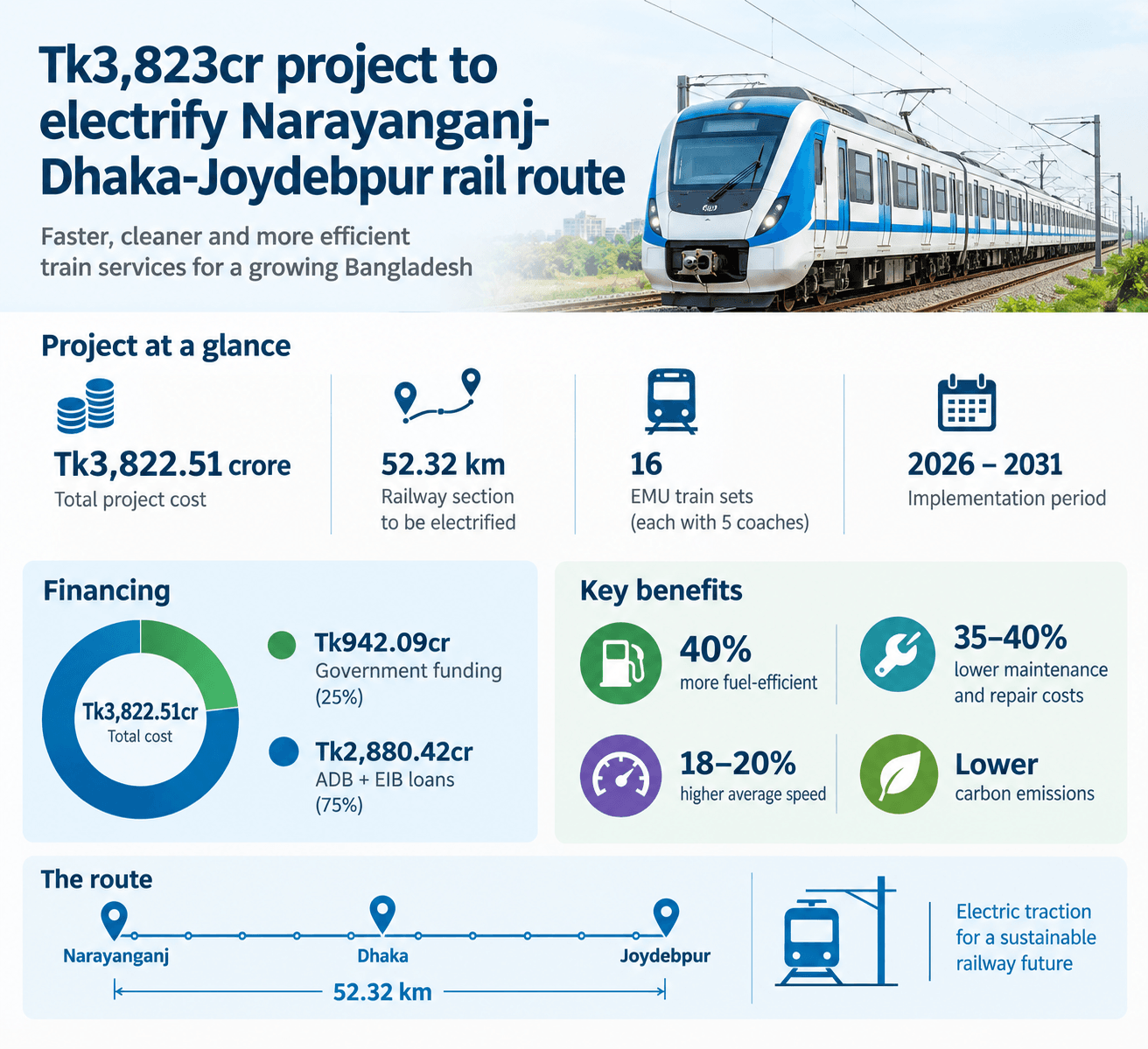
The government plans to spend Tk3,822.51 crore to introduce electric traction on the busy Narayanganj-Dhaka-Joydebpur railway corridor as part of efforts to make train services faster, more efficient and less dependent on diesel.
The Ministry of Railways has proposed a project titled ‘Implementation of Electric Traction Along Narayanganj-Dhaka-Joydebpur Section of Bangladesh Railway’, which is being placed at the upcoming Ecnec meeting for approval, Planning Commission sources said.
Once approved, Bangladesh Railway will implement the project from July 2026 to June 2031.
Under the proposal, the government will provide Tk942.09 crore from its own resources, while Tk2,880.42 crore will come as project loans from the Asian Development Bank (ADB) and the European Investment Bank (EIB).
The proposed scheme includes the construction of an overhead catenary system along 52.32 kilometres of railway track, procurement of 16 electric multiple unit (EMU) train sets, each comprising five coaches, and construction of a repair workshop for electric trains.
The Narayanganj-Dhaka-Joydebpur corridor is one of the country’s busiest and most densely populated railway routes, with heavy passenger movement, extensive industrial activity and high motor-vehicle traffic.
Railway capacity on the corridor is currently inadequate to meet demand, while road transport in the area is under considerable pressure.
The proposed electrification is expected to increase the railway’s sectional capacity and the carrying capacity of its rolling stock, enabling Bangladesh Railway to operate more trains and carry more passengers.
According to the project proposal, electric traction is around 40% more fuel-efficient than the diesel-electric traction system currently used by Bangladesh Railway.
Maintenance and repair costs of electric rolling stock are also estimated to be around 35-40% lower than those of diesel-electric rolling stock.
Electric trains are expected to accelerate and decelerate faster, allowing them to increase and reduce speed more quickly. As a result, their average speed could be around 18-20% higher than that of existing diesel-electric rolling stock.
The government also expects the project to reduce operating costs and increase railway revenue by improving operational efficiency and transport capacity.
The project has an important environmental dimension as well. Electric traction is considered a cleaner mode of rail transport and is expected to reduce carbon emissions from transport in the corridor.
The project document says the Narayanganj-Dhaka-Joydebpur corridor is particularly suitable for railway electrification because of its dense population, large concentration of industries and high motor-vehicle traffic.
Narayanganj and Gazipur host a large number of industrial establishments, while heavy road traffic and industrial emissions contribute to severe air pollution in the area.
By shifting a greater share of passenger transport to rail and reducing reliance on road transport, the project is expected to ease pressure on roads and reduce transport-related emissions.
Financing and project timeline
The proposed project cost was initially estimated at Tk4,282.86 crore, including Tk1,452.25 crore in government funding and Tk2,830.61 crore in ADB and EIB loans, with an implementation period extending to June 2036.
Following scrutiny and restructuring, the estimated cost has been reduced by Tk460.35 crore, or 12.04%, and the implementation period shortened by five years.
The revised proposal puts the total cost at Tk3,822.51 crore, comprising Tk942.09 crore in government funding and Tk2,880.42 crore in project loans.
The annual spending plan envisages the highest expenditure in FY2028-29, at Tk1,848.68 crore, followed by Tk1,103.52 crore in FY2029-30.
The project is included in the FY2026-27 Annual Development Programme as an unapproved new project to facilitate foreign financing.
A feasibility study for the project was conducted by TUMAS Turkish Engineering Consulting & Contracting Co.
The Project Evaluation Committee (PEC) held a meeting on April 20, 2026, and recommended the project for approval subject to compliance with a number of decisions.
“The electrification of the existing Narayanganj-Dhaka-Joydebpur railway would reduce travel time and transport costs while increasing the carrying capacity of trains. The project will enable Bangladesh Railway to carry more passengers faster and at lower cost,” said Md Neyamat Ullah Bhuiyan, member of the Planning Commission’s Physical Infrastructure Division.
He said the increased rail capacity would help ease existing pressure on road transport and reduce related government expenditure. The project would also help increase railway revenue and cut carbon emissions, according to his assessment.