


A European Union-funded poverty reduction project has helped significantly reduce extreme poverty among 215,000 targeted households, with the share of extreme-poor families among participants falling from 62.7 percent to around 22 percent over four years.
The project also more than halved the prevalence of stunting among children under five, from 48 percent to 22.8 percent, according to its final assessment.
The Pathways to Prosperity for Extremely Poor People–European Union (PPEPP-EU) project provided integrated support to about 860,000 people through 19 partner organisations across 145 unions in 34 upazilas in 12 districts.
The four-year project, implemented by the Palli Karma-Sahayak Foundation (PKSF) from October 2022 to September 2026, combined livelihood support, skills development, affordable finance, nutrition and healthcare, women’s empowerment and climate resilience.
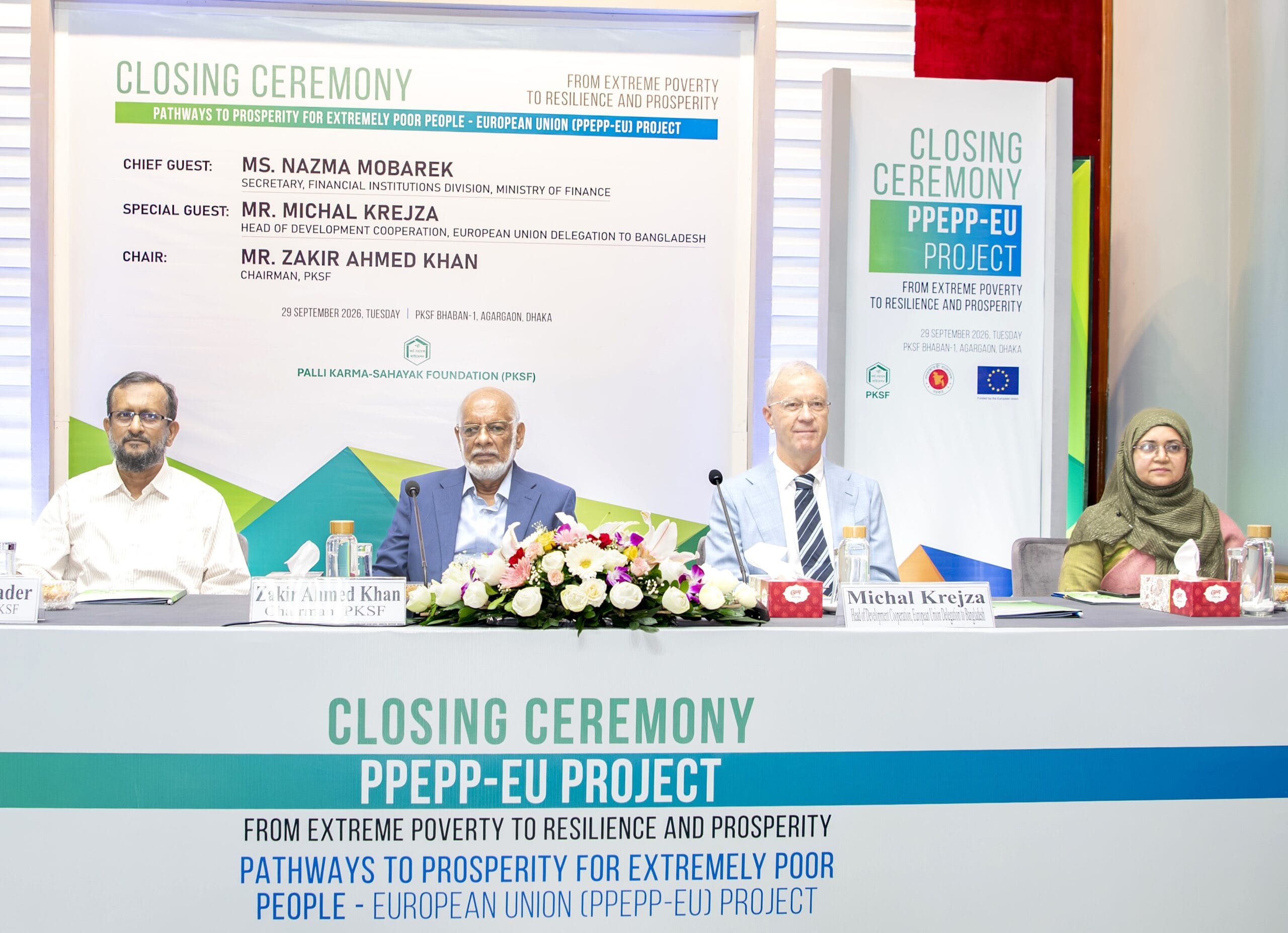
The findings were presented at the project’s closing ceremony at PKSF Bhaban in Agargaon, Dhaka, on Tuesday.
Finance and livelihoods
PKSF Managing Director Md Fazlul Kader said more than three-fourths of the extremely poor households targeted by the project had moved above the extreme poverty threshold, with a significant proportion becoming microentrepreneurs.
The project received a €22.81 million grant from the European Union and facilitated around Tk 3,217 crore in affordable loans for participating households through PKSF and its partner organisations.
He said the experience showed that assistance alone could provide only temporary relief, while building people’s capabilities and creating economic opportunities could lead to longer-term improvements.
“Thousands of families under this project have demonstrated precisely that,” he said.
The project also demonstrated that extremely poor people could access and effectively use credit when appropriate support was provided, PKSF Chairman Zakir Ahmed Khan said.
He said participants would continue to have access to mainstream financial services through PKSF’s regular programmes and those of its partner organisations after the project’s formal completion.
Child nutrition improves
The project recorded substantial improvements in child nutrition.
Stunting among children under five declined from 48 percent to 22.8 percent, while wasting fell from 17 percent to 12.4 percent.
The project said the final stunting rate was lower than the national average.
PKSF said the results were achieved through an integrated approach that linked livelihood development and finance with nutrition, healthcare, social protection and climate resilience.
Financial Institutions Division Secretary Nazma Mobarek said extreme poverty was a multidimensional problem that could not be addressed simply through income or asset transfers.
She said the project’s experience showed that combining financial support, skills, market access, healthcare, nutrition, social protection and climate resilience could help extremely poor people become producers, entrepreneurs and active participants in the economy.
Sustaining the gains
Michal Krejza, Head of Development Cooperation at the European Union Delegation to Bangladesh, stressed the need to sustain the progress made by participating families after the project’s formal closure.
He said the end of project funding should not mean the end of its impact, with the longer-term test being whether families could maintain their businesses, increase their assets and improve their children’s nutrition.
PKSF said the experience and lessons from PPEPP-EU would be incorporated into the design of its future programmes.
The closing ceremony was chaired by PKSF Chairman Zakir Ahmed Khan. Around 400 representatives from PKSF, the European Union, government ministries and departments, partner organisations and other stakeholders attended the event.